Start with the line, not the fleece
At first glance, the Flag Halyard Chair arrives under a small weather system of sheepskin. Look past it. A steel outline bends from floor to back and down again; cord crosses that outline in hundreds of visible turns; a separate headrest waits at the top. This article is really about how repeated line can become a reclining surface, with softness added only where the body negotiates with it.
MoMA dates its Halyard armchair to 1950, names Hans Wegner as designer and Getama in Denmark as manufacturer. The museum's catalogued chair is not an anonymous illustration: it is object 105.2015, with its own materials, measurements and institutional history.1 That specificity gives the design a firm starting point while warning us not to turn every similar chair into the museum's chair.
A surface made by repetition
Most upholstered seating lets fabric conceal the work beneath. Flag Halyard does nearly the reverse. Cord travels around the steel boundary again and again until separate lines read together as a broad plane. The surface remains visually open enough for the eye to follow its construction, yet continuous enough for the body to recline across it.
The repeated line matters more than the picturesque fact that it resembles rigging. A single strand would describe a route; a closely spaced network can receive and spread contact. Where the frame curves, the direction of the surface changes without requiring a padded box to explain the transition. Tension is therefore not backstage engineering alone. It becomes the chair's main graphic event.
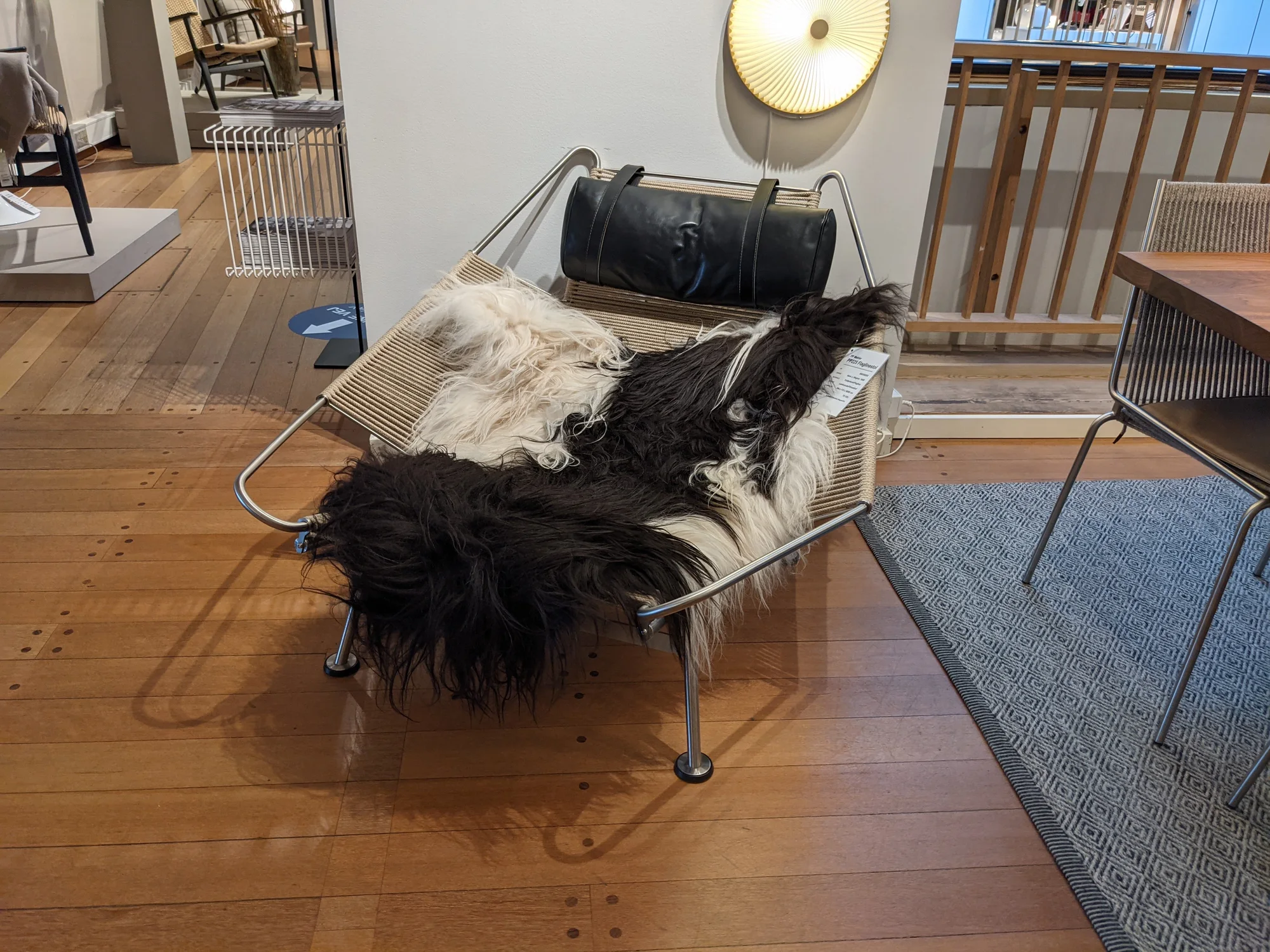
In Ew3234's oblique photograph, pale cord catches the light strand by strand. It wraps the perimeter rather than stopping at a neat upholstered seam, so the edge tells us how the middle came into being.4 The chair is not pretending to have grown naturally. It lets the repetitive labour remain visible.
The steel loop sets the limits
Cord needs a boundary. Here, tubular steel draws one long, low contour: forward to the feet, upward beneath the head and around the opposite side. The shape does not behave like four conventional legs carrying a framed seat. It reads as a continuous limit within which the tensile surface can change direction.
MoMA records its example at 80 centimetres high and 113 centimetres in both width and depth.1 Those are the museum object's measurements, not a ruler to impose upon every production period, but they make the composition easier to imagine. Width and depth exceed height. This is a chair organised for an extended body, not an upright pose compressed into a small footprint.
The small floor contacts are important precisely because the steel outline is so exposed. MoMA lists cork among its object's materials; Montreal's record lists wood and cotton alongside steel, halyard and other components. 2 These details interrupt the metal at particular meetings rather than concealing the entire frame. The chair draws a large structural sentence, then adds punctuation where metal meets floor and body.
Sand is a sketch, not a blueprint
PP Møbler tells the design's best-known origin story. In its account, Wegner formed a comfortable place for himself in the sand during a seaside holiday and translated the body's resulting contours into the chair. 3 It is a useful story when it remains clearly attributable. We do not need invented weather, dialogue or a perfectly timed flash of inspiration to make it better.
What sand offers is not a finished mechanism but a question about support. A body leaves a broad, sloping impression rather than a diagram of seat, back and armrest as separate furniture parts. Flag Halyard preserves something of that continuous recline, then rebuilds it through materials that behave very differently: steel establishes the edge and cord spans it.
The beach account therefore explains a bodily outline, not every workshop decision. Sand does not tell us the tube specification, the winding sequence or the history of an individual chair. It is the beginning of the thought, not a warranty card written by the tide.
One design, several material records
Museum catalogues prevent the chair from becoming a single timeless recipe. MoMA lists steel, cork, leather and plaited flag halyard for its 1950 object. The Montreal Museum record for D97.173.1 lists chromium-plated and painted steel, halyard, wood and cotton.1 2 The overlap establishes a recognisable system; the differences belong to particular records and should not be quietly ironed flat.
Montreal also places the chair in visual conversation with Charlotte Perriand's earlier reclining furniture.2 That comparison is useful because it shifts attention from an isolated Danish curiosity to a wider modern question: how can a recliner separate its carrying frame from the surface receiving the body? It is a curatorial comparison, not a claim that the two chairs share one specification or that this page can prove a line of influence.
The current PP225 adds another, later evidence layer. PP Møbler says its present chair uses 220 metres of specially developed flag line around a solid stainless-steel frame, with natural jute and black high-tensile nylon among its specified line options.3 That number makes the repetition wonderfully concrete. It remains a current PP225 fact, not a length silently assigned to every vintage GE225.
Softness arrives by appointment
The sheepskin is dramatic, but it is not the chair's structural department. It lies over the cord network, allowing the support to remain visible at the edges. The leather headrest is another separate layer. Instead of turning the whole chair into one stuffed volume, each softer element has a discernible job and location.
This hierarchy changes how comfort looks. Comfort is not equated with hiding all resistance beneath foam. The yielding line, the fleece, the headrest and the small floor contacts negotiate different encounters. Remove them in the mind's eye and the steel boundary is still intelligible; remove steel and cord, and the soft pieces no longer describe a chair.
That is why the design can look both austere and indulgent without contradiction. Its indulgence is conspicuous because it has not been spread everywhere. The fleece reads as warmth against an exposed system, not camouflage for an ordinary upholstered recliner.
A later chair, honestly photographed
Ew3234 photographed the chair at Illums Bolighus in 2021 and released the image under CC BY-SA 4.0. PatinaHall's WebP adaptation remains under that licence.4 The view is excellent evidence for looking: it shows the steel curve, cord, dark headrest and fleece in one frame.
It is not evidence that this chair is a 1950 Getama example, that its cord is original or that another chair is authentic. A documentary photograph can teach the eye without being asked to perform an auction-house inspection.
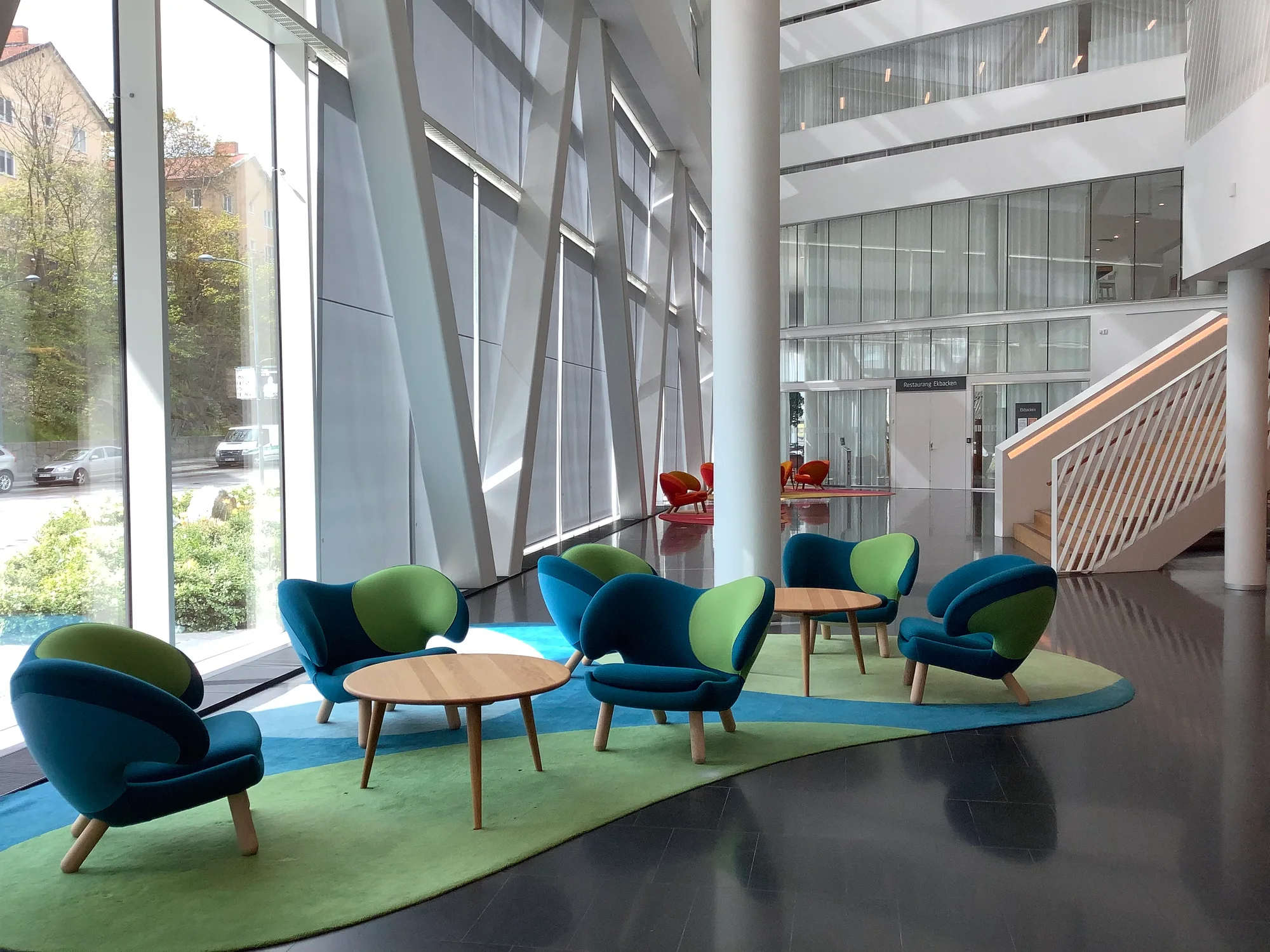
For the opposite visual strategy, continue to Finn Juhl's Pelican Chair. Pelican hides most of its support inside an upholstered body; Flag Halyard displays support until line itself becomes the story. One chair makes structure nearly disappear. The other lets us count it, turn by turn.