Begin with the second name on the label
MoMA's record for Finn Juhl's Model 45 armchair lists the designer first and then names Niels Vodder as its manufacturer and cabinetmaker. It dates the design to 1945 and identifies teak and wool.4 This is ordinary catalogue information, but it corrects an extraordinary amount of design storytelling.
The two names describe two different responsibilities.
Juhl developed the furniture's architectural and visual idea. Vodder's workshop made a physical version whose timber, joints and upholstery had to support a person. One role does not cancel the other. A drawing without a maker remains a proposal; careful construction without a directing design is a different project.
Vodder is difficult to write about as a conventional biography. Public institutional records document many objects and a long collaboration, but they do not supply a richly detailed account of his childhood, personality or daily workshop conversations. A responsible maker history should not fill those silences with invented colour. The furniture records are where the story is strongest.
The Guild exhibition acted like a yearly examination
The current House of Finn Juhl timeline dates the beginning of the partnership to Juhl's 1937 debut at the Copenhagen Cabinetmakers' Guild Exhibition and describes it as lasting more than twenty years.1 The exhibition was not a trade fair filled only with familiar stock. Designers and master cabinetmakers used temporary interiors to show what their collaboration could add to contemporary furniture.
For a workshop, that opportunity also carried risk. An experimental chair might attract attention but fail to find a buyer. A new curve might take longer to shape than expected. A dramatic gap between frame and upholstery might expose every connection rather than hide it.
Designmuseum Danmark remembers the Juhl-Vodder stand as unlike the others and preserves Juhl's original watercolours and drawings for several objects shown around this period.2 The archive lets us see the imaginative side of the partnership. The surviving furniture lets us see that somebody also resolved full-size material, structure and finish.
Our article on the Copenhagen Cabinetmakers' Guild Exhibitions explains why an exhibition date documents a design event but does not automatically establish the date or provenance of another chair.
Difficult lines require practical answers
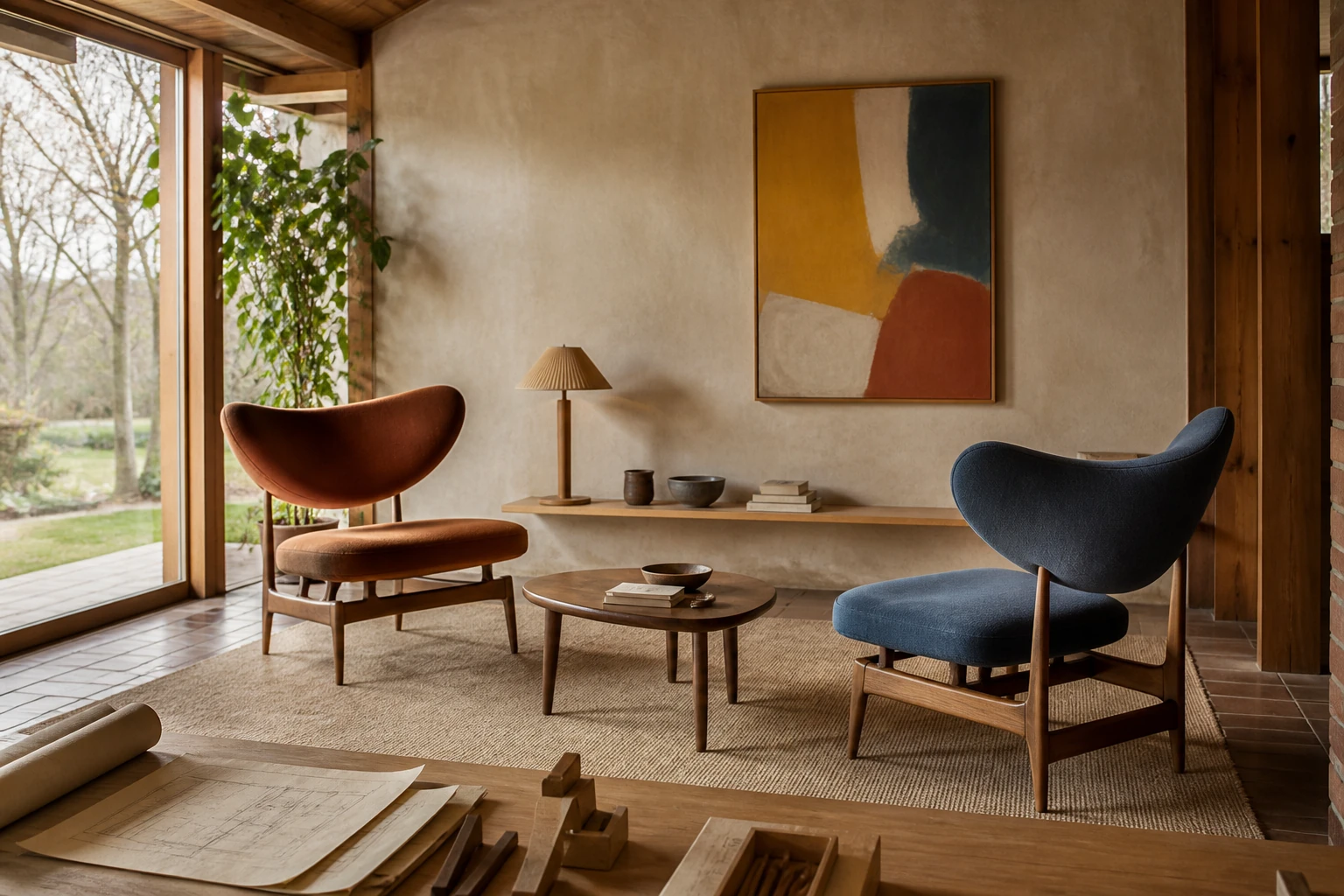
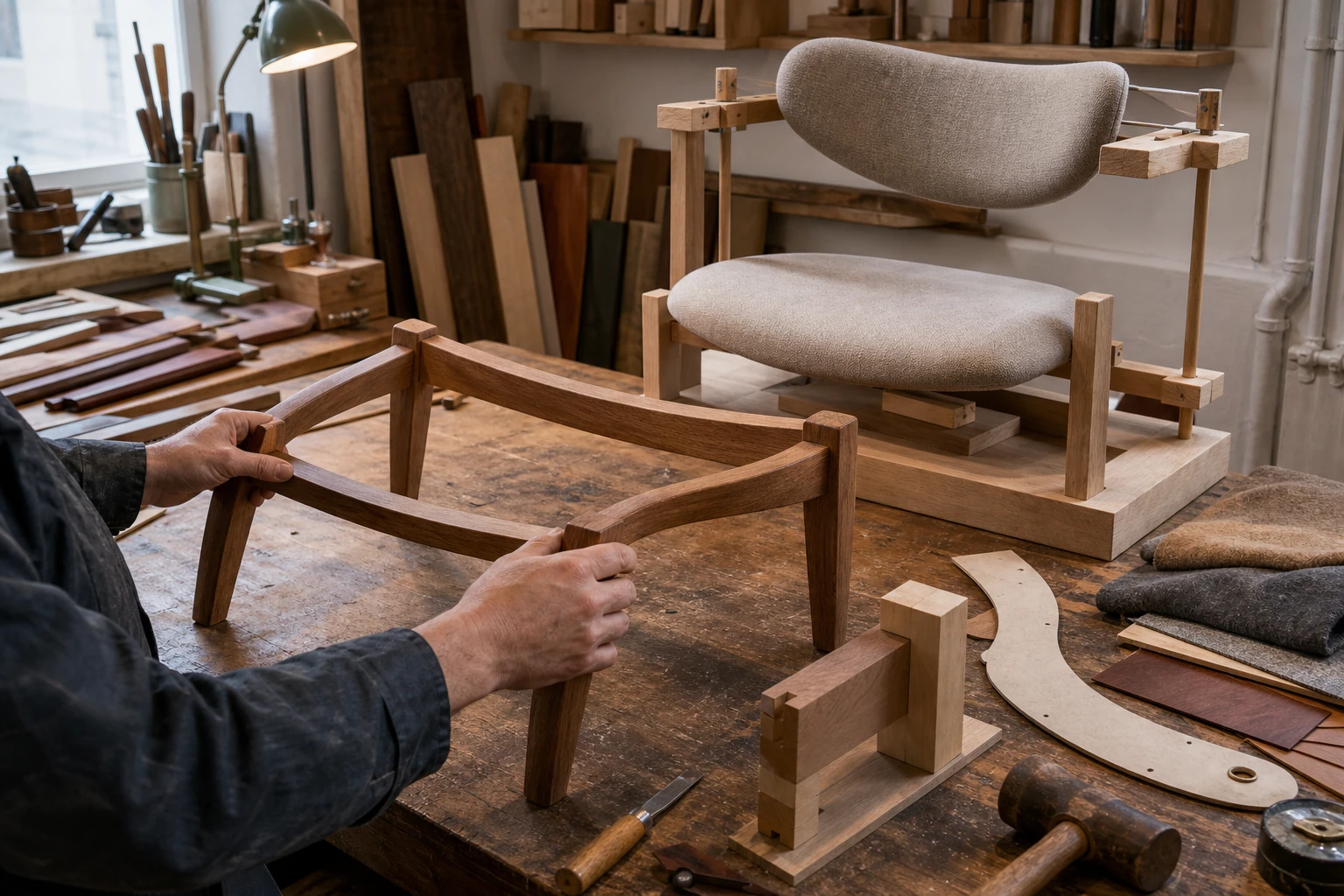
MoMA's extended label for Model 45 explains the chair by separating its seat and back from the load-bearing wooden frame.6 That visual separation creates the impression that the upholstered parts hover. From the bench, however, the problem is not hovering. It is controlled connection.
The frame must carry weight downwards without looking thick. The seat has to attach at points that do not spoil the gap. The back must resist a person's pressure. Teak must be selected and shaped with respect for grain, while upholstery has to hold its form without disguising the timber structure.
The sources do not tell us which exact joint Vodder proposed first or which dimension Juhl changed after a prototype. We should therefore avoid imaginary dialogue between architect and cabinetmaker. The documented object supports a more careful inference: a visibly separated construction could succeed only when design and making agreed at the points where the parts met.
MoMA's Model 48 record broadens the material problem. It identifies an armchair of about 1946, again manufactured by Vodder, using wood, leather and brass.5 The combination is a reminder that a cabinetmaker's contribution was not limited to carving a beautiful timber outline. Different materials expand, compress, wear and meet the hand in different ways.
Small series made the workshop a laboratory
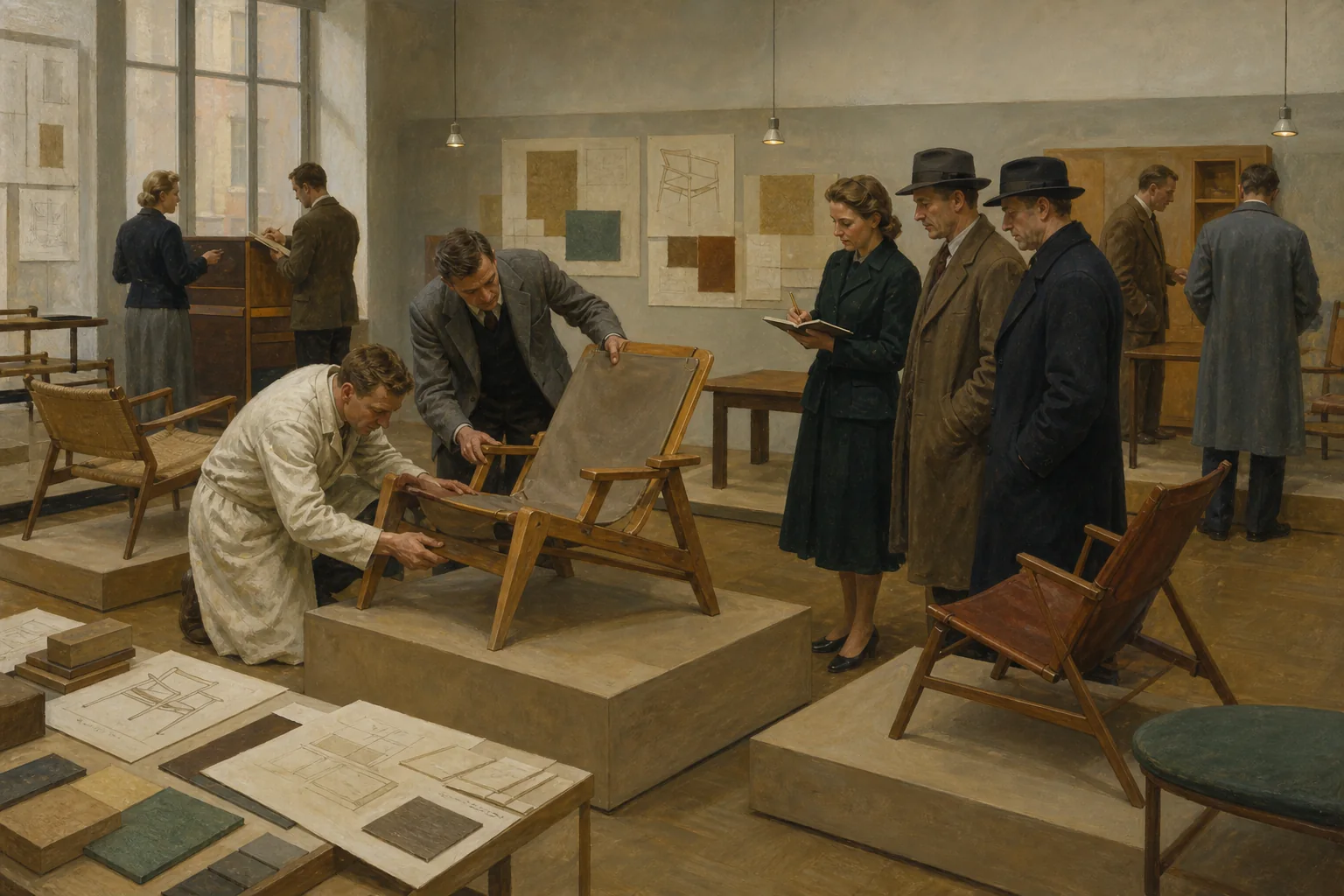
Nationalmuseum describes Juhl's furniture as usually made in small artisanal series with Vodder.3 Small series occupy an important middle ground. They are more than one untested prototype, but they do not yet demand the tooling and simplified operations of mass production.
That scale allows a workshop to learn from repetition. A curve can be compared with the template used for the previous chair. A joint that fits once by luck has to fit again by method. Upholstery that looks correct before use has to remain aligned after the seat and back accept load.
Three museum records show that the partnership cannot be reduced to one famous armchair:
- MoMA's Model 45 combines teak and wool in 1945. 4
- The Metropolitan Museum of Art records a 1948 settee in teak and leather, designed by Juhl and made by Vodder. 7
- The Met also records a 1950 conference table in teak and maple under the same designer-maker pairing. 8
Chair, settee and table ask different structural questions. Upholstery has to meet a visible frame; a longer seat has to control span and repeated support; a table has to remain level across a much larger plane. The records do not describe every operation, but together they establish range. Vodder's name is attached to a body of made work, not one lucky solution.
The workshop and the factory tell different chapters
Small-series furniture helped make Juhl visible, but it was not the only future for his designs. Nationalmuseum notes that he was among the Danish designers who carried the detail and joining knowledge of small-scale work into furniture intended for larger production. 3 MoMA's account of Model 45 adds an American connection: curator Edgar Kaufmann Jr.'s writing introduced Juhl to a wider audience and encouraged a Grand Rapids manufacturer to pursue industrial production.6
Industrial adaptation is not simply the workshop multiplied. Materials may change. A joint may be redesigned for machinery. A complex surface may need a repeatable template. Distribution, price and replacement parts become larger parts of the problem.
This is why the maker line matters when reading a catalogue or museum record. Designed by Finn Juhl identifies the design authorship. Made by Niels Vodder identifies a particular production relationship. A later authorised version may be a legitimate Finn Juhl design without being Vodder-made, and a museum record for one Vodder object does not authenticate a chair that merely looks similar.
That distinction gives both workshop and factory a more accurate history. Neither needs to impersonate the other.
What Vodder's record teaches us
The surviving institutional evidence gives Niels Vodder a quieter public profile than Finn Juhl. Yet the maker does not disappear. MoMA and The Met place his name beside specific objects, dates and materials. Designmuseum places the partnership inside the Guild exhibition. Nationalmuseum explains the small-series scale in which much of the work was made.
Together they teach a simple way to read design history:
- name the idea;
- name the person or workshop that made the documented object;
- look at the material problem they had to solve;
- separate that version from later production;
- leave unsupported biography and attribution out.
The linked portrait Finn Juhl: designing the chair and the room together returns to the architect's side of the partnership and follows the same thinking from a private house to the United Nations. Read the two pages together and the familiar phrase Finn Juhl chair becomes the beginning of a better question: which design, made by whom, for what setting and at what scale?