The oversized answer
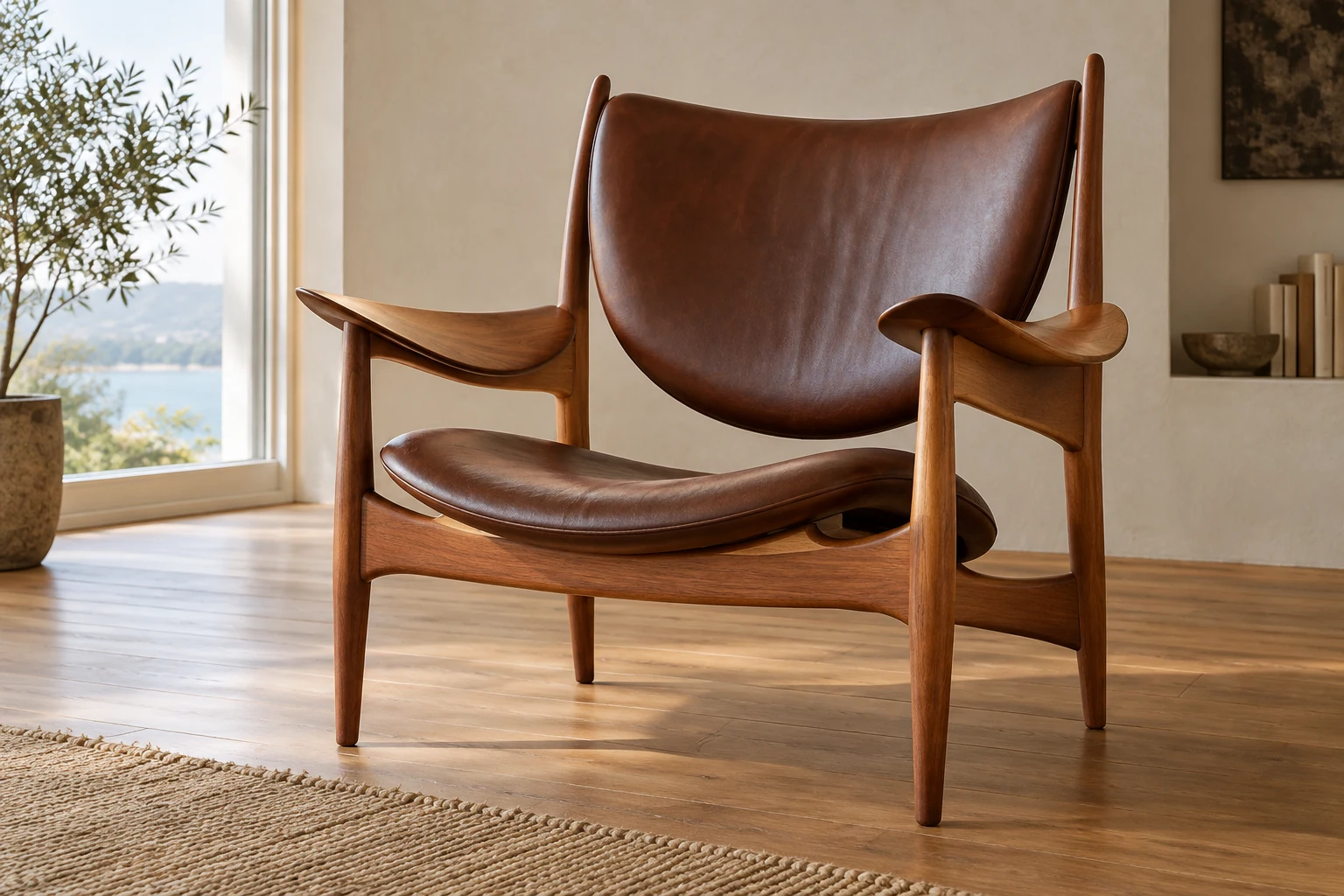
The Chieftain Chair does not wait for a room to grant it importance. Its back rises like a broad suspended shield; its padded arms project as separate ledges; its timber uprights make a visible scaffold around the sitter. The chair is large, but its real force comes from refusing to hide how that size is assembled.
House of Finn Juhl dates the design and its first presentation to 1949. Its current account says Juhl had grown tired of small, handy chairs and wanted to draw something more imposing.1 The result does not make bulk the same thing as solidity. It makes scale into a sequence of parts, gaps and points of support.
A chair entered as exhibition theatre
The Chieftain appeared at the Copenhagen Cabinetmakers' Guild Exhibition, an annual setting where an architect's drawing had to become persuasive full-size furniture. The current House of Finn Juhl timeline places the chair at the 1949 exhibition and recounts the now-familiar moment when King Frederik IX sat in it. The proposed name King Chair was rejected in favour of Chieftain. 2
Designmuseum Danmark preserves another layer of the event. It describes Finn Juhl's stand as a collaboration with master cabinetmaker Niels Vodder, and its paper collection holds Juhl's watercolours and drawings for the Chieftain chair and sofa alongside other works from the display. 3
That evidence keeps two acts visible. Juhl developed a dramatic image of the chair; a cabinetmaking context gave the image weight, joints, upholstery and a floor beneath it. The surviving sources do not record every exchange at the bench, so the useful story is collaboration without invented dialogue.
Our history of the Cabinetmakers' Guild Exhibitions explains why a celebrated model and a particular surviving chair must still be kept separate.
The frame and the body refuse to merge
House of Finn Juhl describes the Chieftain as an especially clear expression of a recurring Juhl idea: separate the carrying structure from the elements that are carried.1
In the chair, those systems can be read almost like a small building.
- Tall timber uprights carry the broad back without becoming the back.
- The seat rests within the frame rather than disguising it beneath one thick upholstered mass.
- Padded arm surfaces occupy their own level while narrow connections return their load to the timber.
- Gaps make each meeting visible, so support can look deliberate rather than inevitable.
This is why the chair can be physically generous without reading as one heavy block. Empty space is not left over after the design; it is one of the materials with which the structure is explained.
The idea had already appeared in Juhl's earlier furniture. Nationalmuseum places his experimental work with Vodder in small artisanal series and explains how workshop knowledge later informed designs for broader production. 4 The Chieftain pushes that exploration towards a limit: if frame and carried form are going to remain separate, they must both become unusually expressive.
Size changes the social scene
The current FJ 4900 relaunch is listed at 100 centimetres wide, 88 deep and 92.5 high, with a seat height of 34.5 centimetres. 1 Those are present manufacturer specifications, not measurements assigned to every historical example. They do make the scale concrete.
A chair one metre wide claims more than floor area. Its back becomes part of the room's elevation. Its arms establish a generous personal boundary. The low seat changes the level from which the sitter meets other people and objects. To place it is to make a social decision: this person will not disappear into a row of convenient seating.
Juhl's design avoids turning that presence into a sealed throne. You can still see between seat and back, beneath the arms and through the timber scaffold. The chair commands space while allowing space to circulate inside it.
The name is part of the evidence, not neutral decoration
The present rightsholder connects the 1949 display with a collage of weapons and crafts from cultures then described in broad, generic terms, and its timeline explains the improvised choice of Chieftain after the King's visit. 1 2
That account should be reported, not polished into a timeless romance. The period language collapses distinct peoples and traditions into an idea of the foreign or exotic. It tells us something about how a European exhibition framed inspiration in 1949; it does not identify one precise cultural source for every curve, nor does it make the name culturally neutral today.
The chair can survive a more exact reading. Its force does not depend on repeating the old display's categories uncritically. Scale, structure, upholstery and space are visible arguments in their own right.
A broad form, an honest visual boundary
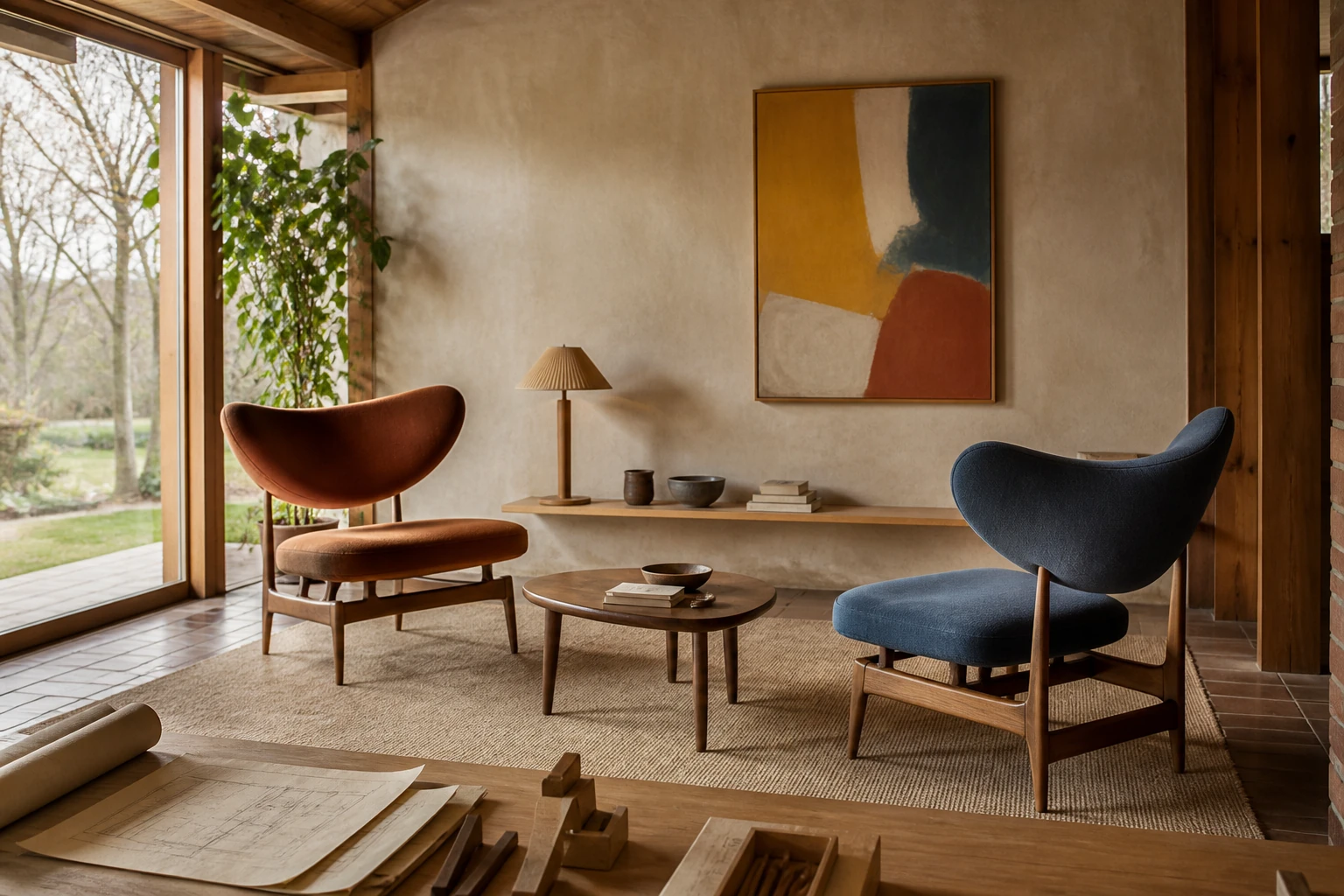
The editorial reconstruction shows an interpretation of the open frame, broad back, separate arms and suspended-looking seat described by the reviewed design sources.
A quiet setting leaves those relationships visible without recreating the 1949 Guild stand. The back sits between uprights, the arms project as separate ledges, and the seat remains distinct from the lower supporting frame. No pictured leather colour, joint or finish is offered as a historical specification.
The illustration helps a reader picture the design. Museum and rightsholder records carry the historical claims; neither the reconstruction nor resemblance to it settles the identity of another chair.
Two chairs, opposite volumes
The wider Finn Juhl profile follows the same carrying-and-carried idea through rooms, exhibitions and the United Nations chamber. The account of Niels Vodder keeps the cabinetmaker's production contribution beside Juhl's drawings.
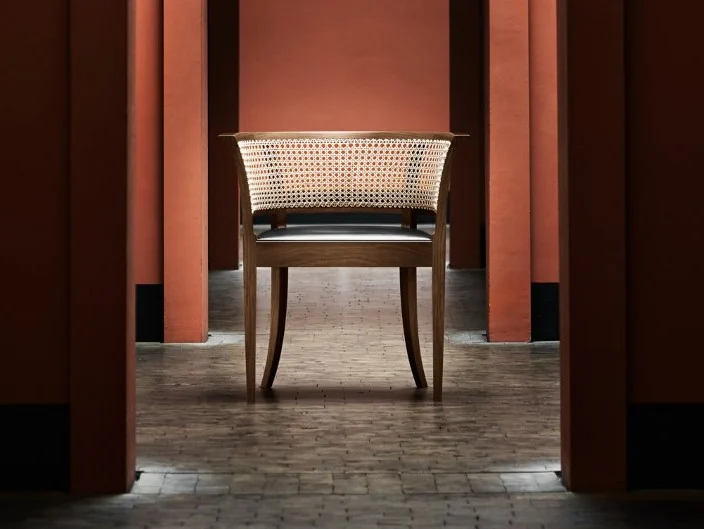
For the useful opposite, return to the 1914 Faaborg Chair. Klint's museum chair directs attention by yielding to the room; Juhl's Chieftain redirects the room around itself. Both make space part of furniture, but one does it in a whisper and the other with an entrance.