The quiet chair with a social trick
Finn Juhl's Reading Chair looks composed enough for dinner: four legs, a rounded seat and an open timber back. Its surprise appears only when somebody turns around. The chair was intended to remain comfortable in that reversed position, with its horizontal top rail serving as an armrest. One small piece of timber gives the chair a second front.
House of Finn Juhl dates the design to 1953 and says Juhl made it for the Danish company Bovirke.1 The date and maker matter, but the real story is behavioural. This is furniture that permits a different relationship with the table, another person or the room without performing a mechanical transformation. It is less a swivel chair than a chair with diplomatic relations in both directions.
One rail, two directions
Used conventionally, the broad curved board supports the back and the thinner rail above it completes the chair's outline. Turn around and the hierarchy changes. The back board leaves the foreground; the rail becomes a shared rest for both arms. House of Finn Juhl describes precisely this forward-or-backwards use and identifies the horizontal top piece as the support in the second posture.1
That double duty is economical, but not minimalism for its own sake. A rail at the wrong height would be decoration. One too narrow, too sharp or too close to the lower board would make the reversed pose an amusing photograph rather than a usable position. The design's wit depends on bodily judgement: where forearms naturally arrive, how a torso leans and how much space shoulders need when the sitter faces the back.
No mechanism announces the change. There is no hinge to explain, no lever to go missing and no instruction label surviving more faithfully than the upholstery. The sitter discovers the option because the chair's geometry makes it plausible.
Why the open back matters
The top rail alone cannot create two orientations. The empty strip beneath it is equally active. It separates the slender arm-resting line from the broader curved board and gives the reversed sitter room rather than presenting a solid timber wall.
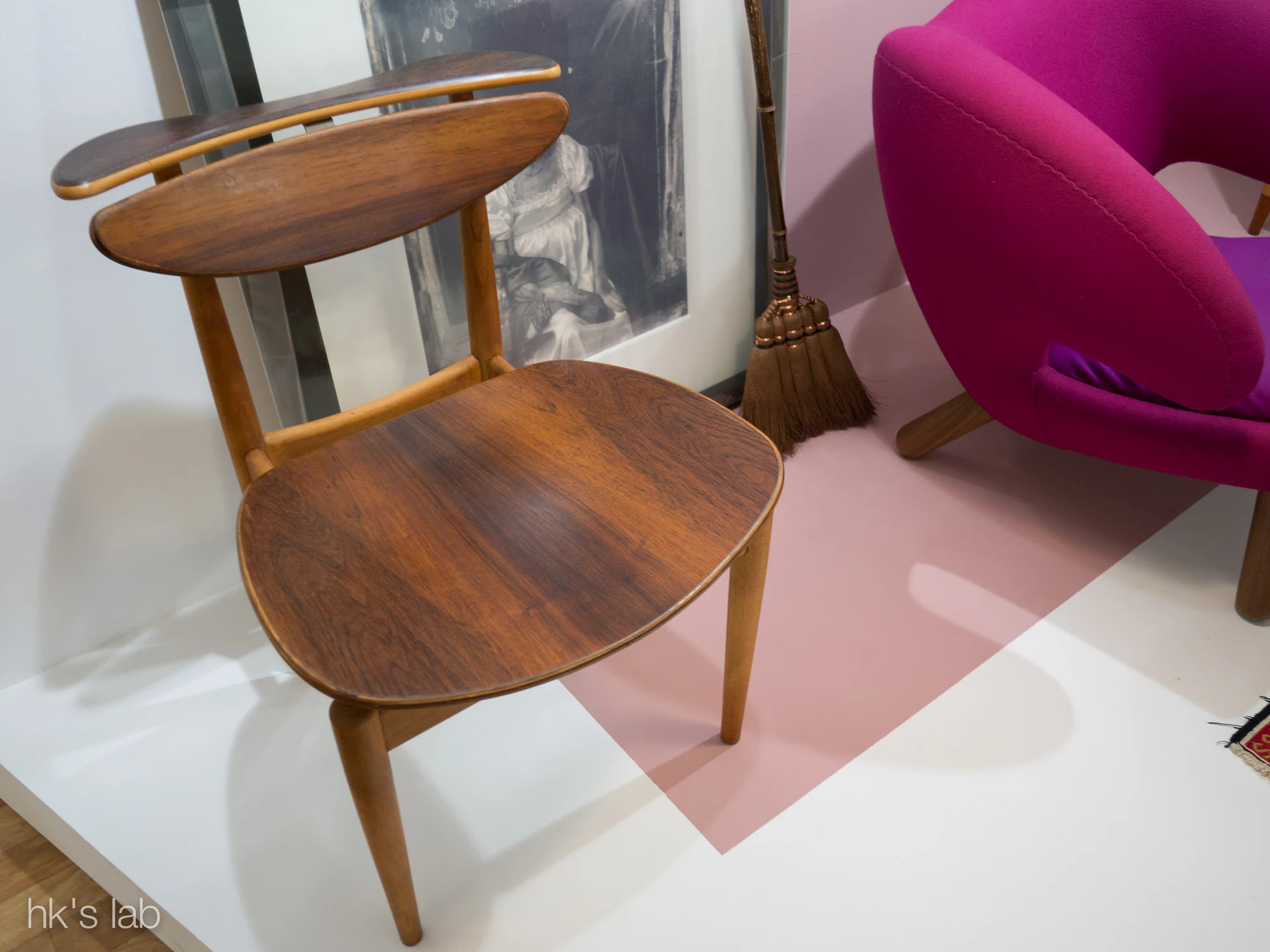
Hyeon Kim's 2012 exhibition photograph makes that relationship unusually legible.4 Seen at an angle, the chair shows three distinct layers: the rounded seat below, a curved back board across the middle and the straight-looking top rail held above it. Background passes between the upper pieces. The opening is not leftover space; it is what allows the rail to be approached from the chair's other side.
The same gap keeps the normal rear view light. A fully boarded back would make the chair more visually defensive around a dining table. Here, shoulders have support without the chair becoming a screen. Juhl gives the back enough presence to be useful, then stops before it closes the view.
The seat changes jobs too
Turning around alters more than the destination of one's elbows. It changes how the seat is occupied. In the conventional posture, the sitter settles towards the curved back board. In the reverse posture, the body approaches the other edge while leaning towards the top rail. The broad, rounded seat must make both positions believable.
The photographed chair has a visible veneered seat, useful for seeing its outline and the way it crosses the frame. The present collection page offers both upholstered and veneered-seat versions.1 That current choice should not be rewritten as a fact about every chair made since 1953. It does, however, expose an important distinction. Upholstery can change pressure and grip; the underlying plan must still accommodate the second orientation.
This is why the Reading Chair is more interesting than a novelty that happens to tolerate being straddled. Its front and back have not simply exchanged names. Seat, opening and rail have been coordinated so that the alternative posture belongs to the design rather than to a mischievous guest.
Bovirke in 1953, with a catalogue caution
House of Finn Juhl's production story says the Reading Chair was designed for Bovirke and shown at the company's stand at the 1953 exhibition in Fredericia.2 Its collection page also notes that Juhl developed a variation for Baker Furniture in the United States.1 Those are useful named contexts, not permission to turn every adjacent Juhl dining chair into this model.
Tokyo Metropolitan Art Museum's bilingual worklist supplies a good reason for care. Record 2-47 lists a 1953 Finn Juhl object as Dining Chair, associates it with Bovirke, Baker Furniture and Onecollection/House of Finn Juhl, and records beech, rosewood and its own dimensions. 3 The record sits close to the Reading Chair's history, but it does not use that title. Its materials and measurements belong to that catalogue entry.
So the worklist is kept as a neighbouring documentary checkpoint, not smuggled in as an exact identity match. It shows how names, versions and maker lines can overlap around a 1953 design. It also demonstrates why a familiar profile or convenient date is not enough to authenticate another chair.
The 2015 return is a new evidence layer
House of Finn Juhl says it relaunched the Reading Chair in 2015. The current collection identifies the model as FJ 5310 and describes a solid-oak frame, a plywood back piece faced in oak or walnut, and a solid oak or walnut top piece.1 A separate company story places present production at its workshop in Vejen, Denmark. 2
These details tell us how the authorised chair is offered now. They do not retroactively give every early Bovirke or Baker example the same timber, construction or finish. The distinction is especially important because the Tokyo worklist's nearby 1953 record lists different woods. A design can retain its organising idea while specifications, names and production circumstances change.
The continuity worth following is therefore not a universal bill of materials. It is the relationship between the open back and horizontal rail: the modest arrangement that makes a second orientation legible.
One photograph, honest limits
Kim photographed the chair at a Scandinavian furniture exhibition and released the image under CC BY-SA 2.0; PatinaHall's WebP adaptation remains under the same licence.4 The oblique view teaches the structure better than a flat front view would. It shows the upper gap, the rail projecting past the curved board and the veneered seat in relation to the legs.
It does not show the 1953 Bovirke stand. It does not identify the chair's production year, establish its internal construction or authenticate another example. Even the most informative photograph has edges. Here those limits are useful: they keep a close reading of visible form separate from the history supplied by named records.
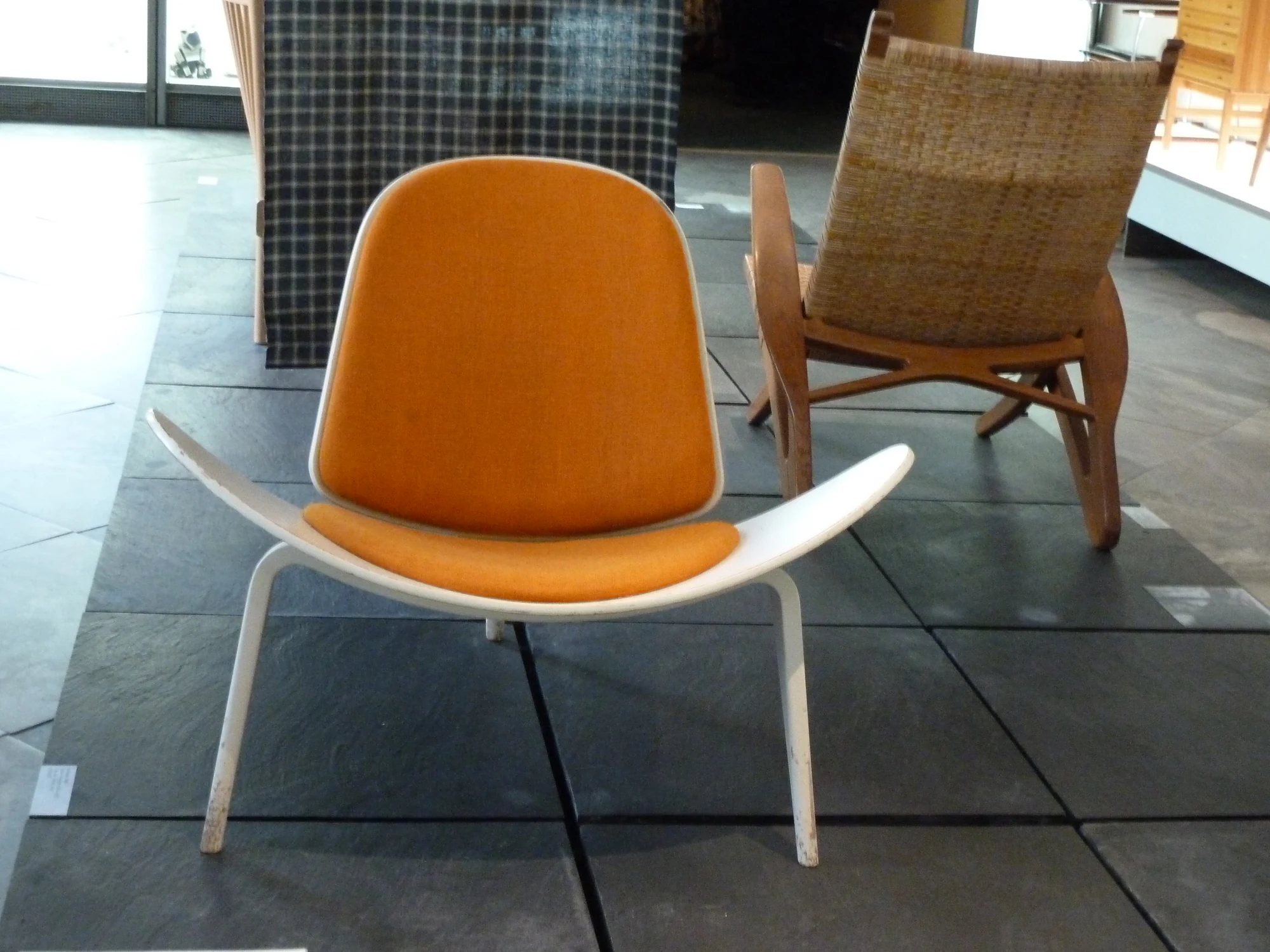
For a design that makes support disappear in a different way, continue to Hans J. Wegner's CH07 Shell Chair. Its separate seat and back seem to float above three concentrated supports. Juhl's Reading Chair stays quieter and more upright, then changes the social direction of the sitter with one rail and a deliberate patch of air. Neither chair needs a moving part to make stillness feel like an event.