A chair with daylight underneath
The first thing to notice about the CH07 is not upholstery, colour or even Hans J. Wegner's name. It is the amount of daylight that survives inside the chair. Air remains visible below the seat, between seat and back, and around three comparatively narrow supports. Two large surfaces appear to occupy the scene without the usual box of rails, arms and four upright legs explaining how they got there.
Designmuseum Danmark describes its exact 1963 prototype as a two-part shell chair and interprets the moulded wooden shells as hovering above a three-legged frame.1 That word hovering is useful because it names an effect, not a miracle. The support has not vanished; Wegner has concentrated it, curved it and allowed the background to remain visible around it. This article is really about that exchange. The less frame the eye is asked to read, the more actively every curve and connection must work.
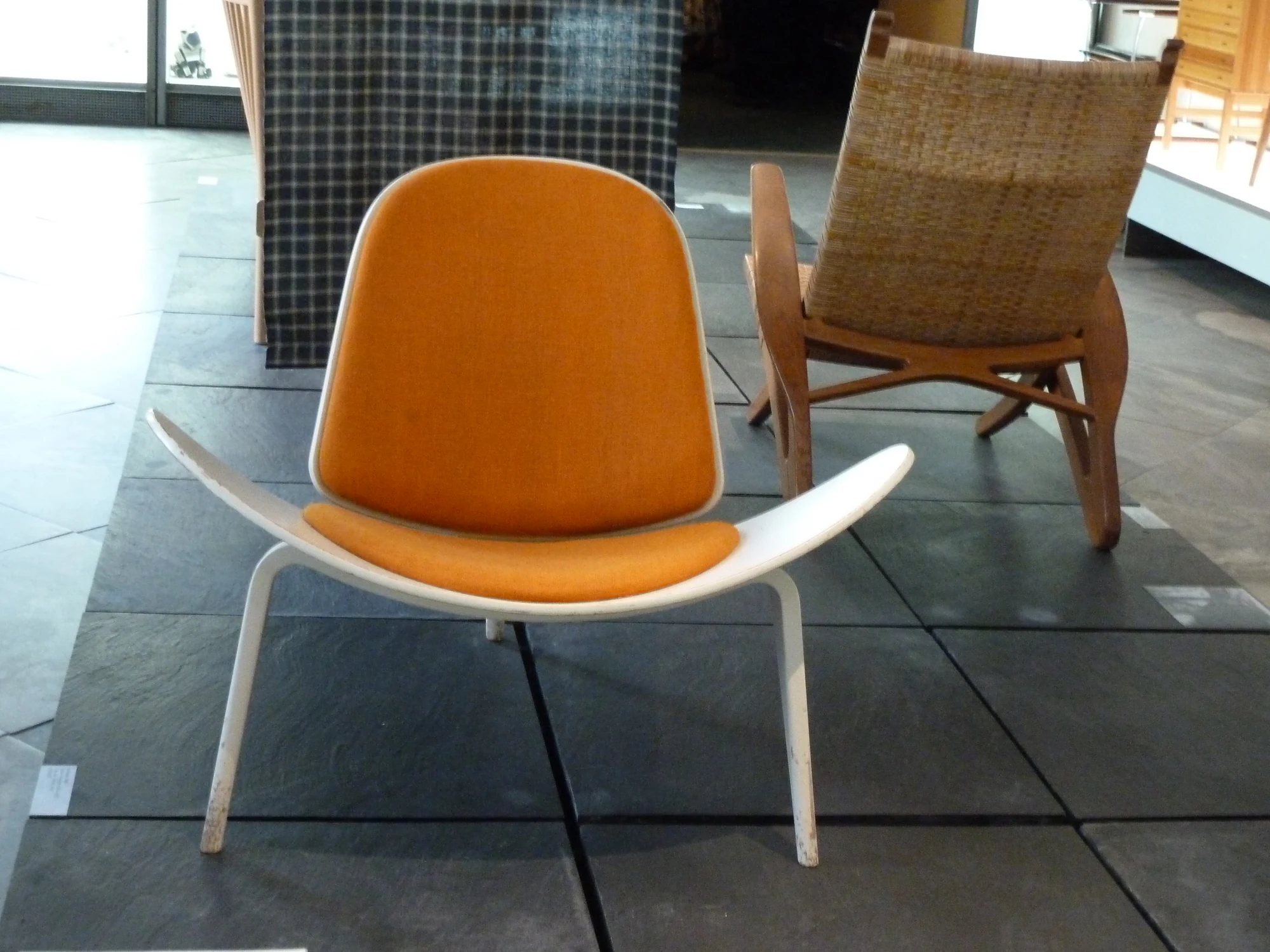
Ramblersen's frontal photograph at Designmuseum Danmark makes the arrangement unusually plain.4 The pale seat spreads much wider than the back. Its tips rise while its centre dips; beneath it, two front legs are close enough to read as a single fork before the third support retreats from view. It is a structural confidence trick, except the mechanism is standing in full sight.
Two shells refuse to become a box
An ordinary upholstered lounge chair can merge seat, arms and back into one deep volume. The Shell Chair does the opposite. Its seat and back remain distinct planes. The gap between them is not leftover space waiting to be filled; it keeps their outlines readable and prevents the chair becoming a closed container around the body.
The lower shell is especially important. Calling it a seat sounds rather flat, but its edge climbs at both sides and bows down through the centre. The body meets a shallow landscape rather than a horizontal board. Because the upholstered pad sits within the wooden perimeter, the eye can distinguish the soft contact surface from the curved element carrying it.
The back repeats that separation on a smaller scale. It rises independently, its rounded top containing the orange pad like a second, more upright field. Nothing visually heavy bridges the space below it. The chair therefore reads in layers: body against upholstery, upholstery against shaped shell, shell against a spare supporting frame.
Carl Hansen & Søn describes the present CH07's seat and back as upholstered, form-pressed veneer.2 That is a current manufacturer specification, not permission to assign the same veneer, upholstery or finish to every earlier chair. It does, however, explain why the two surfaces can be both broad and continuously curved without resembling thick carved blocks.
Three legs carry the argument
Three legs make the visual equation sharper. With four legs, a viewer can quickly imagine a familiar rectangle beneath the seat even when no rails are visible. Three points refuse that easy diagram. Two supports form the front; one settles the chair behind. The broad shell seems to balance over a much smaller footprint of visible structure.
On the current CH07, Carl Hansen & Søn says the legs are laminated from layers of veneer and that the two front legs are formed as one element. The company also attributes stability to the resulting shape.2 Those production details belong to its present chair. Visually, their value is that the front does not break into two unrelated sticks. One shallow arch passes beneath the seat, descends at both sides and lets support read as a single continuous gesture.
The rear support is quieter. From the straight-on museum view it nearly disappears behind the centre, which intensifies the apparent balancing act. Move around the chair and it returns, reminding us that a dramatic elevation is only one view of a three-dimensional object. Wegner did not eliminate support; he arranged the chair so that support changes its emphasis as the viewer moves.
The prototype came before the model number
The museum's photographed prototype is dated 1963. Ramblersen2's later image shows that exact prototype on display: orange back, pale rising seat and three slender legs presented almost square to the camera. 5 Here the wear on the pale finish is useful documentary texture, not a template for judging another chair. The photograph records one museum-labelled survivor, not a generic certificate of age.
Carl Hansen & Søn adds a longer prehistory. Its partnership account says Wegner developed the shell chair for cabinetmaker Johannes Hansen in 1963, building on studies made for a 1948 Museum of Modern Art competition. It says he then chose to concentrate on solid wood rather than continue extensively with form-pressed structures.3 That sequence makes the CH07 less like a sudden stylistic detour. The design belongs to an experiment that had been tested in thought before it appeared as this prototype.
The distinction between prototype and production matters. A prototype can settle proportion, curvature and connection while still leaving awkward questions about repeatable manufacture. It proves that a chair can exist. It does not prove that factories, buyers and prices are ready to let it exist in quantity.
Thirty-five years is part of the design story
Designmuseum Danmark says the public waited until 1998 for Carl Hansen & Søn to put the chair into production.1 The manufacturer's product history gives the intervening years more texture: it records positive critical attention, a hesitant wider public and very limited early production, then a 1998 reintroduction that found a much warmer reception.2
Those accounts should not be flattened into either “designed in 1963” or “launched in 1998”. Both dates matter, and they name different events. The first belongs to the design and prototype; the second belongs to the CH07 relaunch by a particular manufacturer. Between them lies limited manufacture, not an uninterrupted thirty-five-year production line and not total non-existence.
The delay also changes how we understand “ahead of its time”. That phrase can be lazy praise. Here it can be made concrete. The chair asked a manufacturer to repeat broad compound curves, laminated supports and precise meetings while preserving a very light appearance. Carl Hansen's account explicitly connects limited 1960s production with the manufacturing techniques then available. The future the chair awaited was partly a future of making.
Current construction is evidence, not a time machine
The present product page is wonderfully specific: form-pressed veneer shells, laminated veneer legs, one front-leg element, and multiple offered timber, finish and upholstery combinations.2 Those facts help a reader understand why a current CH07 looks coherent from front, side and rear. They do not silently reconstruct the 1963 prototype or identify the specification of a vintage example.
This boundary is especially important with a design that returned after a long interval. A repeated form can survive while tooling, upholstery choices, labels and production responsibility change. Similarity is the beginning of identification, not its conclusion. A seller's chair would still need its own maker marks, dimensions, construction evidence and provenance reviewed on their own terms.
The two photographs serve the same disciplined purpose. Ramblersen's 2011 gallery view is licensed CC BY-SA 3.0; Ramblersen2's exact-prototype view is licensed CC BY-SA 4.0. PatinaHall's WebP adaptations remain under those licences.4 5 One gives the whole chair room to breathe among other furniture. The other fixes the museum prototype to its own record. Neither image has been recruited to authenticate a stranger.
From visual suspension to a chair with two fronts
The CH07 makes one body-sized seat feel improbably light by separating its planes and narrowing its support. Finn Juhl's Reading Chair asks a complementary question at dining-chair scale: what if a back rail could support both the chair and a sitter who has deliberately turned the usual orientation around?
There is no claim here that Wegner and Juhl designed these objects in conversation. The connection is a reader's route. First watch a chair remove visual weight until two shells seem to float. Then watch another Danish designer give a modest chair a second front without adding a hinge, lever or instruction manual.