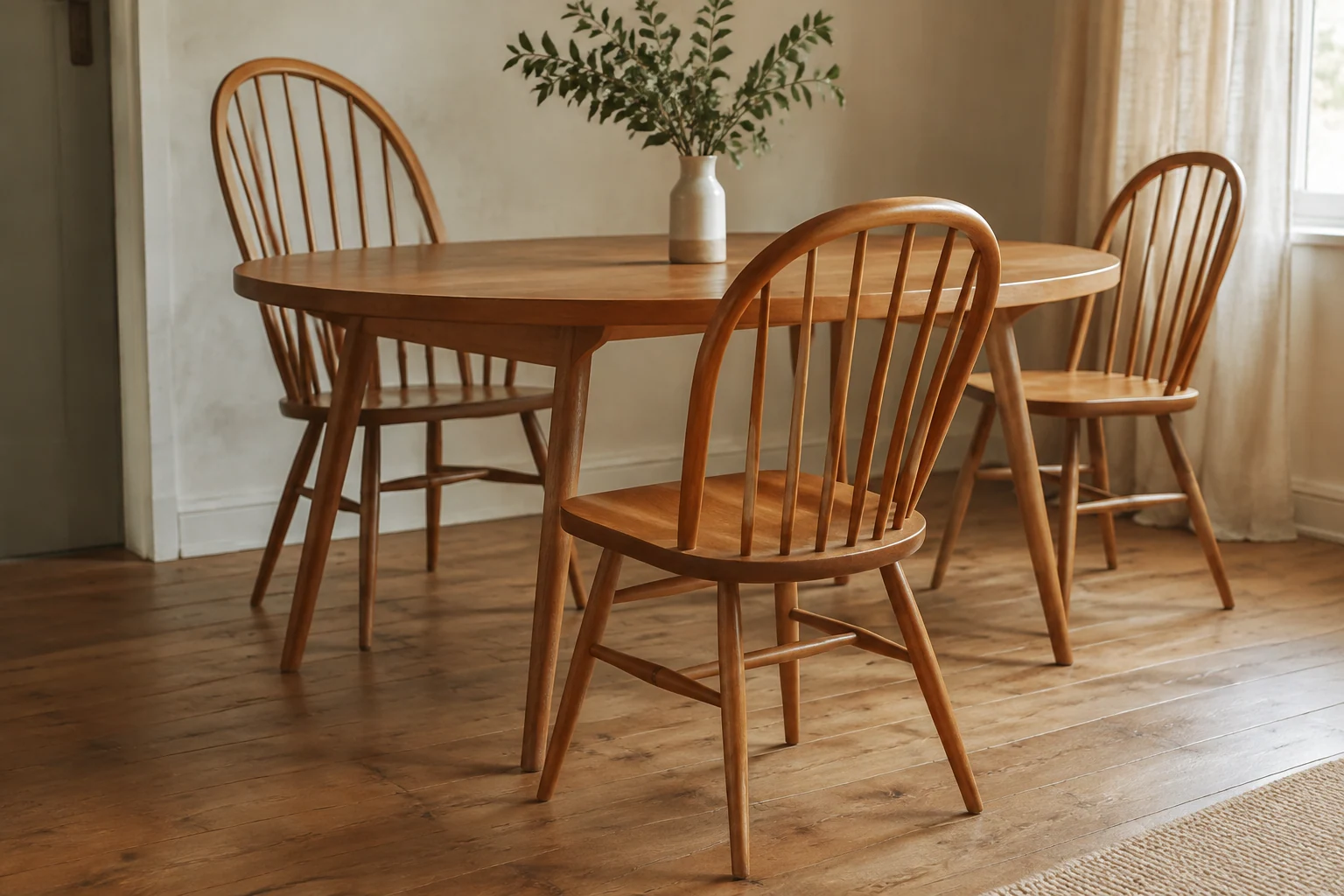
Three models to start with
A set of dining chairs repeats a shape around your table six or eight times. Decide whether you want a compact row of backs, a taller sweep of wood or armchairs at the ends. Model names become useful when they help you choose that outline.
- 391 All-Purpose: a useful starting point if you want a comparatively compact chair that can also move to a desk or bedroom. Ercol’s 1956 catalogue presents exactly that adaptable role.
- 365 Quaker: investigate this family if the tall, rounded bow is what draws you to Ercol. Compare the armless chair with the 365A armchair; the extra width and arms matter at a table.
- 369 Goldsmith: another tall-back starting point with a different outline. The 1965 catalogue distinguishes the chair and its 369A armchair, so ask which version a listing actually contains.
These numbers come from Ercol’s own catalogues. Match the whole chair to the relevant illustration and description, including the seat, legs, stretchers and back. A seller’s use of a familiar model name is the beginning of that comparison.[1]
The 1965 catalogue is particularly useful for comparing the 391, 365 and 369 families side by side. It also records finish and cushion options. Save the relevant page with the listing so a difference can become a precise question instead of an argument about whether a chair “looks right”.[2]
For the construction story, see the Library article on the Ercol Windsor chair.
Measure the seat you actually sit on
The outer width tells you whether chairs fit along a table. It does not tell you how much room your body has on the seat. Ask for usable seat width and depth, seat height, overall width, and arm height where applicable. A shaped seat deserves a photograph with the tape visible so you can see what was measured.
As one period example, the 1965 catalogue gives the 391’s seat width as 1 ft 3 in and depth as 1 ft 1¼ in: about 38 by 34 cm. Those are seat dimensions in that catalogue, not the overall size of every chair now advertised as an All-Purpose. Compare them with the offered chair and with a seat you already find comfortable.[2]
Try the chair at a table of the right height. Does the back support you when eating, or only when leaning away? Can you move your legs comfortably? A higher back may look splendid without being the better fit for the person who will use it every day.
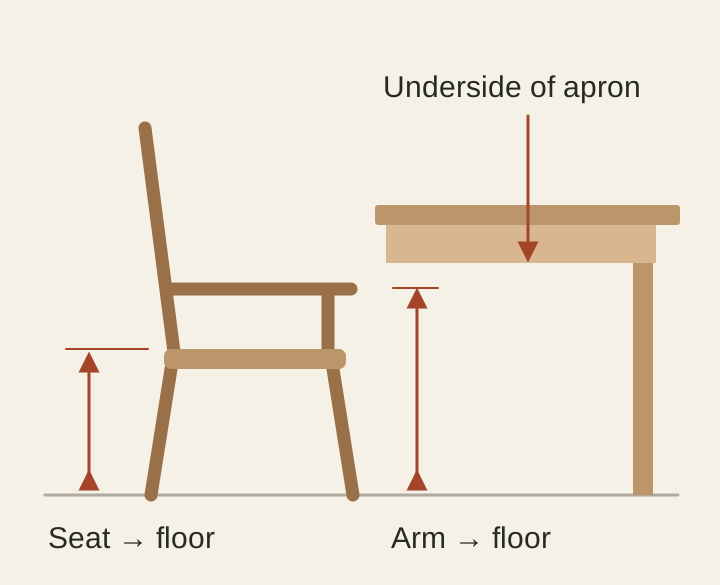
Put the set under your table
A chair can be narrow enough for the gap and still stop at the apron when you push it in. Measure the lowest obstruction beneath your table, then compare the actual arm height and widest part of the chair. Include the table legs and any stretcher in that conversation.
For example, you may prefer four armless chairs along the sides and two armchairs at the ends. Lay out those six positions before buying a nominal “set of six”. At a short table the end chairs may meet their neighbours, and a wide armchair can claim more of the room than the catalogue photograph suggests.
Ask whether seat pads are included and whether they are original, replacements or recent additions. A thicker pad changes the relationship between thighs and apron, and its outline may fit one seat better than another. Inspect and try the chairs with the cushions you intend to use.
Read the seat and joints together
The solid seat is more than a surface: it is where the back and legs meet. Look at the upper face and underside around those connections, then follow the legs and stretchers. A small finish mark and a split running into a joint ask different things of the next owner.
Ercol’s account of its Windsor chair describes legs wedged through the seat, with the protruding wood trimmed flush. Visible joint details can therefore belong to the construction. They still need to be compared with the particular model and any disclosed repair; a close-up alone does not tell you whether a connection is sound.[3]
Look for gaps, cracks, glue residues, extra screws, replaced spindles and uneven leg lengths. Ask what was repaired and by whom. An old, well-explained repair may be acceptable; unexplained movement needs assessment before the chair is used. Do not twist or force an uncertain back to test it.
Number each chair in the photographs. If one has a repaired seat and another has been shortened, an overall “good condition” description hides the two facts that may matter most. The useful result is a record of six individual chairs, even when you choose to buy them together.
Light or dark is not a date
Choose a finish you enjoy beside your table and floor. Then ask whether it is the documented factory finish, a later refinish or an uncertain history. Ercol’s catalogues offered different colours; dark wood by itself does not make a chair older, and a freshly pale surface does not make it original.[2]
Materials also need a production context. In its account of the Windsor chair, Ercol describes early elm seats with beech components and a later version made entirely in ash. That is a reason to check model and period, not a rule that every Ercol seat must be elm.[3]
If a seller has stripped, sanded or refinished a set, request the scope of the work and photographs from before it. Decide whether you like the result, then consider whether remaining joints and parts justify the asking price. A uniform colour can make a mixed set look convincing without making its chairs identical.
Make the shortlist specific
Ask the seller
Which model and period are documented for each chair? Please send matching front, side and underside views, with any labels and repairs shown in place. Could you measure each seat, overall width, seat height and any arms, and explain changes to finish, legs, joints or cushions? I would also like to try the chairs at a table before committing.
Pick the set you want to sit in as well as look at. A compact 391 may be more useful in your room than the tall-backed model you first saved, while a pair of armchairs can make the right table feel more settled. The best comparison ends with actual seats, clear measurements and known work.