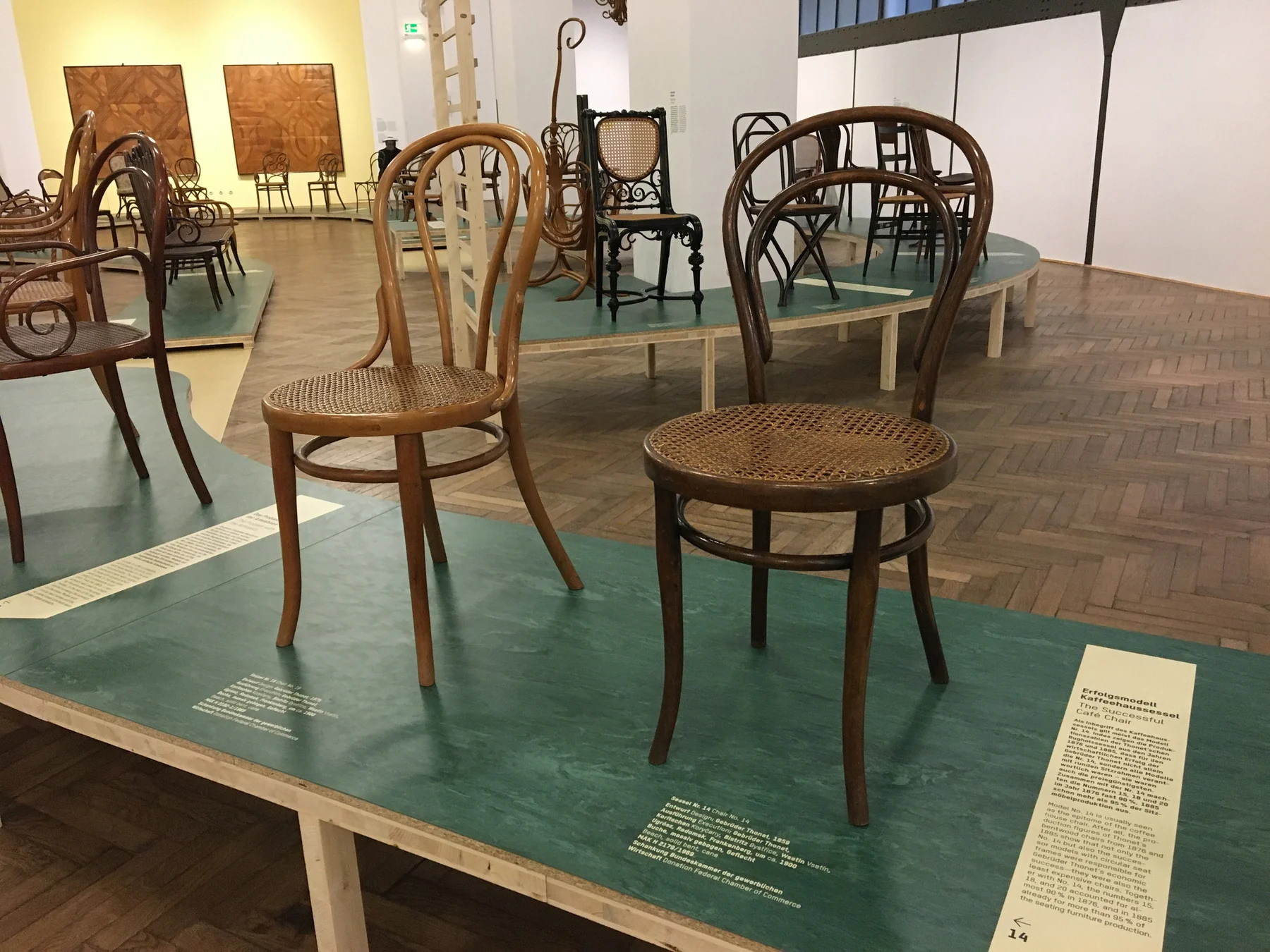
Give every chair a place before buying the group
Draw the table with its legs or pedestal included and number the seats. Put wide armchairs at the ends only if the base and room allow them to work there. Side chairs need room beside one another, and the person at the corner should not inherit all the awkward clearances.
Record each chair individually. Two chairs sold under the same period label may have different seat heights, replacement cushions or altered legs. If the group is assembled over time, keep a small measurement sheet so the next attractive find can be compared with what you already own.
Compare the sitting relationship
Measure the chair with its usual cushion and, where appropriate, note the occupied seat height. Compare the difference between that seat and the table’s lowest relevant underside obstruction. A thick apron can change the fit even when two tables have identical top heights.
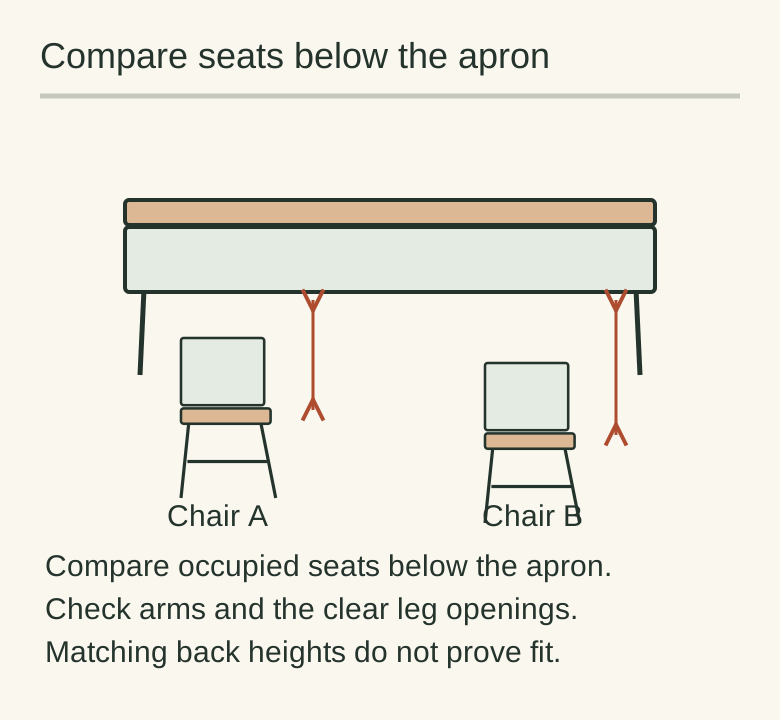
Vitra documents the Standard chair and Standard SP as distinct material versions within one design family. A shared design name is useful for research, but it should not replace measurement of the exact chair, its seat and any later alterations.[1]
Try the actual users where possible. The aim is a comfortable place for each person, not identical numbers for every chair. Avoid compensating for a poor fit with precarious stacks of cushions or alterations to a chair’s legs.
Choose one visual link and one deliberate difference
Start with a link you can see from across the room: a warm timber tone, a dark frame, a curved back or a woven seat. Then allow something else to vary. Three different backs in similar timber can feel calmer than six unrelated finishes, even when every chair is individually beautiful.
Do not insist on matching wood species from photographs. Compare the visible colour and sheen in the same light, while keeping material identification as a separate research question. Old repairs and refinishing can make nominally identical woods look quite different.
A useful first arrangement is two pairs and two end chairs. Another is a run of similar side chairs with one contrasting pair. These are composition experiments, not rules: take a straight room photograph and see whether your eye finds a clear rhythm.
Check how the group behaves during dinner
| Check | Look for |
|---|---|
| Width at the widest point | Arms or curved backs colliding with the next chair. |
| Approach to the table | Legs or a pedestal stopping a comfortable eating position. |
| Occupied seat and arms | A cushion or arm catching beneath the apron. |
| Getting out | Enough space to withdraw the chair and stand. |
| Floor and rug contact | All feet supported during ordinary movement. |
For a worked example, imagine two broad end chairs and four slim side chairs. The room may fit the table perfectly, yet the end chair nearest the door blocks the route when occupied. Swapping that chair for a slimmer one solves a practical problem without requiring the whole set to match.
Assess condition separately. A visually coherent group still needs individual checks of joints, seats and repairs. Label the chairs in your notes so “one loose chair” does not get lost in a six-piece delivery.
Buy in a sequence you can compare
Ask the seller
Please provide each chair’s overall width, seat height and depth, arm height if present, and underside photographs. Are the cushions, seats or legs altered? I am comparing them with a table whose lowest underside clearance is [measurement] and clear leg opening is [measurement].
Begin with the chairs that already work, then add the missing positions. Keep the room photograph and measurement sheet together. That gives an interesting new chair a clear test to pass before it becomes another object to arrange around.