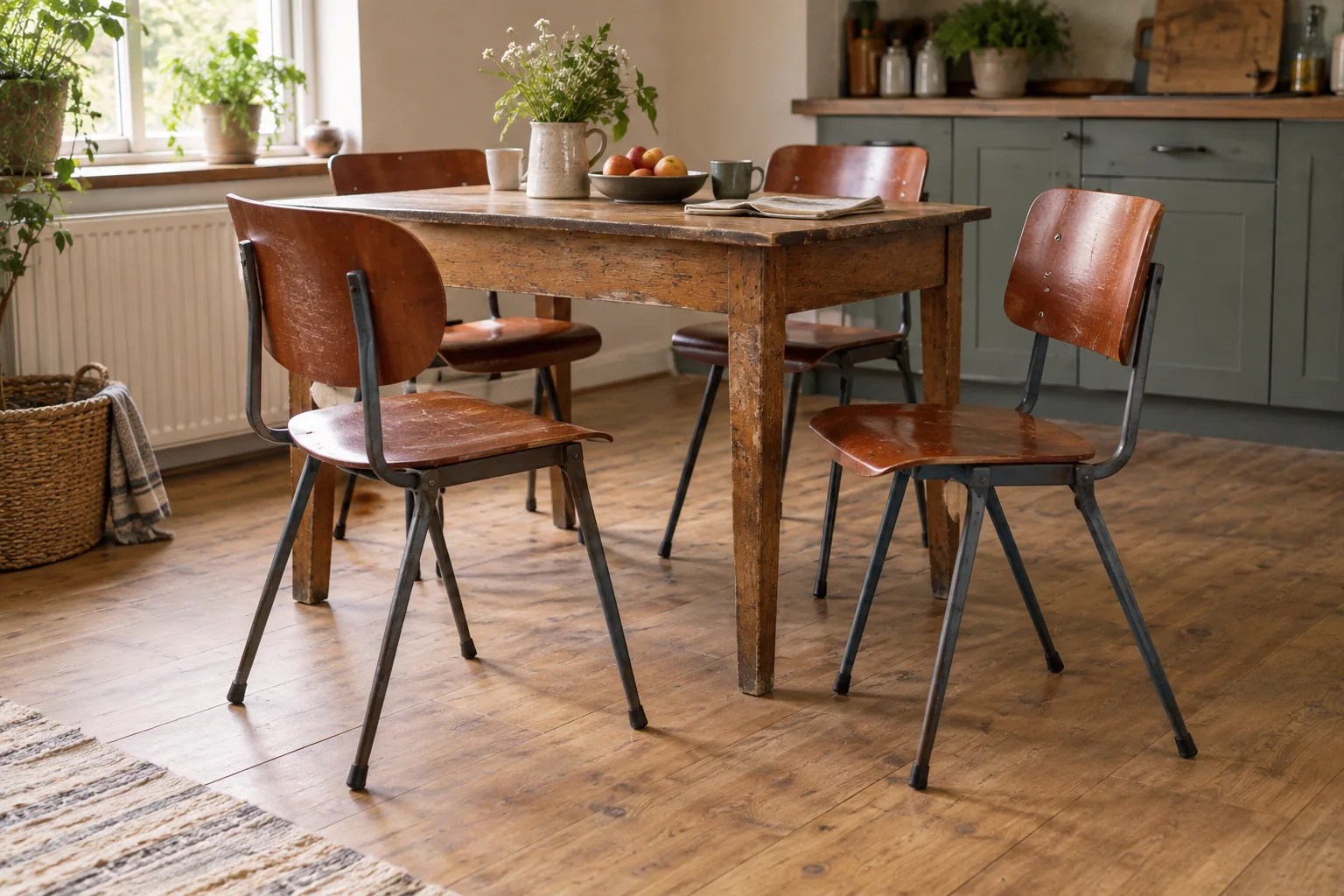
An S16 armchair needs its own place at the table
One older S16 offered on Whoppah is described as approximately 80 cm high, with a 45 cm seat height, 58 cm width and 42 cm depth. It has arms. Those are the seller’s figures for that chair, not measurements for every S16.[1]
The 58 cm width is the useful first number if you want two chairs between table legs. In an illustrative 110 cm clear opening, two such chairs total 116 cm before allowing any space between them. They cannot both tuck into that opening. They might work at separate ends, but that arrangement needs a sitting trial rather than arithmetic alone.
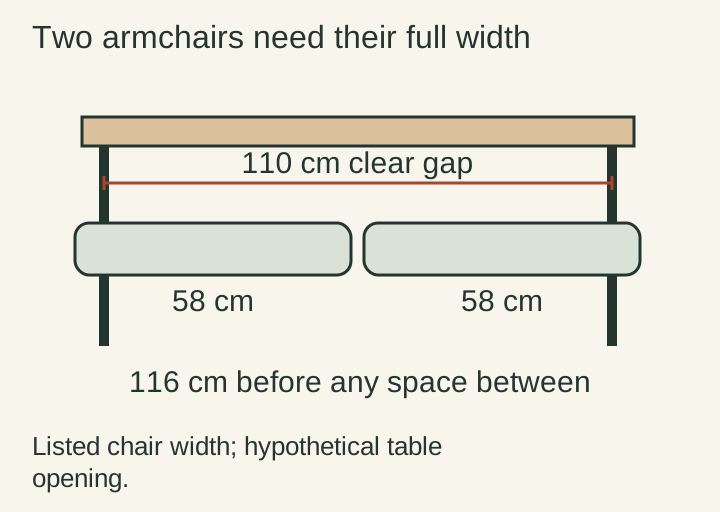
Ask for the arm height and the widest point at the height where the chair enters beneath your table. Compare them with the underside of the apron, not the top surface. A chair can fit comfortably while occupied and still be awkward to park after dinner.
Soliwood and Pagwood are not interchangeable labels
Galvanitas dates the S16 by Paul Philipsen to 1965 and describes its characteristic pressed-steel leg. Its current S16 Soliwood page identifies the seat and back material of that current product. That gives a manufacturer reference, not a material certificate for an older chair.[2]
The Whoppah seller describes its older chair using Pagwood terminology and gives a broad earlier dating claim. Keep those statements attributed to the listing; do not resolve the disagreement by silently copying the seller’s date. Request photographs of labels, exposed seat edges, the underside and the whole frame.[1]
| Component | Useful evidence |
|---|---|
| Frame | Whole-frame view, joints, finish and any label. |
| Seat and back | Edges, underside, fixings and the seller’s basis for the material description. |
| Arms, if present | Width, clearance height and attachment condition. |
| Feet and glides | Every foot in view, missing pieces and replacements. |
An edge photograph may help a specialist assess construction, but it will not reliably establish a proprietary material or production date by itself. Keep an unresolved description unresolved when deciding what a repair can cost.
Choose a consistent set where consistency matters
Number the chairs in the seller’s photographs. Ask for a simple comparison of overall width, seat height, arm presence and known repairs. A set assembled over time can be perfectly useful; what matters is whether the differences suit your room and are reflected in the offer.
Inspect the transitions between seat, back and metal support. A replacement panel or fixing needs to suit that frame, not merely cover the hole. Where a panel moves, a fixing is missing or metal has been repaired, obtain an assessment before using the chair. Fresh paint can make several histories look deceptively uniform.
Count glides individually and establish whether the intended replacements fit those legs. The cost of six small parts is only meaningful when the part is correct. Ask whether fitting, necessary frame work and protection for your floor are included.
Give it a meal-length job
Once condition permits, sit at the intended table with your feet supported and your back in its normal position. Try the armchair beside a side chair if you are mixing them. Compare the room needed when someone stands up, not just the row of chairs pushed underneath.
A focused seller request
Please identify which chairs have arms, measure their overall width and arm clearance, and show the seat edges, underside, frame joints and feet. Which panels, glides or fixings have been replaced?
The best S16 set is one you can arrange comfortably and maintain with understood parts. A tidy match of paint colours can be a bonus; it is a poor substitute for those answers.