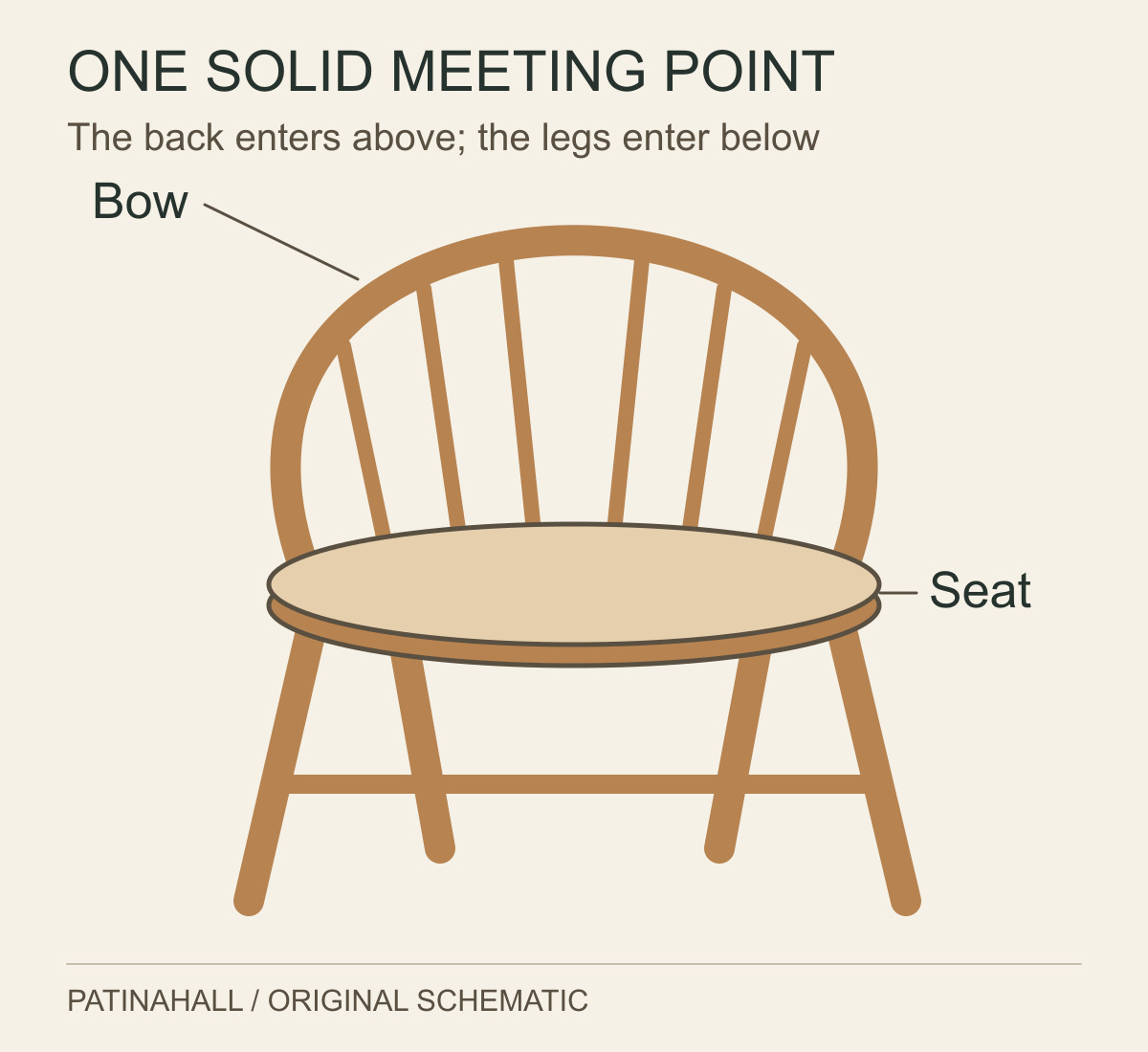
The seat is doing two jobs
Look beneath an Ercol Windsor dining chair and then look at its back. The legs and the slender back components approach the same solid seat from opposite directions. The seat is both a place to sit and the part that brings the chair together.
That helps explain the open appearance. A large panel does not have to fill the back, and a heavy rectangular frame does not have to wrap around the seat's edge. Much of what you see is the space between the wooden parts.
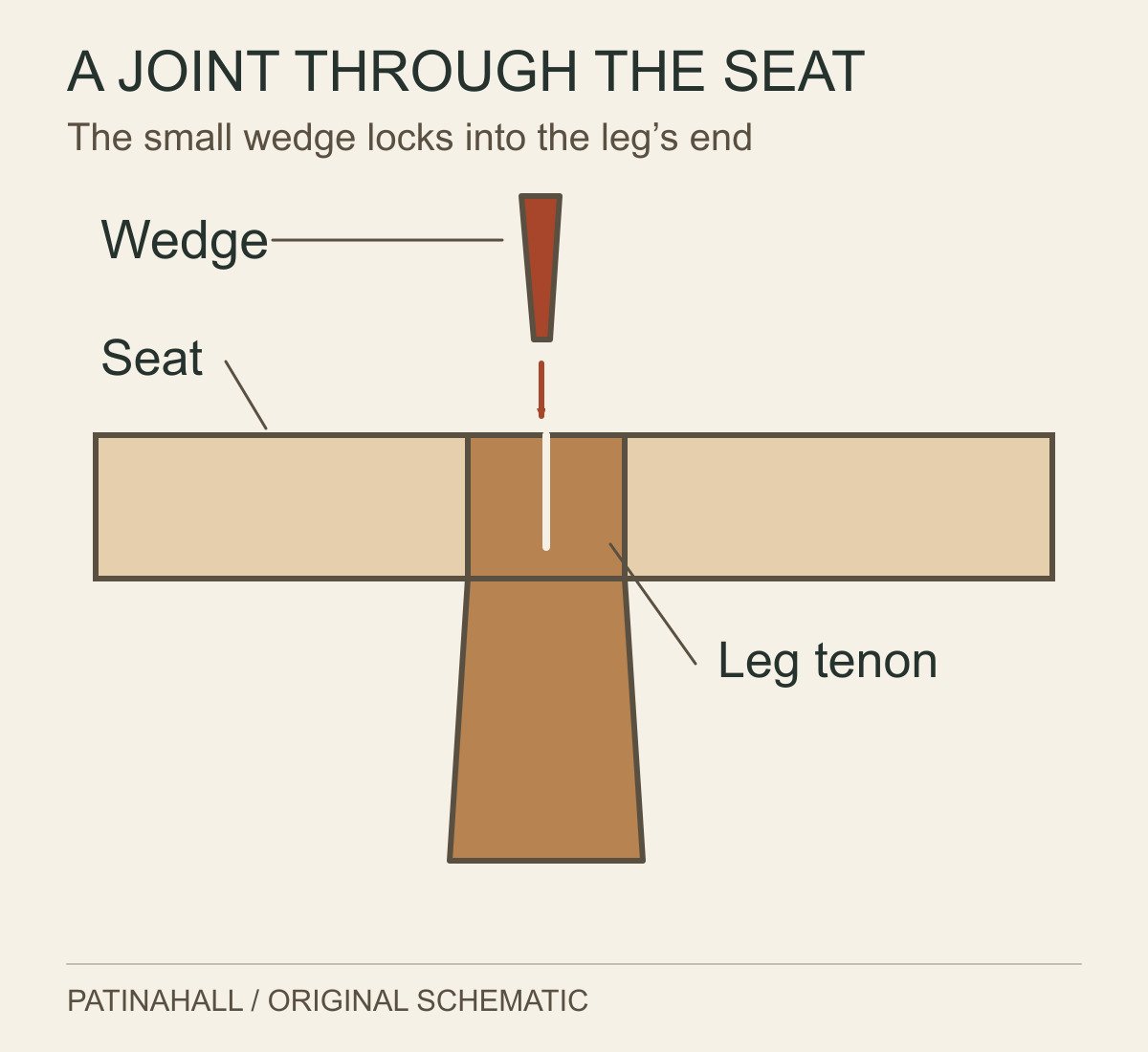
Ercol's construction account describes a bent bow, turned spindles and leg tenons secured through the seat with wedges before being trimmed flush. It also distinguishes the early elm seat and beech components from the ash used for its current Windsor chair.1
The visual lightness comes from an arrangement of solid parts. It is not simply a matter of making every piece thin.
A factory had to make the old idea repeatable
Ercol's history of production describes a wartime problem of scale. The company participated in the Utility furniture programme, and its account records a 1944 Board of Trade order for 100,000 chairs. Factory equipment and methods had to support that volume.2
Those Utility chairs should not be mistaken for the later No. 370 Windsor. They belong to the background: a manufacturer developing the means to make wooden furniture repeatedly and in quantity.
Ercol dates the launch of its Windsor range to the 1950 Furniture Exhibition at Earl's Court and credits Lucian Ercolani with the design. The interesting connection is between a familiar construction tradition and a factory able to reproduce its parts and connections.1
A curve may look relaxed, but repeatable manufacture asks it to meet other parts consistently. The bowed back, the holes in the seat and the shaped ends of the legs have to belong to the same assembly.
“Windsor” still leaves a choice of chair
An archived Ercol catalogue lists No. 370 as the Windsor dining chair and No. 370A as its armchair counterpart. It describes broad, shaped legs and an underframe set close beneath the seat. It also offers a removable cushion attached with straps and press studs.3
That cushion is a useful reminder of the chair's intended everyday life. An open wooden structure and a softer sitting surface could be separate parts, with the cover removable rather than permanently built into the chair.
The 1978 catalogue puts the 370 Windsor alongside the 365 Quaker and 369 Goldsmith. These names and numbers matter because the broader family contains different chairs.4
A maker name can establish the beginning of a search. The catalogue model makes the shape you are discussing more precise.
Read it from the middle outwards
Try following the chair from its seat rather than starting with its silhouette. First notice where the back enters the wood. Then trace the legs down to the floor and the bow up around the sitter. Finally, look at the gaps left between them.
Seen that way, the chair becomes easier to understand. The back occupies height without becoming a solid screen. The legs spread support below a much smaller central area. The seat is the compact meeting point between those different directions.
This is why a plain Windsor chair can sustain a closer look. Its history of manufacture is not separate from its appearance: the turning, bending and joining are part of what you can see. The seat holds together both the chair and the story.