Define the object, use, household and place
Start with the decision lead evidence must support. A painted side table kept behind a barrier for display is not the same use as a dresser opened every day, a chair whose edges receive repeated hand contact or furniture intended for a child's room. Record where the piece will stand, who can touch it, whether painted parts rub or shed debris and whether any cleaning, repair or refinishing is planned.
Write the lead-question brief
- Exact objectLink the listing, dimensions, photographs, included parts and every painted wooden, metal or other component.
- Intended useRecord display, storage, seating, food-adjacent, children's or other use and every frequent touch or friction point.
- HouseholdInclude young children, pregnancy, pets, pica, accessibility needs and anyone likely to chew, mouth, climb or handle low surfaces.
- Planned workState whether the purchase only needs stable use or whether cleaning, drilling, repair, stripping or refinishing is contemplated.
- JurisdictionIdentify where the furniture is sold, used and worked on so the right current authority and competent practitioner can answer.
Decision boundary
The Guide cannot clear exposure
PatinaHall can organise the object and evidence question. A public-health authority or qualified local professional must interpret an exposure concern, applicable rules and the suitability of testing or work for the exact household.
Keep appearance, history and chemistry separate
Write what can actually be observed: red paint on the seat, a darker layer beneath a loss, later brush marks around a hinge, a powdery edge or a clean modern-looking overcoat. None of those observations identifies lead. Equally, a smooth finish or recent top layer cannot show what remains underneath. One object may carry several original, repaired and repainted zones.
The U.S. Consumer Product Safety Commission currently regulates lead in paint and similar surface coatings on many furniture articles. That is one jurisdiction-specific present rule, not a visual dating tool: it does not certify a vintage object, prove when a layer was applied or replace the rules where the buyer lives.[2]
| Statement | What it can establish | What remains open |
|---|---|---|
| ‘Made around 1940’ | A supported or seller-reported object date | Composition and date of every coating layer |
| ‘Original paint’ | A seller or documentary claim that needs its own support | Pigment chemistry, later touch-ups and exposure consequence |
| ‘No chips visible’ | Condition visible in the supplied views at that time | Hidden layers, friction dust and future stability |
| ‘Lead-free’ | Only as much as the named method, locations, layers and competent interpretation support | Every untested surface, hardware coating and later change |
| ‘Complies with current rules’ | A documented claim for the exact market and product scope | Whether an older or altered piece was actually assessed |
Avoid converting a production date into a yes-or-no formula. The piece may be older than its present paint, newer than a reused component or assembled from parts with different histories. The useful question is not ‘Does furniture of this colour contain lead?’ but ‘Which exact surfaces and layers does credible evidence cover for my intended use?’
Map every painted surface and wear point
Ask for the complete object in neutral diffuse light, then repeat important areas with light travelling across the surface. Photograph the front, back, sides, top, base and safely visible underside; open ordinary moving parts only when the seller already regards them as usable. Keep a whole view, the area in context and a close view with a ruler beside each change.

Cover the full paint map
- Large facesTops, sides, doors, drawer fronts, shelves, seats, backs and panels may have different layers or exposure.
- Edges and cornersRecord worn rims, mouldings, feet, handles and projections where paint is frequently touched or knocked.
- Friction pointsShow drawers, doors, hinges, slides, folding parts, stacked components and any place painted surfaces rub.
- Recesses and hardwareInclude keyholes, screw heads, brackets, pulls, fasteners and sheltered areas where an earlier layer may remain.
- Damage and debrisLocate every crack, chip, flake, powdery patch, loss, detached fragment and dust-like material without brushing it away.
- Repairs and transitionsShow overpainting, filled losses, new hardware, masked edges and places where one colour or coating ends.
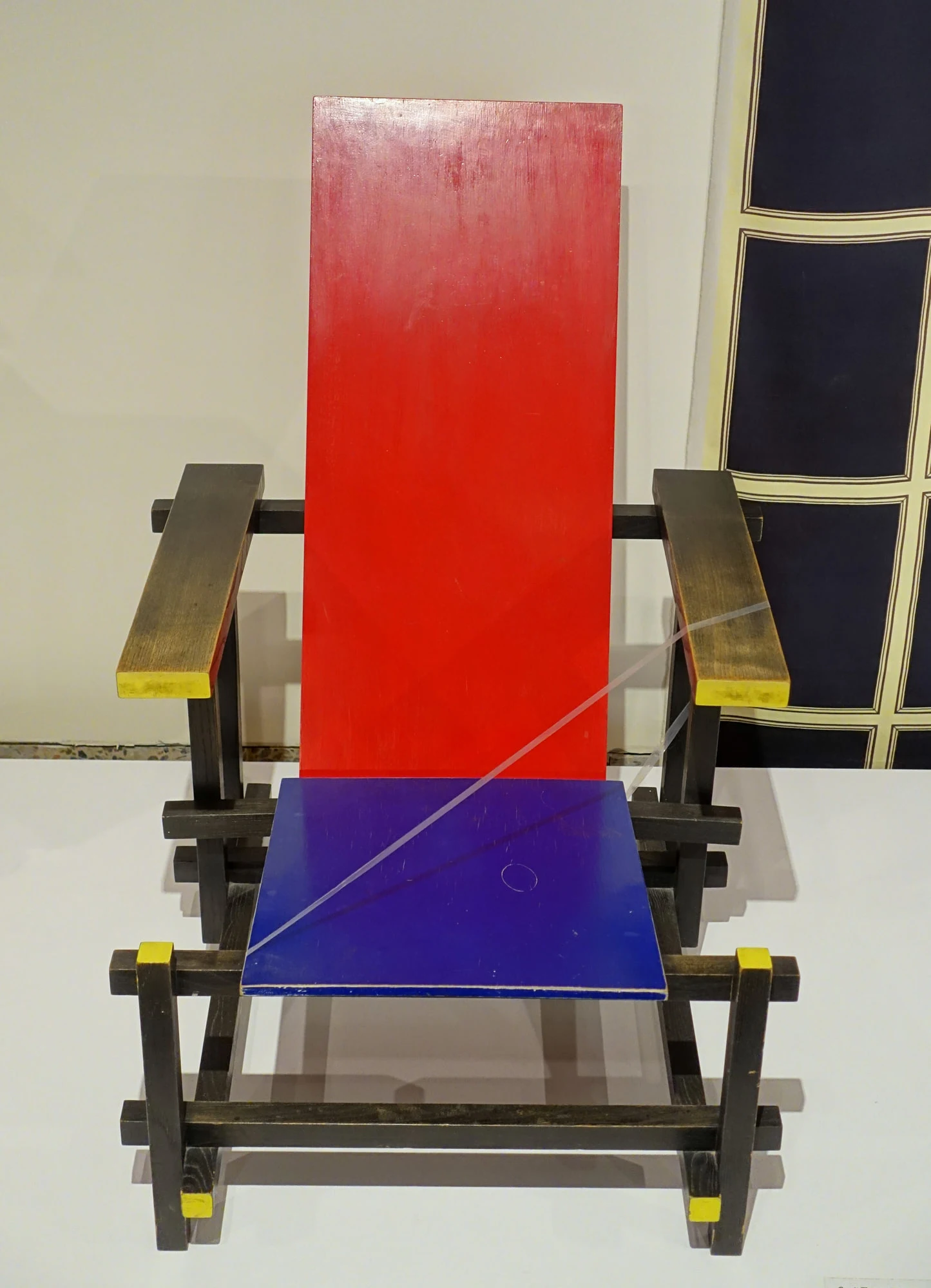
The photographed Red Blue Chair is a real 1960s museum example with visibly worn painted planes. It is useful because the complete object keeps each observation located; neither its famous colours nor its wear reveals coating chemistry, and its facts do not transfer to another chair.[6]
Use the furniture-photograph Guide for the whole, area and close-up sequence. Do not ask a seller to remove a handle, open a sealed panel or create a chip merely to reveal another layer.
Read finish condition without diagnosing lead
The Canadian Conservation Institute explains that painted wooden surfaces can crack and loosen as the wood moves, while light and ageing can contribute to powdering and colour change. It treats flaking, powdering and loose paint as fragile finish conditions requiring careful handling and, where consequential, an experienced conservator. Those observations describe stability; they do not identify lead.[5]
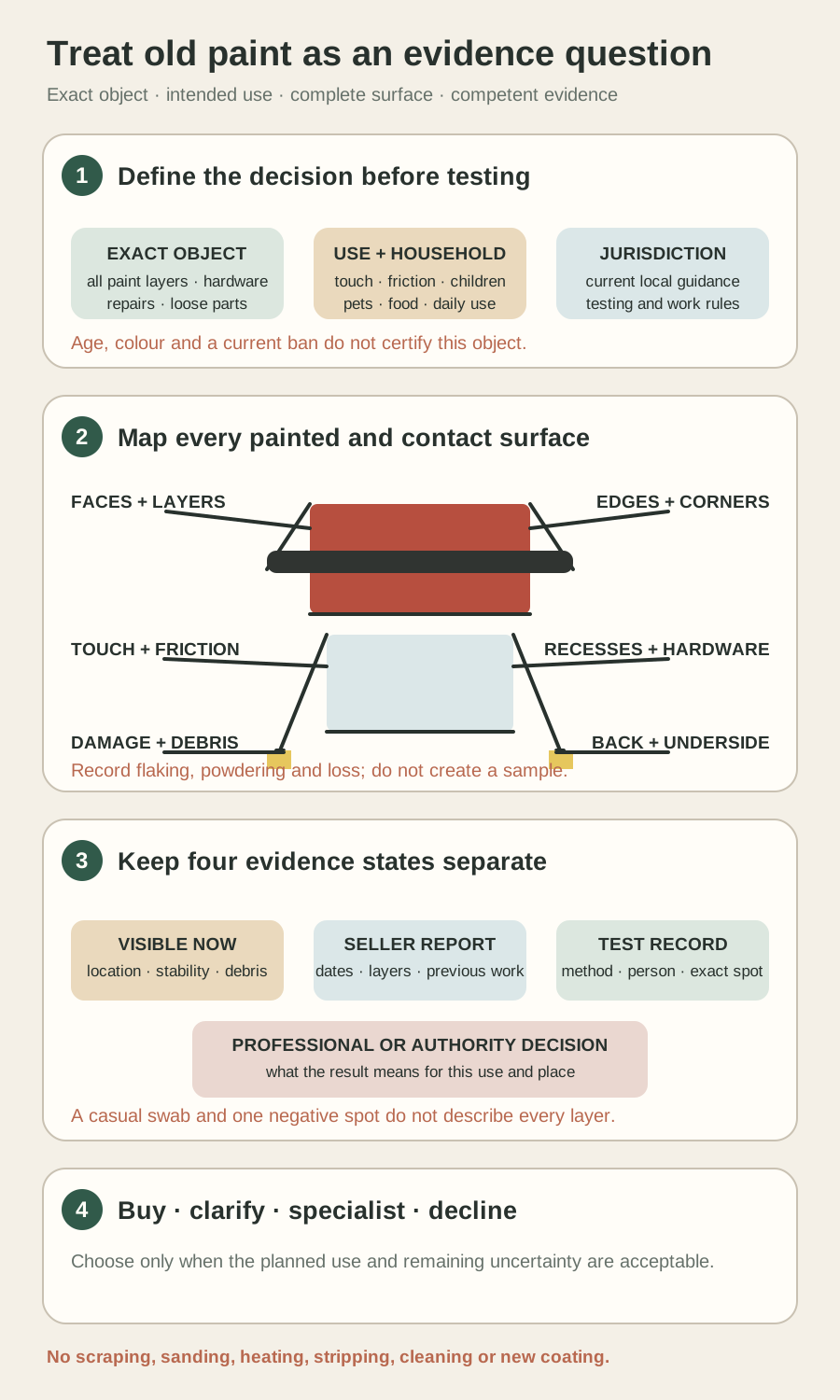
| Observation | Record | Do not infer |
|---|---|---|
| Stable-looking continuous film | All views, contact and friction zones, cleaning and repair history | Lead-free chemistry or indefinite future stability |
| Cracking or alligator-like pattern | Extent, layer transitions, movement, light and storage history | Pigment, cause or safe coating choice |
| Flaking or lifting edge | Exact location, loose fragments, nearby movement and whether loss is recent | That brushing, glue or overcoating is safe |
| Powder or dust-like material | Where it accumulates and which surfaces rub or move | Its composition from colour or texture |
| Later paint or filled repair | Boundary, provider, date, product and earlier layer if documented | That the new layer isolates every underlying risk |
Preservation boundary
Do not sacrifice the surface to improve the listing
An old painted finish may carry historical and aesthetic information. Do not let a request for certainty become unauthorised scraping, destructive sampling or an improvised coating. Agree who may examine what, using which method, before any contact occurs.
Choose a credible testing route
Testing is not one generic event. Ask what question the method answers, which material and layers it can assess, whether it marks or disturbs the surface, who is competent or authorised to perform it, how many locations represent the object and what local rule or professional decision will use the result. Obtain the seller's written permission before any contact test or sample.
In the U.S. housing Renovation, Repair and Painting context, EPA distinguishes recognised kits used by trained professionals from other evidence routes and notes laboratory paint-chip analysis and X-ray fluorescence among professional options. It also says its recognised-kit framework has specific performance and surface limits. Use that as a warning against treating any retail swab as universal proof, not as a furniture testing prescription for every country.[3]
| Field | Ask for | Why it matters |
|---|---|---|
| Authority | Name, competence, accreditation or programme and jurisdiction | Availability of a device does not establish competent interpretation |
| Method | Named kit, laboratory method, instrument or documented assumption | Different methods have different materials, detection and decision scopes |
| Location | Photograph or diagram of every exact tested point and component | One drawer or colour does not represent the complete object |
| Layers reached | Whether the result addresses only the surface or a documented stack | A later topcoat can leave older paint unresolved |
| Condition before testing | Intact, cracked, flaking, dusty, repaired or already sampled | Condition changes both preservation and exposure questions |
| Result and meaning | Raw result, date, threshold or limit used and the professional conclusion | A colour change without its method is not a transferable certificate |
If permission, competent testing or interpretation is unavailable, leave lead status unknown. Decide whether the piece can remain unpurchased, isolated from ordinary use or handled under a locally advised assumption until the question is resolved. Do not transform ‘untested’ into ‘safe’ or ‘contains lead’.
Stop before dust, chips or fumes are created
The World Health Organization identifies ingestion of lead-contaminated dust or paint flakes and inhalation of particles generated while stripping leaded paint as exposure routes, with young children especially vulnerable. That is why the buying decision must reach its evidence and professional boundary before the surface is disturbed.[1]
The U.S. Environmental Protection Agency lists refinishing old furniture among activities that can increase lead exposure and warns that disturbing old painted surfaces can create dust. Its recommendations and legal programmes are U.S.-specific, but the practical boundary is portable: do not improvise paint-disturbing work while the material and containment plan remain unknown.[4]
Keep inspection non-disturbing
- No scraping or sandingDo not expose a lower layer, smooth an edge or collect dust to see what colour appears.
- No heat or burningDo not use a heat gun, torch or hot tool to investigate or remove an uncertain coating.
- No solvent or stripping trialDo not apply water, cleaner, solvent or stripper to identify the finish or make a test easier.
- No casual containment promiseWrapping, vacuuming or adding a clear coat can disturb fragile material or hide evidence and must not be prescribed from photographs.
- No ordinary move through debrisIf flakes or powder are present, stop normal handling and obtain locally appropriate advice for access, isolation and transport.
Do not ask a seller, courier or restorer to ‘just wipe it first’. Cleaning may move dust, catch loose flakes or alter the surface. The person accepting responsibility for assessment or work should define preparation, access, containment, handling and records for the exact object and place.
Connect the evidence to the planned use
A material result does not complete the furniture decision. Combine it with present stability, who can contact the surface, whether parts rub, planned cleaning or work, the route into the home and the authority's or professional's advice. A responsible answer may be use as planned, use only after an agreed intervention, keep out of ordinary access while assessed or do not acquire.
| Planned situation | Question that must be answered | Owner of the answer |
|---|---|---|
| Child-accessible storage or seating | Are all accessible surfaces and wear points suitably assessed for that use? | Appropriate local lead and public-health professionals |
| Stable adult display with no planned disturbance | Can access, dust, future movement and monitoring be responsibly controlled? | Buyer with competent local advice where uncertainty is consequential |
| Drawer, door, folding or sliding use | Do friction points create chips or dust, and has each painted part been covered? | Lead professional plus furniture specialist as needed |
| Conservation of an important old finish | How can testing and stabilisation respect the surface and retain evidence? | Furniture conservator-restorer working with lead expertise |
| Stripping, sanding, drilling or repair | What rules, controls, competence and waste path apply before disturbance? | Qualified local lead-safe work provider and relevant authorities |
Use the completed-restoration Guide when a seller says paint was removed, sealed or replaced. A treatment story and a current lead decision must still refer to the same object and exact surfaces.
Send one painted-furniture evidence request
Message to copy
Ask for the whole paint record without requesting damage
Hello—I'm considering this exact piece for [use] in a household that includes [relevant users or pets] in [country/region]. Could you send complete front, rear, side, top, base and safely visible underside views in neutral and raking light; then locate every painted wooden, metal or other component, colour or layer transition, edge, corner, handle, recess, friction point, chip, crack, flake, powdery area, loose fragment, repair and overpaint? Please describe known manufacture, repainting, refinishing, cleaning, testing and work history with dates and documents where available. If lead testing has been performed, could you provide the exact method, person or laboratory, date, tested locations and layers, raw result and stated interpretation? Please do not scrape, sand, heat, strip, clean, coat, remove hardware or sample anything for my request. Mark every untested surface and unknown layer explicitly. Thank you.
Ask before arranging collection. If consequential flakes, dust or unstable paint remain, ordinary wrapping and transport may not be the next safe step. Let the relevant professional define how the object can be assessed, handled or declined without creating a new exposure or losing the historic surface.
Make a bounded purchase decision
| Decision | Appropriate when | Record |
|---|---|---|
| Buy | The exact planned use, complete surface condition and competent evidence or accepted assumption form a responsible plan | Evidence pack, intended use, handling and any future work boundary |
| Clarify | One missing surface, layer, friction point, permission or test field could change the decision | One specific seller or professional question |
| Specialist before purchase | Potential lead, unstable paint, child access or paint-disturbing work creates a consequential unknown | Exact remit for lead, health, conservation and furniture condition |
| Decline | The required evidence, permission, control or responsible work path is unavailable or disproportionate to the intended use | The unresolved fact, without accusing the seller or diagnosing the object |
An old painted surface can be beautiful, historically informative and entirely worth preserving. Respect does not mean denial, and caution does not mean every painted vintage piece is hazardous. The sound purchase is the one whose exact use, complete evidence and remaining uncertainty are understood before anybody changes the surface.