
One familiar number can lead to the wrong parts
An Anglepoise often enters a home as a useful find rather than a collector’s purchase: a desk lamp at a house clearance, or an inherited light that has worked for years. The model name becomes important when you need a spring, a shade or a service booking. Searching only for the number on an old listing can bring back parts for a different generation.
Anglepoise’s dating guide distinguishes Model 75, dated 1968–1973, from Sir Kenneth Grange’s Type 75, introduced in 2004. It also distinguishes the earlier Model 1227 from the Original 1227 launched in 2009. Use those names and dates as reference points, then compare the complete lamp and its records with the maker’s illustrated guide.[1]
| Name in the maker’s guide | Buying implication |
|---|---|
| Model 75 — 1968–1973 | Use this older model name when asking about its parts; do not shorten it to “75”. |
| Type 75 — introduced 2004 | A later design with a similar number; confirm its own version and parts. |
| Model 1227 — early production variants | Match the offered example to the appropriate variant and service eligibility. |
| Original 1227 — launched 2009 | An established later version; the design’s earlier origins do not date this individual lamp. |
Ask for a full side view, the base from above and below, the shade, the joints and all labels or marks. A replaced component may still be serviceable, but it should be declared. If the evidence conflicts, ask the maker or a specialist to identify the assembly before paying a premium for a particular period.
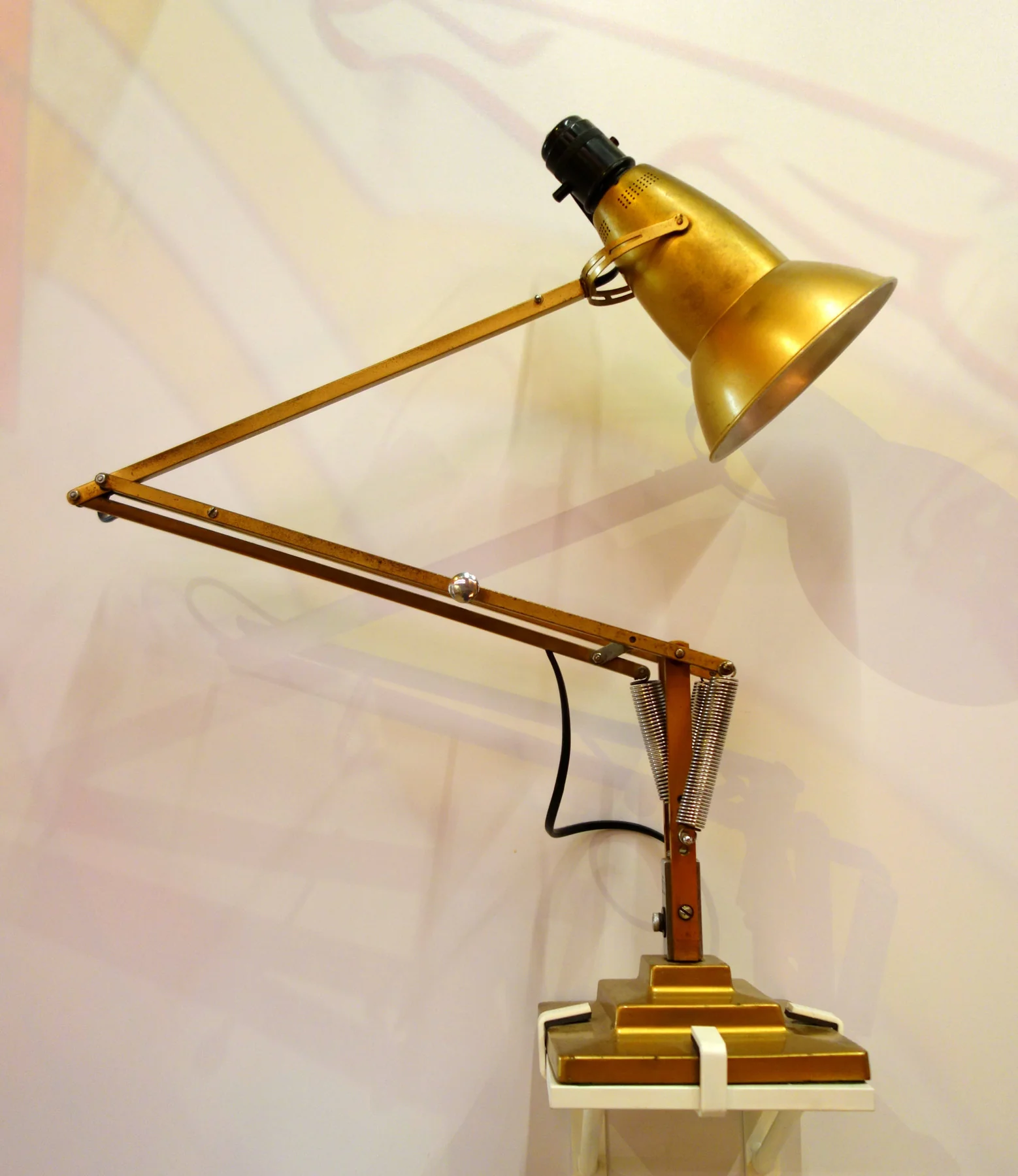
The photograph has its own CC0 source record. For the design’s history, see the Anglepoise Library story. Neither a museum image nor a design date identifies a separate lamp for sale.[5]
A lamp should suit the position where you work
Consider the base and the moving arms together. On a shallow desk, a base that looks compact may leave the shade in front of your screen or force the elbow of the arm against a wall. Measure the surface and ask the seller for the lamp’s reach in the position you intend to use. A folded transport dimension is not a working dimension.
With the lamp unplugged, and only if its structure appears sound, have the seller show gentle movement through ordinary working positions. It should not require a hidden prop or a hand holding the shade in the final photograph. If a joint is cracked, the fork is damaged or the arm drops abruptly, stop the demonstration and obtain a repair assessment.
Do not conclude that every drifting lamp needs a new set of springs. The maker’s balance guidance identifies bulb weight, spring arrangement and joint friction as contributing factors. That is a reason to obtain a diagnosis for the actual model, rather than applying one adjustment recipe to every vintage example.[4]
Ask what was fitted when the movement was checked, including the bulb and any replacement shade. A mechanical observation made on an incomplete assembly may not describe how the completed lamp will behave. Keep the electrical assessment separate: smooth movement does not establish safe wiring, and illumination does not establish sound joints.
The missing spring may matter more than the scratched shade
A complete lamp with worn paint can be easier to plan around than a freshly painted one missing an essential component. Decide which surface wear you can happily keep. Then identify the things that stop the lamp working as a lamp: a broken fork, incomplete spring arrangement, missing fixing or damaged shade support.
In its vintage FAQs, checked on 8 September 2026, Anglepoise says it has not reproduced springs for Model 1227 and Model 75, or forks for Model 1227. It does identify some compatible parts for Model 90 and Apex 90. Availability therefore has to be checked by model and component; a general spares shop is not a promise that an older lamp can be completed.[3]
Send a repairer clear photographs of the missing or damaged area and ask whether the proposed replacement is available, compatible and suitable for the intended repair. If it must come from a donor lamp, ask who will source and assess it. Do not buy a second incomplete lamp merely because its colour matches.
A service record should distinguish retained components from replacements. This is useful even when originality is not your priority: the next person servicing the lamp needs to know what is there. For an expensive period claim, it also prevents an electrical repair invoice being mistaken for proof that every visible part belongs to the original assembly.
What a real repair price includes, and what it leaves out
On 8 September 2026, Anglepoise’s UK website lists its repair service for eligible Model 1227 lamps from 1938–1968 at £135. It includes transport packaging, collection and return, electrical replacement work as required, and safety testing. Eligibility is assessed from photographs; extensive missing components may cost extra. The service is unavailable in the Republic of Ireland.[2]
The same page excludes replacement springs, painted components, paint restoration and removal of dents or scratches. Those exclusions are decisive if the cheap lamp you are considering needs a spring or a new shade. Confirm current eligibility, your location and the exact scope before relying on this UK price; it is not a European restoration average.[2]
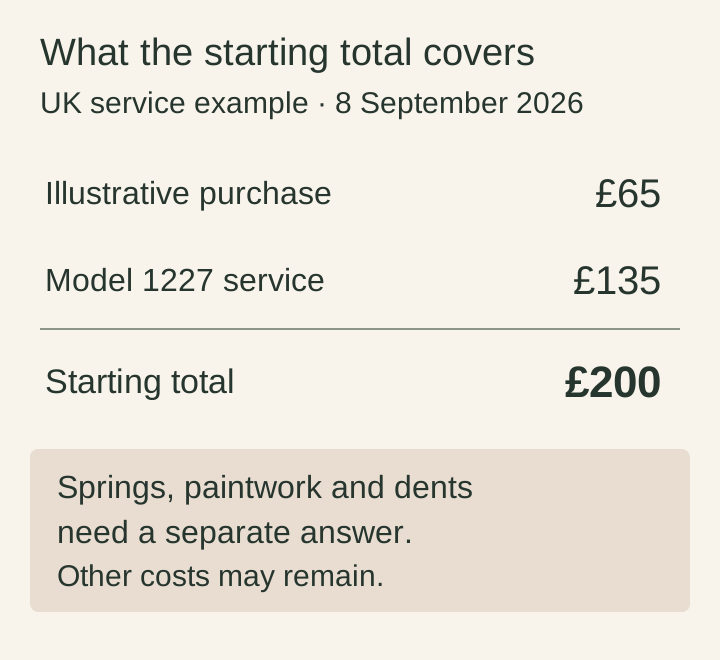
In that hypothetical purchase, £65 plus £135 is £200 before any uncovered work or cost of getting the purchased lamp to you. The purchase price is an example, not a market quotation. If the lamp also lacks a spring, the arithmetic remains incomplete until the part and fitting have a credible route. Compare the resulting total with a complete, professionally checked alternative.
If you prefer an independent repairer, ask for the same separation: electrical work and testing, mechanical work, replacement parts, surface work and transport. Tell them which wear you want to retain. The guide to a vintage lamp rewiring quote helps you define that professional handoff without treating a rewire as a full restoration.
Choose the lamp you can finish and enjoy
A sensible comparison might favour the complete lamp with honest chipped paint over the gleaming one whose joint will not hold. That is not a rule about patina being more valuable. It is a decision about your intended desk use, the repairs actually available and how much uncertainty you want to take on.
Ask before paying
Which exact model and variant is this, what has been replaced, and will it hold ordinary working positions with its intended shade and bulb fitted? Please send photographs of the complete assembly and the service record. I would also like any missing parts identified before collection.
Arrange suitable packing around the whole articulated assembly and agree how its condition will be recorded before transport. On arrival, have any unresolved mechanical and electrical concerns addressed before use. Once the lamp is complete and appropriately checked, the reward is straightforward: light where you need it, movement that suits the task, and a surface whose wear you chose to keep.