Define the job and the exact material claim
Start with use. A daily family sofa, dining chair, desk pad and occasional lounge chair expose leather to different flexing, abrasion, body contact, light, spills and movement. Decide whether the piece must be ready on arrival, whether sympathetic surface work is acceptable and which material or repair result would make you walk away.
Competition Bureau Canada separates full-grain, top-grain, split, bi-cast, bonded and imitation materials in furniture, and warns that familiar leather terms can describe materially different constructions. Use that vocabulary to ask a clearer question, not to create a visual grading ladder: the seller should identify the exact panels and basis for the description, while uncertain material remains uncertain.[1]
| Part | Ask the seller to state | Keep separate |
|---|---|---|
| Seat and back contact panels | Material description, maker documentation or earlier invoice, and whether the panel is original or replaced | The fact that it feels or photographs like another known leather |
| Outer arms, sides and back | Whether they match the contact panels or use another material or backing | A whole-chair “leather” claim that never names these areas |
| Piping, gussets, cushion boxing and undersides | Known material, repairs and the safe reverse or edge view | Small matching-looking parts that may have a different construction |
| Coating and colour | Known finish, recolouring, touch-up or protective treatment history | The leather substrate and the condition of what sits on its surface |
Material boundary
“Genuine” is not a complete buying answer
Do not rank a chair from one sales term or a grain close-up. Keep the seller's wording, the exact component it describes and its documentary basis together. If identity materially changes value or treatment, ask an appropriate leather specialist to confirm it.
Map the whole piece and compare use zones
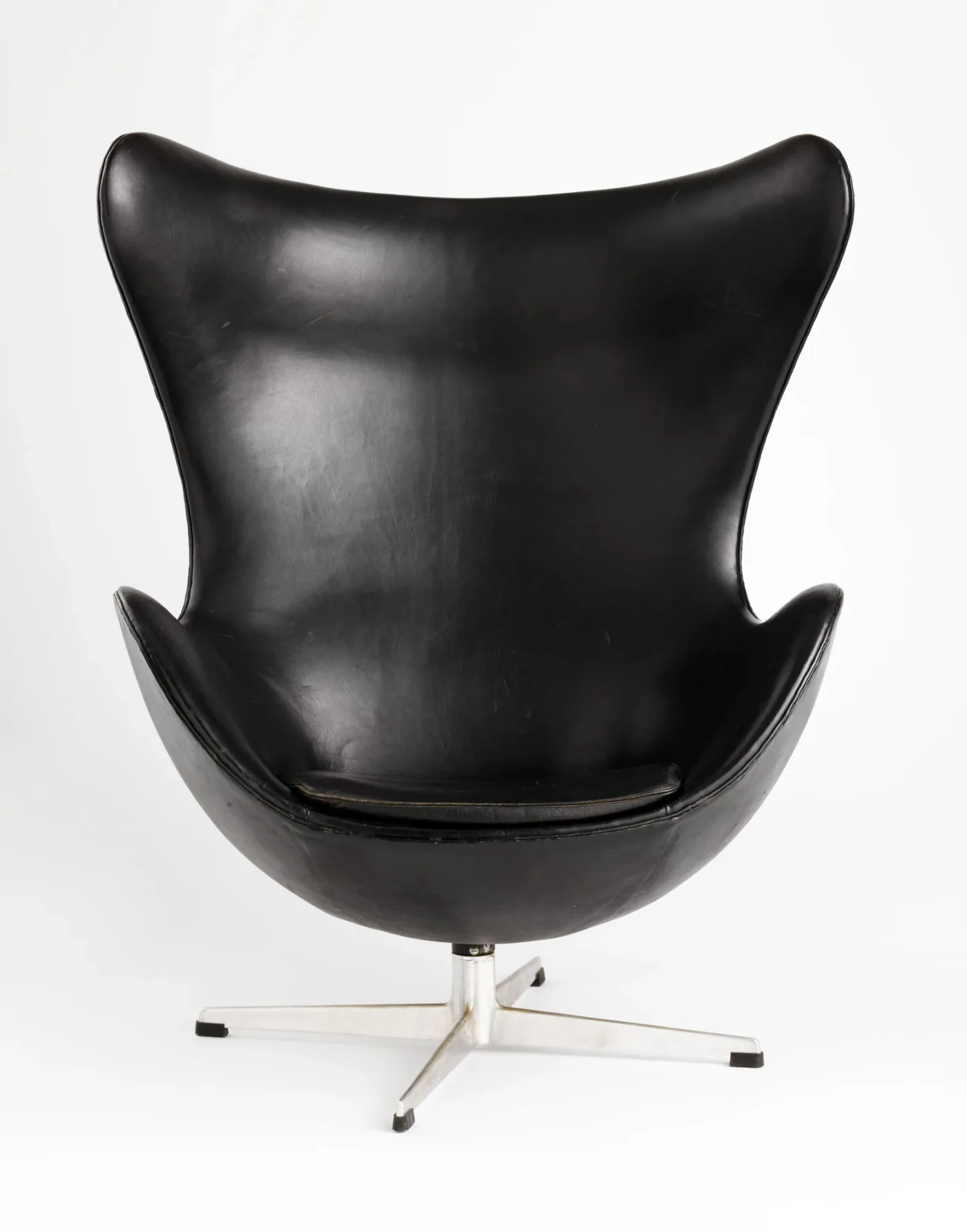
Nasjonalmuseet's catalogue records Egg Chair OK-1989-0185 as a leather-covered upholstered moulded-plastic and aluminium chair. That precise record belongs only to the museum object. Its front photograph is useful here because seat, back, wings, stitched perimeter and base remain visible together; it is not a condition standard or a shortcut to identifying another chair.[5]
Give every cushion and major panel a simple identifier. Compare left with right, the centre with edges, seat front with rear, arm tops with outer sides, and exposed faces with safe reverses. Repeated differences can be useful: a favourite seat may show more abrasion, a window side may have changed colour, and a replaced cushion may behave differently from the surrounding cover. Record the pattern before naming its cause.
Ask for one coherent image sequence
- Whole objectFront, rear, both sides and an oblique view with every cushion in its ordinary position.
- Cushions and removable partsTop, bottom, boxing, closures, labels and the deck below, without opening fixed upholstery.
- Matching zonesThe same distance and light across left/right arms, seat positions, back panels and sheltered outer surfaces.
- Edges and seamsPiping, folds, buttons, zips, stitch lines, attachment points and every area with lifting or loss.
- Safe undersideFrame, support and cover relationship only if the object can be positioned without stressing it.
Use the furniture-photograph Guide to keep each detail attached to its whole-object location. A macro image without a panel identifier can make ordinary variation look universal—or hide that the photograph came from the best area.
Turn surface appearance into bounded questions
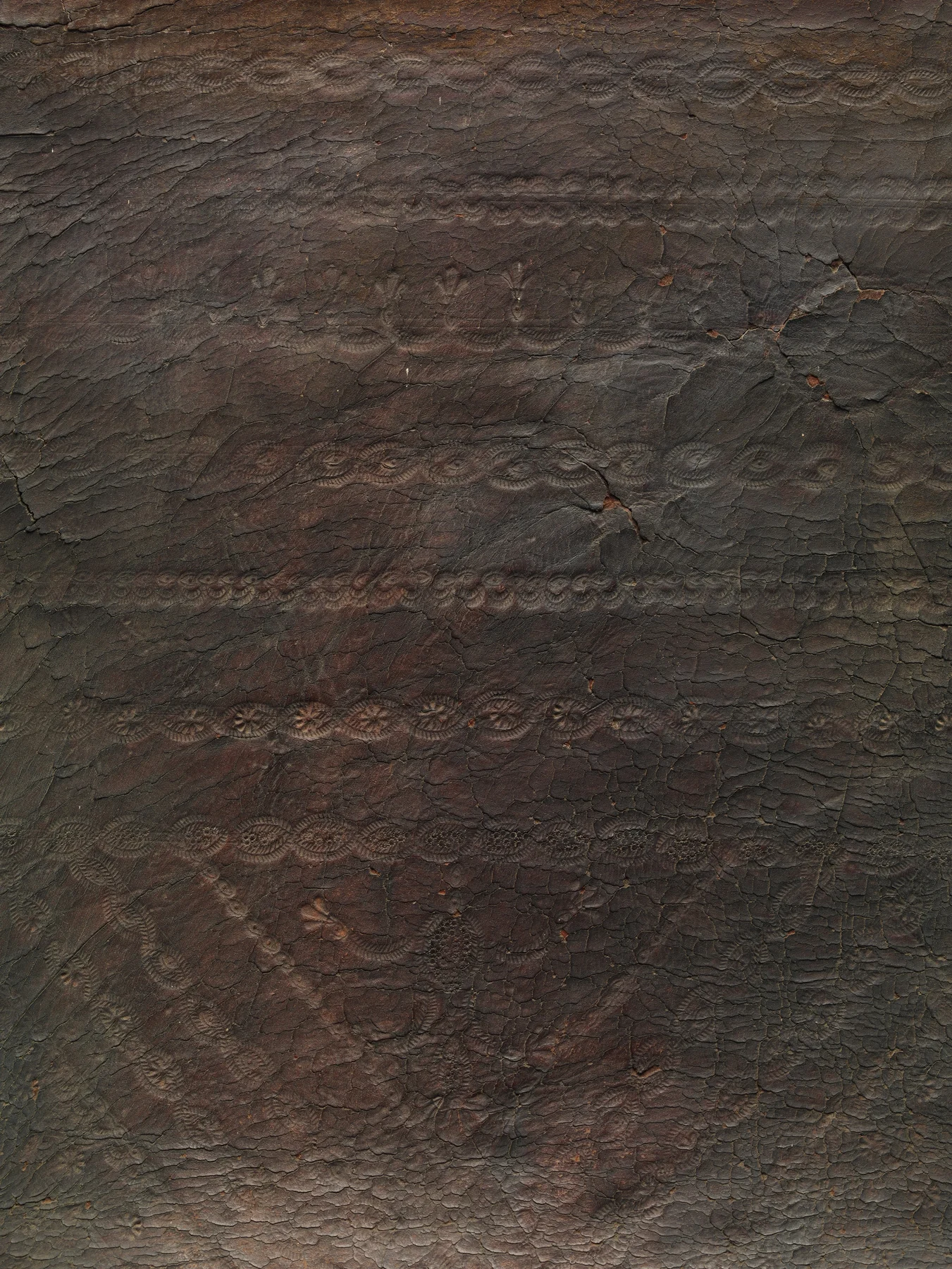
Ask for diffuse daylight or neutral room light for overall colour, then gentle raking light from more than one direction for texture and lift. Do not wet, warm, scratch, stretch or polish a patch to make it photograph differently. Name only what the image supports and carry the observation to the corresponding edge, seam or reverse.
| Observation | Ask next | Do not conclude |
|---|---|---|
| Soft creasing, polish or gradual colour change | Distribution across matching use zones and any known cleaning or placement history | That all change is desirable patina or that the surface needs feeding |
| Crack, split or open stitch | Full path, movement under ordinary unloaded handling, reverse view and what lies beneath | Remaining strength, repairability or cause from length alone |
| Peeling, flaking or lifting film | Every affected panel, edge behaviour, transfer and known coating, recolouring or material description | Whether the failure is leather, a finish, bonded material or an earlier treatment |
| Sticky, oily or colour-transferring surface | When it appears, what contacts it, prior products and a professional material assessment | That more cleaner, oil or dressing will reverse it |
| White, grey or coloured bloom or powder | Extent, humidity or damp history, smell, recurrence and safe specialist examination | Mould, salts, dressing residue or harmless dust from a photograph |
| Local patch or unusually even colour | Raking-light boundary, matching panel, known recolouring, repair or replacement record | Deception, originality or treatment quality without evidence |
Inspection boundary
A buying visit is not a material test
Do not use a fingernail, water drop, solvent, heat, flame, smell test, abrasive cloth or hidden cleaning patch to identify or grade the cover. Those actions can alter the evidence and still fail to answer the question.
Follow the cover into seams, support and frame
Leather is only the visible layer in many chairs and sofas. Follow the cover through seams, piping, buttons, cushion boxing and attachment to the safe underside, then keep padding, springs or webbing, deck, frame and joints as separate evidence fields. A supple-looking cover can sit over failed support; a worn cover can sit over a coherent structure.
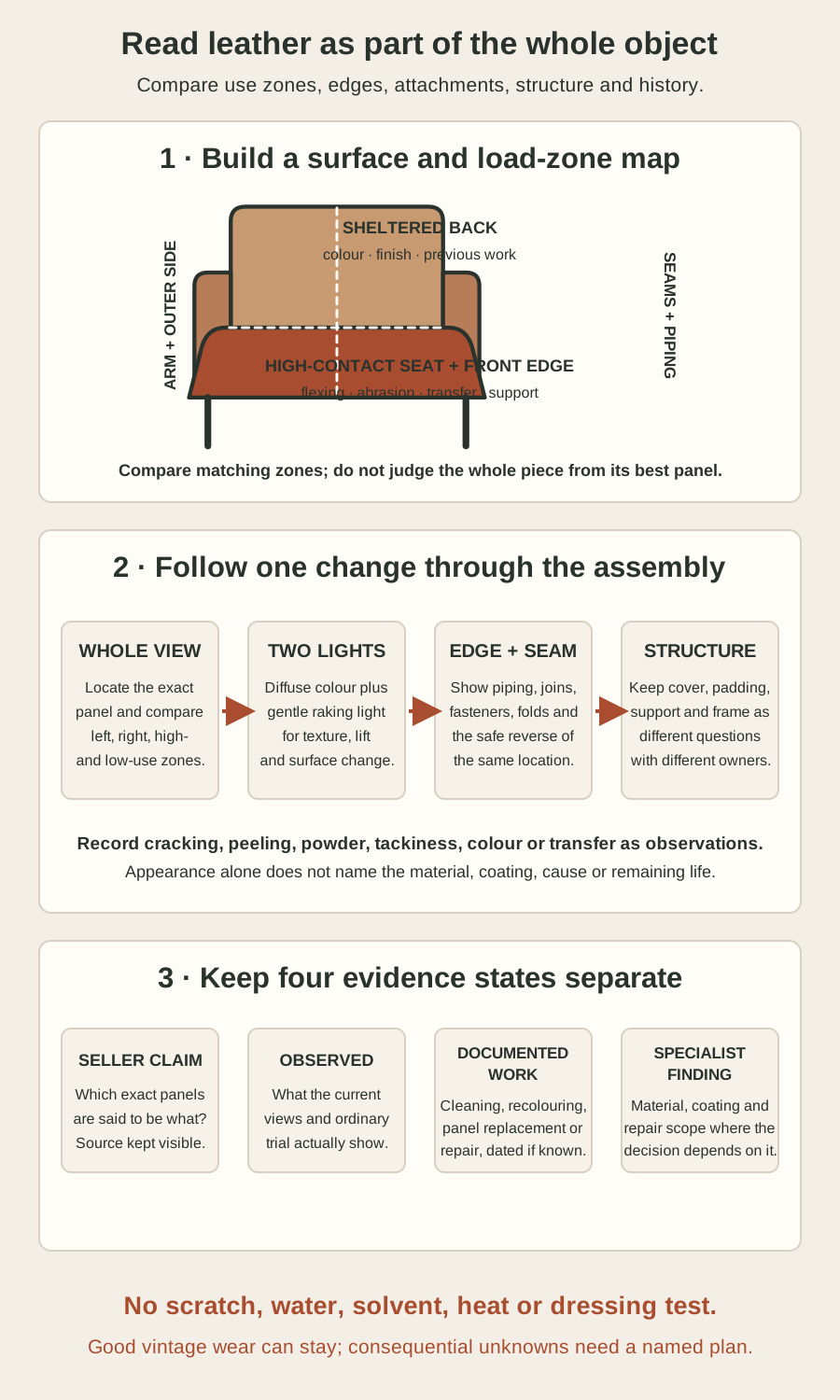
National Park Service guidance treats upholstered furniture as a multi-material assembly and asks caretakers to consider fabric or leather, stuffing, support, wood and metal together. For a buyer, this supports one joined evidence packet; it does not make a photograph a structural assessment or invite removal of a dust cover.[4]
Use the upholstery Guide for padding, support, underside and frame scope. Keep leather-specific material, finish and intervention history alongside that structural record rather than replacing it.
Ask what was cleaned, coloured, repaired or replaced
The Canadian Conservation Institute explains that animal species, tanning, processing and finishing can change leather's look, feel and behaviour, and that grain can be deliberately modified or impressed. Appearance therefore carries useful observations but cannot reconstruct the substrate or treatment history by itself.[2]
Build an intervention history
- CleaningProduct or method if known, who did it, approximate date, affected panels and any change afterward.
- Conditioning or dressingExact product, frequency and last application—do not accept “regularly conditioned” as a quality certificate.
- Colour and coating workTouch-up, dye, pigment, topcoat or unknown treatment, with before/after evidence and the area treated.
- RepairsClosed tears, patches, fillers, stitched areas, edge work and whether the underlying support was also repaired.
- ReplacementWhich panel, cushion, piping or complete cover changed, and whether original material remains elsewhere.
| History state | Record | Buying meaning |
|---|---|---|
| Documented | Dated invoice, treatment note, maker record or named professional with exact scope | A stronger basis for material and likely-work questions, not a guarantee of future performance |
| Seller reported | Original wording, panels involved and what the seller personally observed | Useful disclosure that remains a report rather than independent assessment |
| Visibly altered, method unknown | Boundaries, texture, colour, transfer and corresponding edge or reverse | A reason to scope uncertainty without inventing the product or motive |
| No known history | Present evidence and the exact questions that remain unanswered | Unknown—not evidence that no work occurred |
Separate the room-care decision from restoration
CCI records that high light and ultraviolet exposure can weaken and embrittle leather, local heat can contribute to drying and distortion, and humidity changes can produce shrinkage, swelling or splitting—especially where leather is stretched or fixed. Translate that conservation evidence into a room and work-scope question, not a universal household climate prescription.[2]
Test the proposed room
- Direct lightMap windows and seasonal sun against every exposed face instead of trusting the listing-room placement.
- Heat and moving airRecord radiators, fireplaces, vents and hot equipment near the cover and frame.
- Daily contactInclude clothing transfer, pets, food, drinks, bare skin, bags and the frequency of sitting or leaning.
- Cleaning realityDecide whether the current surface can be lived with before assuming a cleaner or dressing will improve it.
- Mixed materialsRemember that wood, metal, textile, foam, adhesives and leather may need incompatible treatments.
The best buying outcome may be no cosmetic intervention: accepted creasing, softened colour and a disclosed old repair can belong to the piece. If cleaning, recolouring or repair is necessary for purchase, obtain a scope from someone who has seen the exact material and complete assembly before treating an online estimate as part of the price.
Stop at white bloom, damp and health unknowns
National Park Service research on fatty-acid spew explains that white material on leather can be confused with mould, salts, soiling, residues or earlier dressings; even experienced conservators may need in-person context and magnification. Images alone may not be sufficient. A marketplace photograph should therefore preserve the uncertainty rather than settle it.[3]
Pause before handling or delivery when
- Growth or powder is unexplainedThe surface shows white, grey, green, black or coloured material with no responsible identification.
- Damp is current or recentThere is moisture, staining, swelling, persistent musty odour or an unresolved storage event.
- The surface transfersColour, oil, tacky material or powder moves to clothing, packaging or adjacent furniture.
- The examination would disturb itIdentification would require brushing, sampling, heating, wetting, scraping or opening fixed upholstery.
Health boundary
Do not turn a seller into the test laboratory
Ask the seller to stop handling, isolate the evidence and seek appropriate professional advice when mould, residues, contamination or active damp is plausible. This Guide does not identify a substance, clear a piece for a home or prescribe remediation.
Scope work and the total commitment
The National Park Service's current review of leather dressings describes how routine oil, fat or wax applications can darken, stiffen, become sticky, create bloom and complicate later repair. Museum treatment and a working household chair are not the same problem, but the evidence rejects one important shortcut: an unknown vintage surface does not automatically improve because more product is applied.[3]
| Question | Responsible assessment | Buyer needs before commitment |
|---|---|---|
| Material or coating identity changes value or treatment | Experienced leather specialist or conservator | What can be confirmed, what remains unknown and whether examination is non-destructive |
| Cover repair or replacement is likely | Upholsterer experienced with the relevant construction | Panel-by-panel scope, effect on neighbouring material and whether support work is included |
| Seat support or frame is uncertain | Furniture or upholstery professional | Structural sequence before cosmetic work and whether ordinary use should stop |
| Damp, mould or residue may affect people or property | Appropriate conservation or environmental professional | Handling, isolation and next-step boundary before collection |
| The piece is accepted as it is | Buyer with seller disclosure retained | Room placement, ordinary care boundary and tolerance for present wear |
Add the confirmed purchase price, protected delivery, immediate structural or upholstery work, material assessment and any accepted uncertainty. Do not budget only for a colour touch-up when support, mixed panels or an earlier coating may control the real scope.
Send one complete leather-furniture request
Message to copy
Ask for components, surface and history in one record
Hello—I'm considering this [chair/sofa/other piece] for [daily/occasional] use. Could you identify which exact seat, back, arm, side, piping, cushion and reverse panels are described as leather or another material, and share the label, invoice or other basis if available? Please show the whole piece from front, rear, both sides and obliquely; every cushion on and off; matching high-contact and sheltered zones in diffuse and gentle raking light; all seams, edges, closures and the safe underside; and every area of cracking, peeling, powder, tackiness, colour transfer, staining or repair in context. Please list known cleaning, conditioning, recolouring, coating, repair and replacement work, with dates and affected panels if known, plus any damp, mould, smoke, pet, pest or persistent odour concern. Please leave unknowns as unknown and do not scratch, wet, heat, clean, dress, open or stress the upholstery for the inspection. Thank you.
Buy when the exact material claim is clear enough for your decision, present surface and structural state suit the intended use, earlier work is acceptable, consequential unknowns have a credible owner and the whole commitment still makes sense. Pause for material, residue, support, frame or health assessment when the answer changes safe use or cost. Decline when the purchase depends on certainty the evidence cannot supply or on irreversible treatment merely to discover what the piece is.