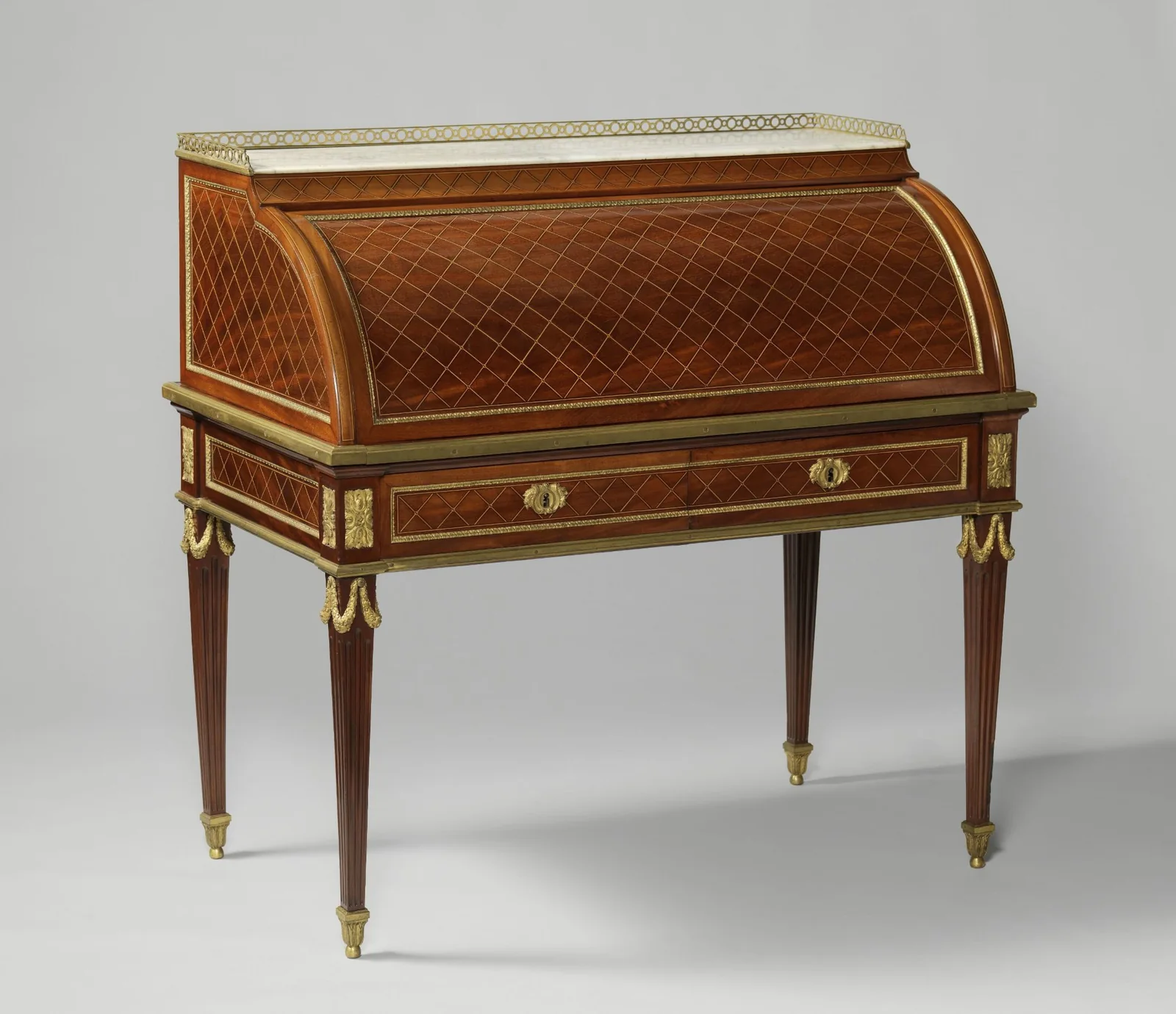
Define the exact assembly and use
Begin with the complete piece and its intended job. A marble-topped bedside cabinet, café table, console and large dining table place different demands on water exposure, edge contact, overhang, support and moving. Decide whether the object must be ready for ordinary use or whether conservation, restoration and specialist delivery can enter the plan.
Write the stone-top brief
- Exact pieceKeep the top with the base, listing, dimensions, seller report and photographs that belong to it.
- UseRecord expected heat, spills, food contact, children, frequency of use and tolerance for visible etching or repair.
- ReadinessDecide whether the top must be usable on arrival or can wait for stone, furniture or conservation work.
- MoveIdentify collection floor, stairs, lifts, route constraints and who accepts responsibility for the exact assembly.
Do not separate surface condition from the furniture below. A beautiful slab on an altered, undersized or moving base is a different purchase from the same slab on a coherent support system.
Keep stone and finish names provisional
The Natural Stone Institute groups stones by composition and notes that calcareous stones such as marble and limestone react to acids differently from siliceous stones such as granite. Listings, however, can use marble, travertine, granite, onyx and composite-stone names loosely. Record the name as seller-reported unless documentation or an appropriate specialist supports it.[1]
- Ask for invoices, maker records, labels or previous treatment reports that name the material or finish.
- Photograph the complete top, edge profile and safe underside; construction and backing may clarify the question without proving it.
- Record polished, honed, textured or coated as appearance when the finish history is unknown.
- Do not use an acid, scratch, solvent, water-absorption or improvised cleaning test to identify a seller's top.
Evidence boundary
A stone name is not a condition conclusion
Even a well-supported material identification does not tell you whether a line is natural, repaired or active; whether a slab is safely supported; or how it should be treated and moved.
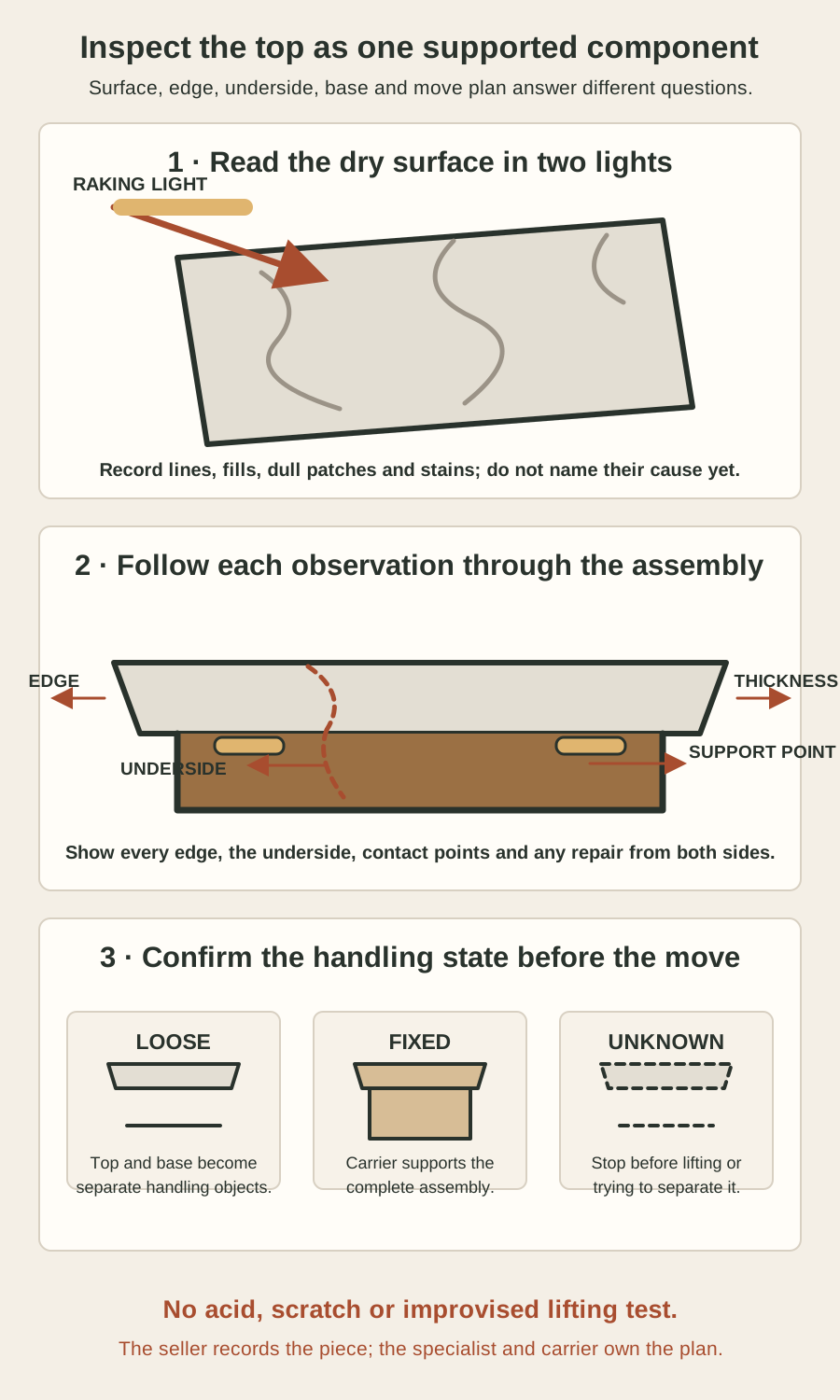
Photograph a dry surface in two lights
Ask for the top dry, uncovered and photographed before any new cleaning or dressing. Begin square-on in broad diffuse light for overall colour and pattern. Repeat from a low angle with light travelling across the surface; this raking view can make changes in gloss, shallow losses, raised fills and unevenness easier to locate. Add overlapping close views with a scale beside—not over—the area.
The Natural Stone Institute distinguishes staining, in which material has darkened or discoloured the stone, from etching, a physical change to a calcareous surface that often appears as a duller or lighter area. A photograph can support those as different questions; it cannot always diagnose which process occurred or prescribe treatment.[1]
Use the furniture-photograph Guide to preserve whole-object location. Reflections, wet patches, styling objects and aggressive image contrast can hide or invent apparent differences in the surface.
Follow every line through the edge and underside
For every line, chip, filled area or colour change, make a small evidence sequence: one whole-top view, one relationship view, the detail in diffuse and raking light, the nearest edge and the corresponding safe underside. If the underside is enclosed or the top cannot be viewed without lifting, record that limitation instead of improvising access.
Keep the observations separate
- SurfaceRecord colour, gloss, texture, line, dull patch, deposit, fill or local height change without naming the cause.
- Edge and cornerShow chips, impact points, open joints, repairs, profile changes and where a surface line meets the edge.
- UndersideShow corresponding lines, backing, mesh, rods, patches, residues and labels only where they are safely visible.
- MovementAsk whether an existing repair or separate fragment moves; do not press, tap, flex or lift it to find out.
Inspect support, attachment and overhang
Photograph the complete base level on the floor, all rails or ledges beneath the top, every corner and any pad, clip, screw, adhesive, pin or locating block that is already visible. Measure the slab and the supporting footprint separately. Note where the top overhangs the base and whether any support appears missing, altered or out of contact.
CCI handling guidance recommends inspecting weak areas, old repairs and attachments before movement and supporting an object's weight from sound structural areas. For a buyer, that means the top and base need an explicit handling assessment; it does not authorise lifting a slab to discover how it is held.[3]
| Observation | Ask next | Keep unpromised |
|---|---|---|
| Even-looking contact on all sides | What sits between top and base and whether attachment is known | Adequate support or safe movement from a front view |
| One gap, shim or altered block | Level views, matching corners and known furniture work | That removing or tightening one part is the remedy |
| Visible adhesive or metal fixing | Extent, date, purpose and corresponding underside evidence | Originality, reversibility or strength |
| Wide or asymmetric overhang | Exact slab and support dimensions plus carrier assessment | That the top can be used as a lifting point |
| Separate top shown away from its base | How both components are identified, supported and reunited | That separation is original or transport is simple |
Record dimensions, weight and handling state
Record the top's maximum length, width, thickness and edge profile, then the complete furniture dimensions and every projection. Ask for the actual or documented weight and say plainly when it is unknown; do not estimate from a photograph or stone name. The carrier also needs floor, stairs, lift, turns, thresholds and the final support or installation location.
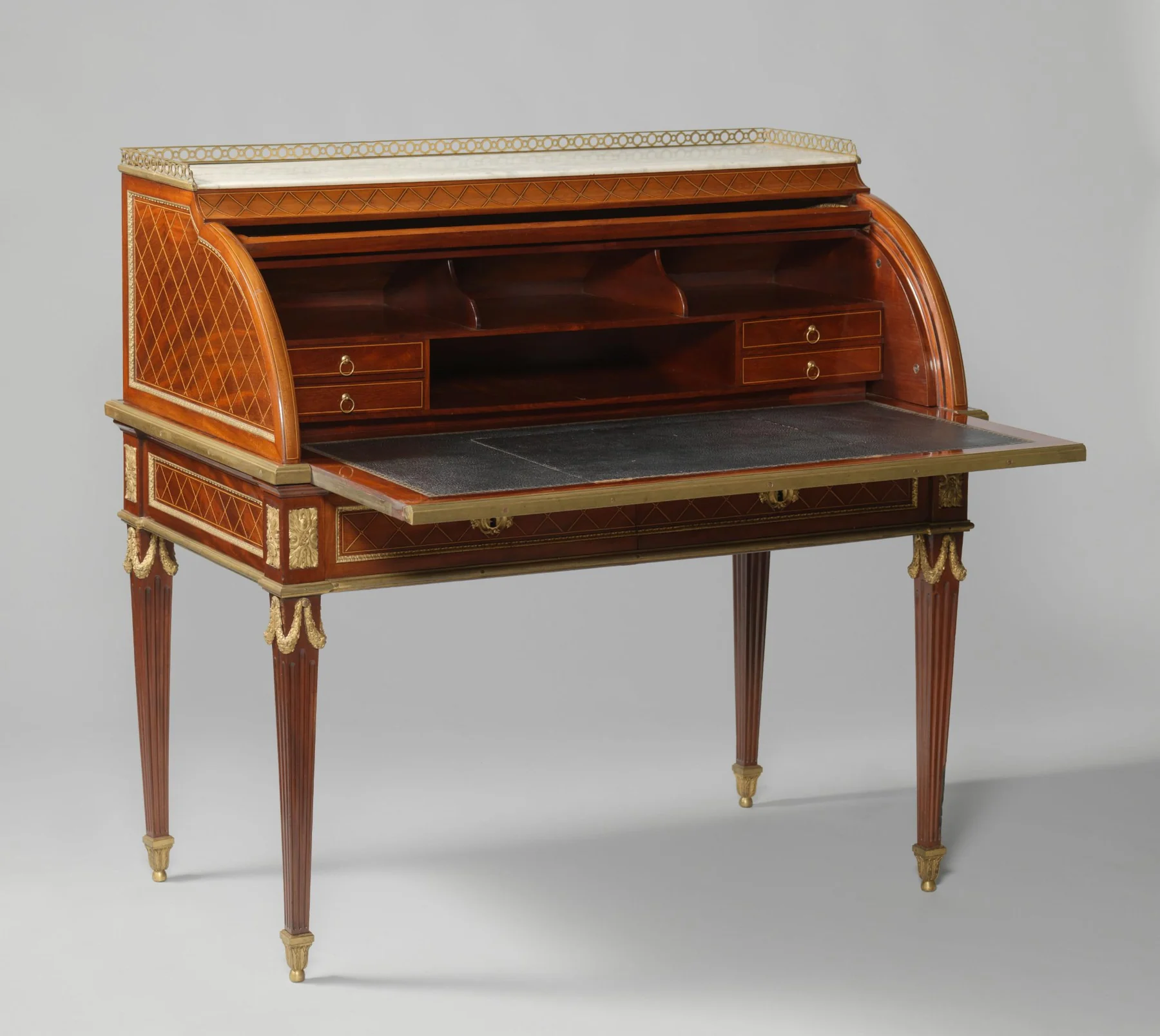
The Rijksmuseum records the pictured cylinder-top desk as a 92 kg object containing Carrara marble. That exact catalogue fact shows why a visually slim top cannot substitute for a complete assembly weight; it does not estimate the weight or material of another piece.[4]
Choose one honest handling state
- LooseThe seller reports that the top is separate or normally separates, with evidence of how top and base correspond.
- FixedThe seller reports a known attachment; the carrier plans around the complete assembly and does not assume removal.
- UnknownNo one lifts, levers or cuts anything to improve the listing; the carrier or specialist resolves the state.
Use the delivery-route Guide for the protected dimensions and turning envelope of every component in its carrier-approved orientation.
Separate visible age from unknown structure
| You can record | You still need | Do not promise |
|---|---|---|
| Vein-like line visible only on the face | Edge, underside, raking-light and movement evidence | Natural vein or harmless crack |
| Dull or lighter patch | Material, finish, spill and treatment history | Stain, etch or easy polish-out from one image |
| Filled pore, chip or line | Extent, stability, underside and known repair record | Factory fill, later repair or structural adequacy |
| Small edge loss | Location, sharpness, loose fragments and intended use | Cosmetic importance or repair cost for every stone |
| Mesh, rod or patch below | Full underside, top relationship and specialist interpretation | Damage, manufacture date or unacceptable repair by presence alone |
Vintage stone can remain useful with etching, old fills, edge losses or a disclosed repair. The buying decision changes when a consequential line, moving fragment, unsupported area, unknown attachment or treatment-dependent surface is hidden, minimised or left without a responsible work and transport plan.
Use the general condition Guide to carry the observation, seller report, unknown, likely work and decision consequence into the complete object record.
Leave treatment and moving to the right specialists
The Natural Stone Institute advises professional help for deep or stubborn problems and explains that an impregnating sealer improves stain resistance rather than making stone stain-proof. Do not turn a purchase inspection into cleaner, poultice, polish, sealer or repair advice for an unidentified surface.[1]
CCI's furniture guidance treats a marble top as a separate handling question, while its broader handling guidance calls for suitable equipment and experienced people for very heavy objects. A seller should not remove the top for photographs. Ask an experienced carrier to decide separation, support, packing, orientation, team and equipment for the exact piece.[2]
Professional boundary
Stone, furniture and transport can be three scopes
A stone conservator or restoration specialist owns uncertain lines, repairs, finish and treatment. A furniture specialist owns an unstable or altered base. An experienced carrier owns lifting, separation, packing, orientation and access. Confirm who coordinates them before collection.
Send one complete stone-top request
Message to copy
Ask for surface, support and handling facts
Hello—could you send the complete piece level from every side, the dry uncovered top in diffuse and low raking light, all edges and corners, and the safely visible underside, supports and attachments? For each line, dull patch, stain, chip, fill or repair, please include a whole view, close view, nearest edge and corresponding underside. Please report the material and treatment only as known, give exact top and overall dimensions and actual or documented weight if available, and state whether the top is loose, fixed or unknown. Please do not clean, wet, test, lift, lever, detach or move it for the inspection. Thank you.
Buy when the exact top, base and intended use are coherent, disclosed wear or repair is acceptable and a responsible work and delivery plan exists. Pause when a consequential line cannot be followed, the support or attachment is hidden, weight is guessed, or safe collection depends on seller improvisation. Decline when the known condition, specialist scope, access risk or handling cost does not fit the purchase—even if the polished face photographs beautifully.