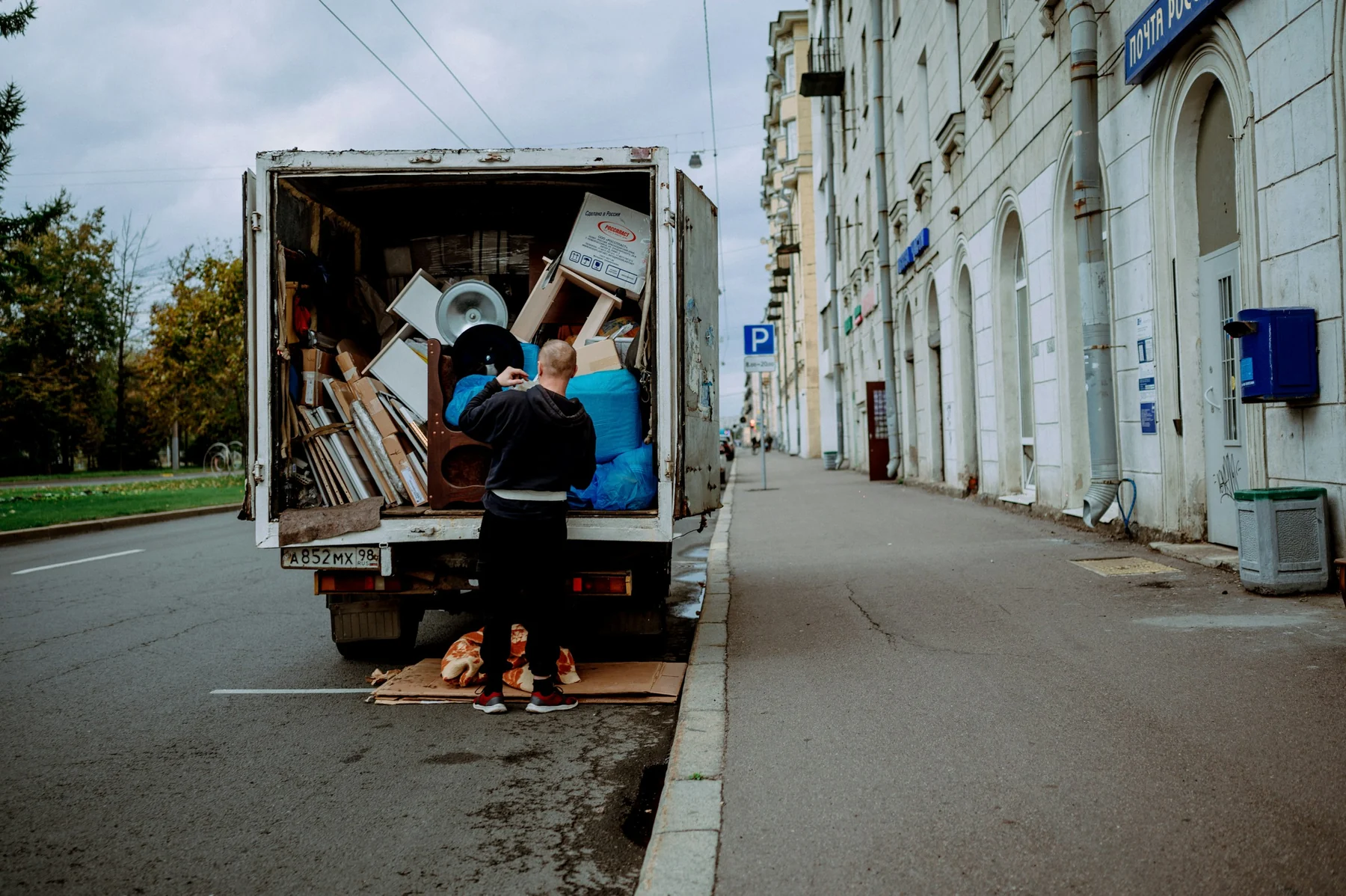
Decide whether self-collection is the right job
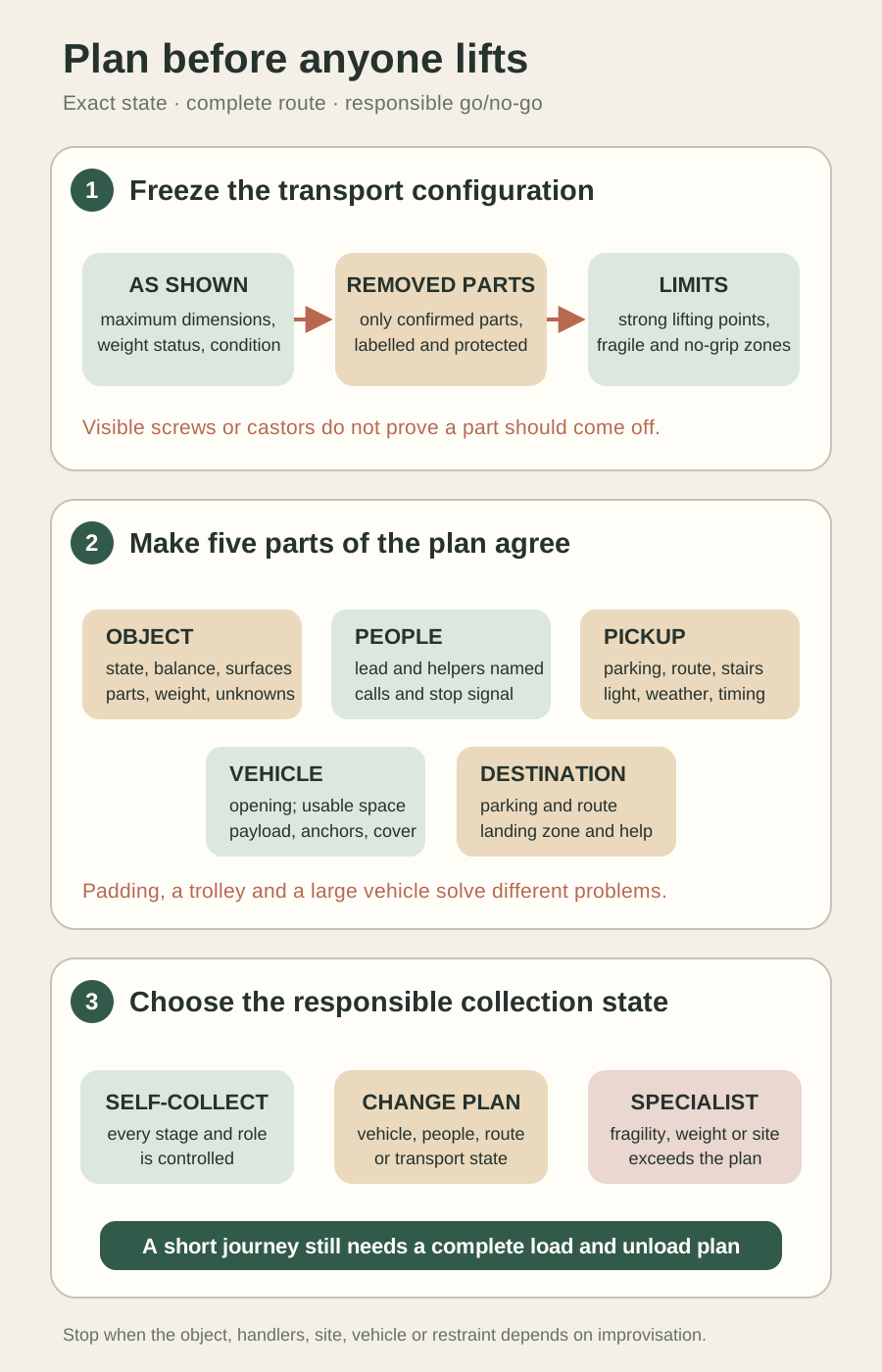
Use a five-part go or no-go
- ObjectIts exact state, dimensions, weight status, balance, loose parts, fragile materials, earlier repairs and strong handling areas are known.
- PeopleEnough capable handlers can complete every move without relying on a passer-by, seller promise or risky last-minute lift.
- SitesParking, permissions, surfaces, stairs, thresholds, weather exposure, lighting and a landing zone are controlled at both ends.
- VehiclePayload and axle limits, usable opening and load space, closure, weather protection, visibility and rated anchor points suit the plan.
- CustodyThe seller handoff, accepted condition, included parts, loading state and destination receipt will be recorded.
Use a specialist carrier
Do not make rarity or fragility the first practical lesson
Unknown or high weight, a loose or failed structure, stone or large glass, significant historic surface, complex dismantling, a piano-like load, crane/window access, difficult stairs, no rated restraint plan or any handling beyond the people present is a reason to obtain a competent furniture or fine-art mover.
Cost alone does not decide. A hired van with the wrong opening, a friend who can help only at pickup, or a trolley that cannot cross the final threshold can leave the highest-risk move until the end. Compare a complete self-collection cost and plan with a carrier who has seen the same evidence.
Freeze the exact transport configuration
| Field | Record | Do not assume |
|---|---|---|
| Envelope | Maximum width, depth and height including handles, overhangs, feet, protrusions and protective layers | A seller's neat front-view dimensions control the vehicle opening |
| Weight | Documented weight, credible professional estimate or explicitly unknown; note heavy tops, doors and uneven balance | Two people can lift it because two people delivered it once |
| Removed parts | Only parts designed and agreed to detach, who removes them, hardware labels and protected storage | Visible screws, clips or modern equivalents are permission to dismantle |
| Moving parts | Doors, drawers, leaves, shelves, sliders and mechanisms in their safe transport state | Tape across a finish or a locked key will safely restrain them |
| Handling map | Strong base, rails or frame areas; weak joints, arms, backs, handles, veneer, glass, stone and repaired zones | The easiest place to grip is a structural lifting point |
Use the furniture and delivery-route Guide to prove the object can pass every opening and turn. Add the protection, supports, hands and loading angle here; those can make the transport envelope larger than the bare piece.
One exact state
Do not mix assembled and dismantled measurements
A cabinet may fit the van only without its top, yet the top may require vertical transport and its own support. List every travelling component, its protected envelope and its location in the vehicle rather than subtracting a part from one overall number.
Walk pickup and destination as one route
Brief both ends in travel order
- Vehicle positionConfirm legal parking, vehicle height/length access, loading distance, slope, traffic, gates and the time window.
- Ground and weatherCheck rain, wind, ice, gravel, mud, kerbs, ramps and where the object can pause without touching damp or abrasive ground.
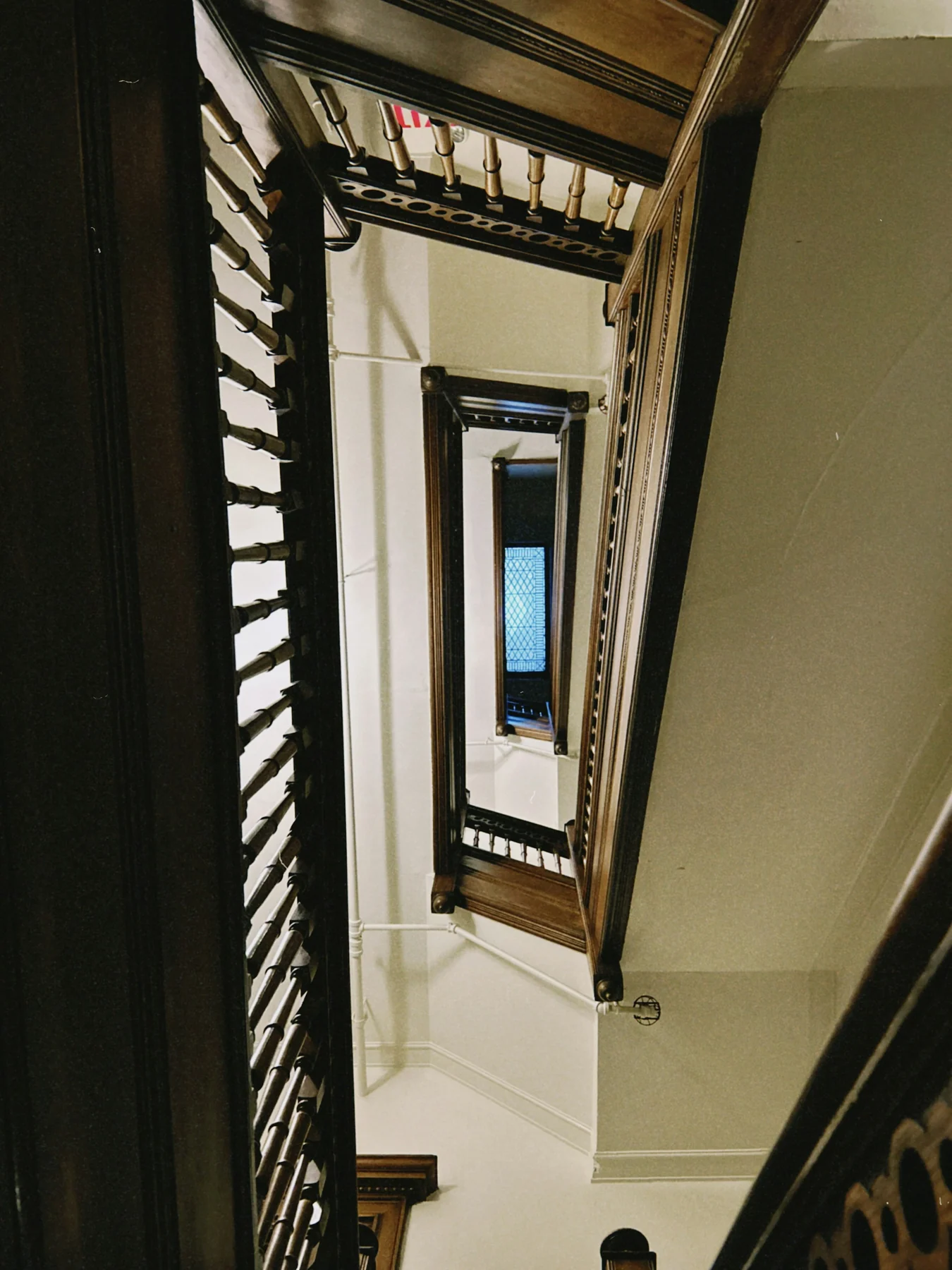
- Internal routeWalk every doorway, turn, stair, landing, lift and threshold in the exact sequence, with doors held and obstructions removed.
- People and rolesName the movement lead, each handler, door/route spotter and driver; agree simple calls and an immediate stop signal.
- Rest and landing pointsChoose stable protected places where the object can be set down without blocking an exit or balancing on a vulnerable edge.
- Destination readinessThe unload help, inspection area, route protection and final or temporary position are ready before departure.
Route boundary
The seller is not an unplanned handler
Ask whether the seller will only release the item, help bring it to ground level or participate in loading, and record the answer. Do not arrive assuming a shop employee, private seller, neighbour or building staff member can lift.
If either site cannot be reviewed directly, request a continuous route video with a tape at the narrowest openings and photographs of stairs, turns, surface changes and vehicle position. Keep unshown stages unknown rather than letting the easiest room stand in for the whole route.
Choose the vehicle for the protected load
| Vehicle question | Evidence to obtain | Stop condition |
|---|---|---|
| Will it enter? | Usable door width/height, sill, wheel arch, roof/door taper and loading approach | The protected piece fits only diagonally through an unproved turn |
| Will it sit responsibly? | Usable load length/width/height, bulkhead or barrier, floor, support points and planned orientation | It must balance on a handle, arm, loose top, projecting leg or unprotected edge |
| Can the vehicle carry it? | Vehicle payload and axle limits plus people, equipment, packaging and every other item | Weight is unknown or the plan relies on advertised cargo volume alone |
| Can it be restrained? | Rated vehicle anchor points, compatible rated restraints, edge protection and a movement-prevention plan | There is nowhere suitable to anchor or the furniture itself must become the anchor |
| Can it travel enclosed? | Doors or cover close without forcing; load does not obstruct driver view, lights, plate or safe operation | An open or projecting load has no reviewed weather, restraint and legal plan |
Measure a hired vehicle's exact usable interior and ask for its payload, anchor-point and loading instructions; a model class or stock photograph is not the vehicle at collection. Include blankets, boards, supports, ramp or trolley and handlers when testing the opening and working space.
Vehicle choice
Bigger is not automatically safer
A large empty space can allow more movement and may place usable anchors far from the object. Choose the vehicle and restraint arrangement together, with sufficient access to install and recheck the load without climbing onto unstable furniture.
Prepare people and equipment for specific jobs
UK Health and Safety Executive manual-handling guidance uses a hierarchy: avoid hazardous handling where reasonably practicable, assess unavoidable handling and reduce the risk. For a private buyer, the useful principle is to change the object state, route, equipment, people or carrier before asking a body to compensate for a poor plan. It is not a personalised lifting instruction.[2]
| Job | Possible equipment | It does not prove |
|---|---|---|
| Surface protection | Clean moving blankets, acid-free tissue where suitable, corner/edge protectors and non-marking wraps | That the protected surface can bear weight or strap pressure |
| Support and spacing | Stable clean pads, blocking or platform selected for the strong base and vehicle | That a weak foot, top or projection becomes load-bearing |
| Movement aid | Suitable trolley, dolly, skid, ramp or lift-gate with known capacity and a compatible route | That transitions, stairs and final placement are solved |
| Parts control | Labelled bags, lidded boxes and separate wrapping for approved loose parts and hardware | That dismantling is safe, intended or reversible |
| Vehicle restraint | Compatible rated straps and anchor points with edge protection and manufacturer instructions | That padding, rope or friction alone prevents movement |
Personal stop
Capacity is not a test performed under the furniture
Do not begin a lift to discover whether a person, trolley, ramp, lift-gate or vehicle can manage it. When individual health, mobility, balance or load concerns are material, change the task or use trained handlers and appropriate equipment.
Support the structure without using vulnerable parts
The Canadian Conservation Institute recommends checking for damage or loose joints before moving furniture, lifting rather than dragging, removing suitable loose elements and handling from strong structural areas—for example, a chair by the seat rather than its back or arms. Apply that conservatively to the exact construction and condition; it is not a load rating.[1]
| Furniture | Prefer a documented strong path | Protect from use as a handle |
|---|---|---|
| Chair or sofa | Sound base, seat frame or rails accepted for handling | Back, arms, upholstery, loose cushions, springs and projecting legs |
| Table or desk | Sound apron/base or supported top as appropriate to exact construction | Overhang, leaf, drawer, stretcher, veneer edge and handle |
| Cabinet or chest | Sound base/plinth and case structure with moving parts secured appropriately | Top cornice, doors, drawers, keys, handles and unsupported feet |
| Stone, glass or removable top | Specialist-agreed orientation, support and separate component plan | Flat span, corner, drilled fitting or attached base used by assumption |
- Inspect and photograph every intended handling and support area before the move.
- Remove contents and only those shelves, drawers, cushions, leaves or fittings that are designed and agreed to come out safely.
- Label each component and its hardware so reassembly does not depend on memory or interchangeable-looking parts.
- Use one movement lead and short agreed calls; stop and set down at a planned support if balance, grip, route or structure changes.
- Never drag old feet or legs, twist the case to make a corner, lift by a decorative projection or let a door swing during movement.
Use the condition Guide to identify loose joints, earlier repairs and active problems before movement. Collection is not the moment to test whether a doubtful joint holds.
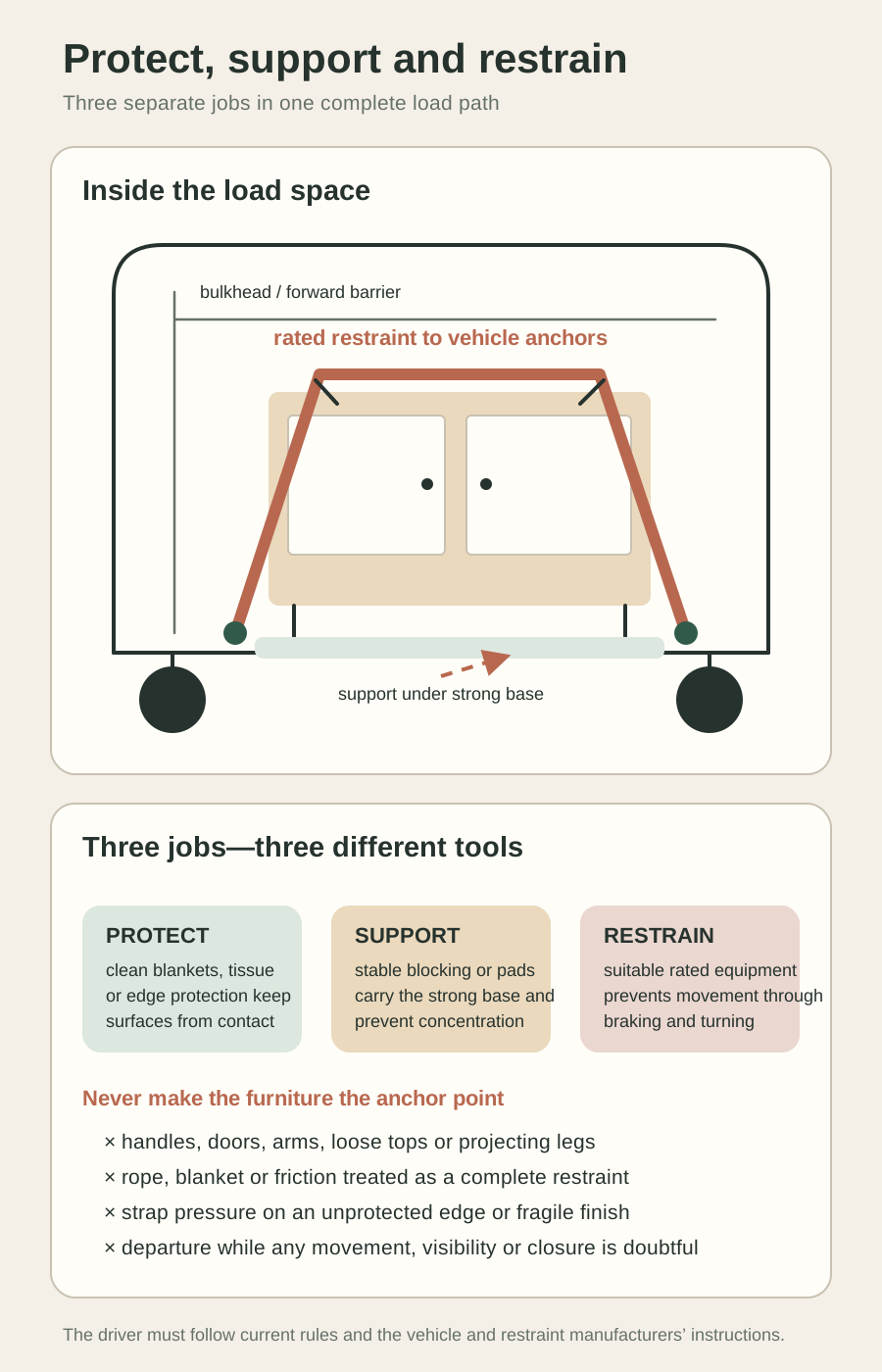
Protect, support and restrain the load
Driver and Vehicle Standards Agency guidance covers cars and small vans as well as goods vehicles and treats safe loading, restraint and unloading as one responsibility. It says loads must be secure, suitable restraints and anchor points must be used, and friction alone cannot be relied on. Follow the current rules for the journey plus the vehicle and equipment instructions; this Guide does not calculate a restraint system.[3]
Before the vehicle moves
- Stable orientationThe exact piece and every component rests on agreed strong areas without rocking, point loading or dependence on a loose part.
- Protected contactClean suitable material separates finishes from vehicle, equipment, other parts and restraint edges without trapping a new moisture risk.
- Movement preventedSuitable rated restraint reaches rated vehicle anchors in the planned geometry; doors, handles, arms, legs and furniture fasteners are not anchor points.
- People separatedThe load cannot move into occupants, and no handler remains in the load space for travel.
- Vehicle readyDoors or approved cover close, driver visibility and controls remain clear, limits are respected and loose equipment is also secured.
- Final photographRecord supports, protection, restraints, anchor points, components and closures before departure without treating the image as certification.
Do not depart
Any doubt about movement is a stop
If the piece shifts during a controlled pre-departure check, a restraint cannot be fitted as designed, an anchor or strap is damaged, a door will not close, the load affects visibility or the plan requires rope, a blanket or a person's hand to hold it, unload or rebuild the plan before travel.
Record the seller handoff and every component
One custody record
- IdentityMatch the exact piece, maker/model evidence where relevant, listing and agreed included parts before it leaves the seller.
- ConditionPhotograph all sides, vulnerable zones, disclosed damage and approved removed parts before handling; record any difference immediately.
- PartsCount, label and photograph drawers, shelves, leaves, cushions, keys, fittings and every hardware bag against one inventory.
- ResponsibilityRecord when the buyer takes custody, who loads, and what the seller has or has not agreed to do if condition differs.
- Loaded stateKeep the vehicle photograph with the route and equipment record so arrival can be compared with the actual transport state.
For an online purchase, use the online seller Guide to preserve payment, terms, deadlines and applicable platform protection. Self-collection does not erase the written transaction or return and damage process.
At handoff
A material difference is not a loading problem
If the furniture, included parts, dimensions, odour, moisture, pest concern or condition differs materially from the accepted record, pause the transaction or apply the agreed process. Do not load first merely because the van, helpers or seller are waiting.
Unload with the same discipline
- Park in the agreed destination position and make the full route, landing zone, light and people ready before opening the load space.
- Check whether anything moved, loosened, became damp or was damaged before releasing a restraint; photograph the complete loaded state.
- Release restraint in a sequence that leaves every component stable. Stop if an item leans, springs, rolls or depends on the door or strap for support.
- Move each labelled component through the planned route and place the main object on a stable protected landing area before reassembly.
- Compare all sides and vulnerable zones with the seller and loading photographs; record any change before cleaning, repair or use.
- Reassemble only through the documented method and responsible person. Recheck structure, level and moving parts before ordinary use.
If the piece needs a separate home-entry decision, follow the used-furniture home-entry Guide before it moves from the landing or inspection zone into an occupied room. Transport completion and household entry are two decisions.
After arrival
Do not erase the evidence to make the room look finished
Keep packaging, hardware, photographs and seller/carrier messages until identity, condition, completeness, reassembly and applicable claim or return deadlines are resolved. A quick polish or repair can make cause and timing harder to establish.
Send one self-collection brief before booking the vehicle
Message to copy
Ask the seller to confirm the real pickup
Hello—I'm planning to collect this piece myself. Could you confirm the exact included object and parts; maximum dimensions and known weight in the transport state; which parts are designed to detach and who will remove them; current loose joints, repairs, fragile surfaces, glass/stone, moving parts and strong or prohibited handling areas; the route from its position to the vehicle, including stairs, thresholds, turns, parking distance and weather exposure; and whether your role ends at release, ground-level handoff or agreed help loading? Please send current whole and vulnerable-area photographs and tell me about any change before collection. I will confirm the people, equipment, protected vehicle envelope, support and rated restraint plan before booking. Thank you.
Send the seller the arrival window, vehicle position, responsible buyer and what happens if the item differs from the record. Keep the final plan short enough that every person can read their part before lifting. A checklist nobody at the pickup has seen is not a controlled collection.
Self-collect when the whole chain is ordinary, visible and controlled. Change the plan when one input can be improved. Use a specialist carrier when the object, people, route, vehicle or restraint exceeds the evidence and competence available.