Define the use and exact glass component
State what the table must do: low coffee table in a busy route, dining table, bedside surface, display table, desk or occasional stand. Record who uses the room, what normally sits on the top and whether edges, corners or an unsupported projection enter circulation. The consequence of an unknown pane is different in a quiet display corner and an everyday family route.
MoMA records its exact Eileen Gray Adjustable Table as chrome-plated tubular steel, sheet steel and glass, designed in 1927 with this example made in 1976. That record shows why design date, object date and material belong to one identified piece. It does not establish the glass type, specification or present state of a later table that shares the outline.[1]
Write the component brief
- Exact topOne pane or several, shape, maximum dimensions, thickness, edge profile, holes, cut-outs and markings.
- Relationship to the baseLoose, captured, bonded, clipped, bolted, resting on pads or not yet confirmed.
- Claim historyOriginal, replacement, tempered, laminated, safety glass or unknown—with the source of each term.
- Intended useTable type, room, users, ordinary objects and any daily edge or impact exposure.
- Decision boundaryWhether replacement glass, specialist assessment, surface wear or a stricter room position is acceptable.
Purchase boundary
Transparent does not mean self-explanatory
The top, support and base must be recorded as one exact assembly. Do not transfer a material, safety or capacity claim from another table of the same design, and do not treat a replacement pane as equivalent until its own evidence is understood.
Build a complete pane and assembly record
Ask for a full overhead or elevated view against a visually simple floor, then front, rear, both sides and floor-level views showing the complete base. Transparent glass can disappear against a busy room; use a contrasting sheet or board beyond the edge only as a background, never wedged beneath an installed top. Keep one stable pane identifier in every close-up.
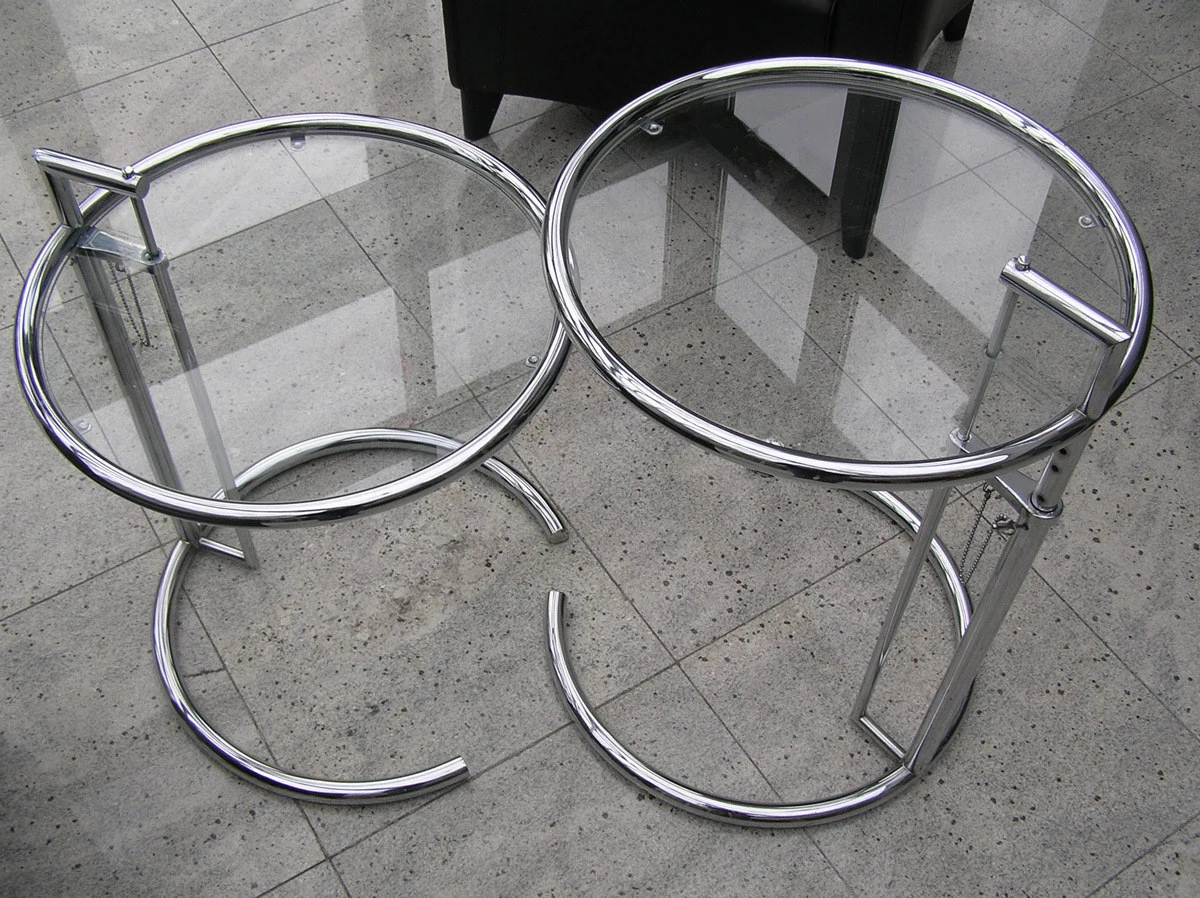
The public-domain photograph of two later E-1027 tables makes their circular panes, small contact points, offset uprights and open bases readable in one frame. It is useful orientation, not a test: the image cannot reveal glass treatment, edge condition, fastening, stability or whether either pane is original to its base.[2]
| Record | Show | Question answered |
|---|---|---|
| Pane identity | Whole shape, identifier, every edge and its relationship to the exact base | Which physical pane do all measurements and claims describe? |
| Dimensions | Maximum width and depth or diameter, thickness at a safe visible edge, hole and cut-out positions | Does the pane fit the support and the intended room without projection surprises? |
| Condition | Diffuse and raking surface views plus every corner, edge, hole, notch and repair | Where is each observation and does it meet a support or stressed feature? |
| Support | Every pad, clip, frame, fastener, boss or contact area with the top undisturbed | How is load transferred from pane to base as presently assembled? |
| Mark or document | Complete marking in context and the record that connects it to this exact pane | What supports a material or safety-glass claim? |
Use the photograph-request Guide for whole, relationship and detail views. Do not ask the seller to remove, flip or balance a large pane merely to complete the underside record.
Inspect the surface, edges and cut-outs without stress testing
The Canadian Conservation Institute describes glass as hard and brittle: surface flaws concentrate applied stress, and cracks tend to spread because glass lacks internal boundaries that would arrest them. For a buyer, that makes location and assembly context essential; it does not supply a universal acceptable chip size or a remaining-strength calculation.[3]
| Observation | Ask next | Do not conclude |
|---|---|---|
| Fine surface scratch | Length, location, raking views from both directions and whether it reaches an edge, hole or support | Depth, glass treatment or harmlessness from one highlight |
| Edge or corner chip | Whole edge, both faces, nearest support or cut-out and professional assessment when consequential | Remaining strength from a coin, ruler or fingertip comparison |
| Line that may be a crack | Continuous views, changing reflections, both faces where safe and immediate handling pause | That it is a scratch, seam or stable historic damage without examination |
| Hole, notch or drilled fixing | All edges of the feature, fastener, sleeve, washer or pad and signs of local contact | That visible hardware is correctly specified or evenly loaded |
| Clouding, film or residue | Whether it sits on the accessible surface, between layers or near a bonded contact, plus cleaning history | Composition or a safe cleaning method from appearance |
| Old repair or bonded addition | Full boundary, material if documented, movement and how it meets supports and handling points | Capacity, permanence or reversibility from neatness |
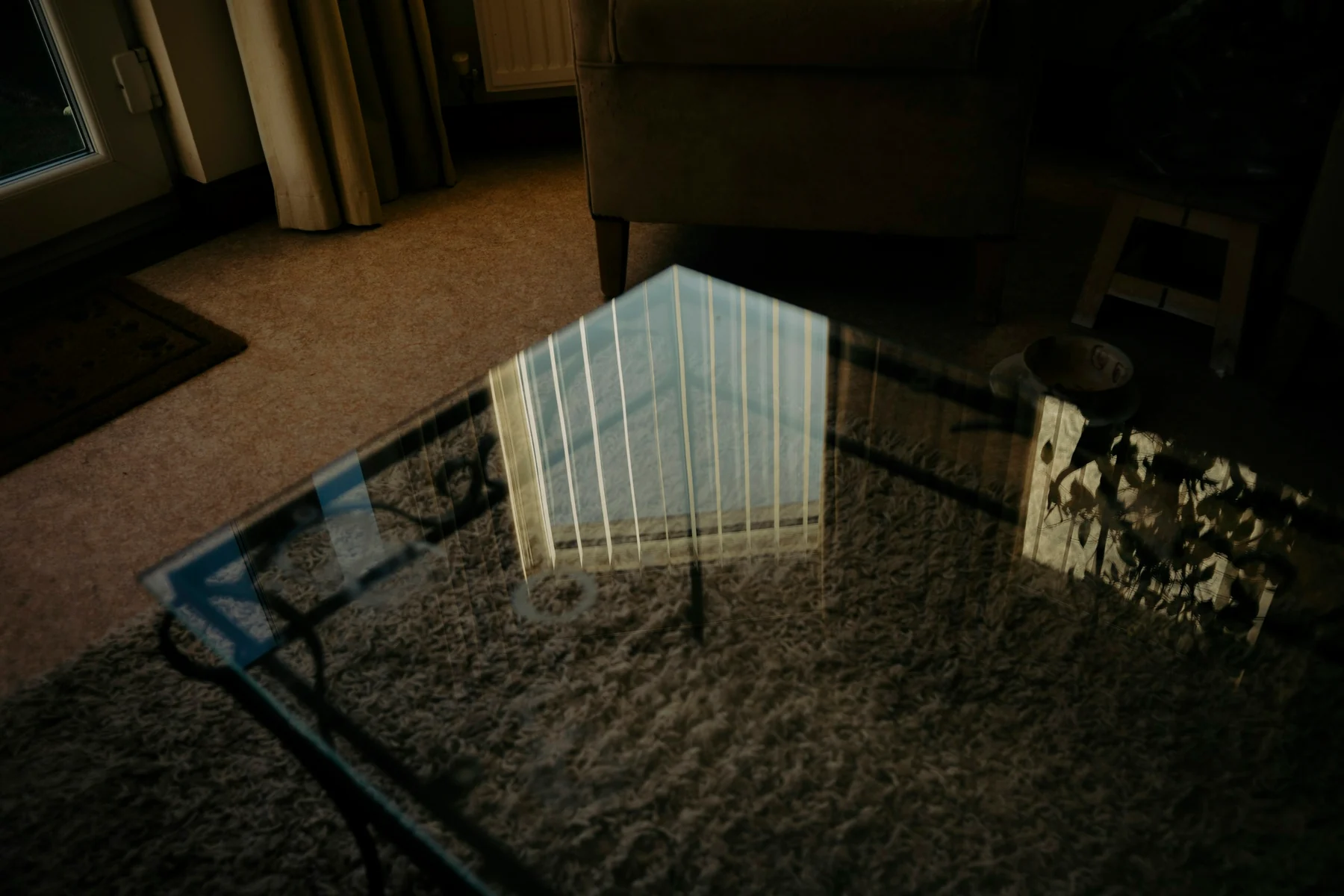
Glass boundary
Do not turn observation into impact or flex testing
Do not tap, ring, press, flex, twist, edge-load, scratch, heat or lift the pane to decide what it is or whether a mark matters. Stop at a possible crack, moving top, damaged support or seller concern and give the exact evidence to an appropriate professional.
Keep tempered and safety-glass claims evidenced
The U.S. Consumer Product Safety Commission explains that tempered glass is designed to break into smaller fragments rather than large shards and points to a voluntary standard for glass used as horizontal surfaces in desks and tables. This is safety context, not a visual identification method and not a retroactive certificate for every vintage table.[4]
The current ASTM F2813-18(2023) abstract covers unenclosed horizontal glass surfaces under 44 inches in desks and tables and specifies laminated or tempered safety glass meeting referenced performance criteria, with bounded exceptions. Its scope shows why compliance is a specification-and-performance claim. A seller photograph, familiar brand or unverified etched word does not reproduce that evidence.[5]
| Evidence state | What it can support | What remains |
|---|---|---|
| Exact maker or fabricator document tied to this pane | The stated material, dimensions, treatment and referenced test or standard within the document's scope | Present damage, correct installation and continued fitness |
| Permanent marking photographed in full context | A traceable clue to investigate with maker or specialist records | Whether the mark belongs to this complete specification or proves current compliance |
| Seller report or earlier invoice | Who described the glass and what was believed at that time | Independent confirmation and present condition |
| Appearance, thickness, edge colour, sound or phone-screen effect | A visible or experiential observation only | Tempering, lamination, standard conformity and safe use |
| No connected evidence | An honest unknown for price, use and professional handoff | All consequential safety-glass claims |
Standards and legal duties vary by place, product age, supply context and exact use. Ask the seller or responsible professional which requirement is being claimed and what proves it for this pane. This Guide does not determine regulatory compliance.
Follow the pane through every support and into the base
Place the table on the seller's ordinary level floor without adding a wedge. View every contact point at the same height and compare pads, clips, sleeves, bosses, holes and support rails. Follow each support into its joint, leg or pedestal and then to every floor contact. A perfect pane cannot make a loose base coherent, and a sound base cannot erase edge damage or an ill-fitting replacement top.
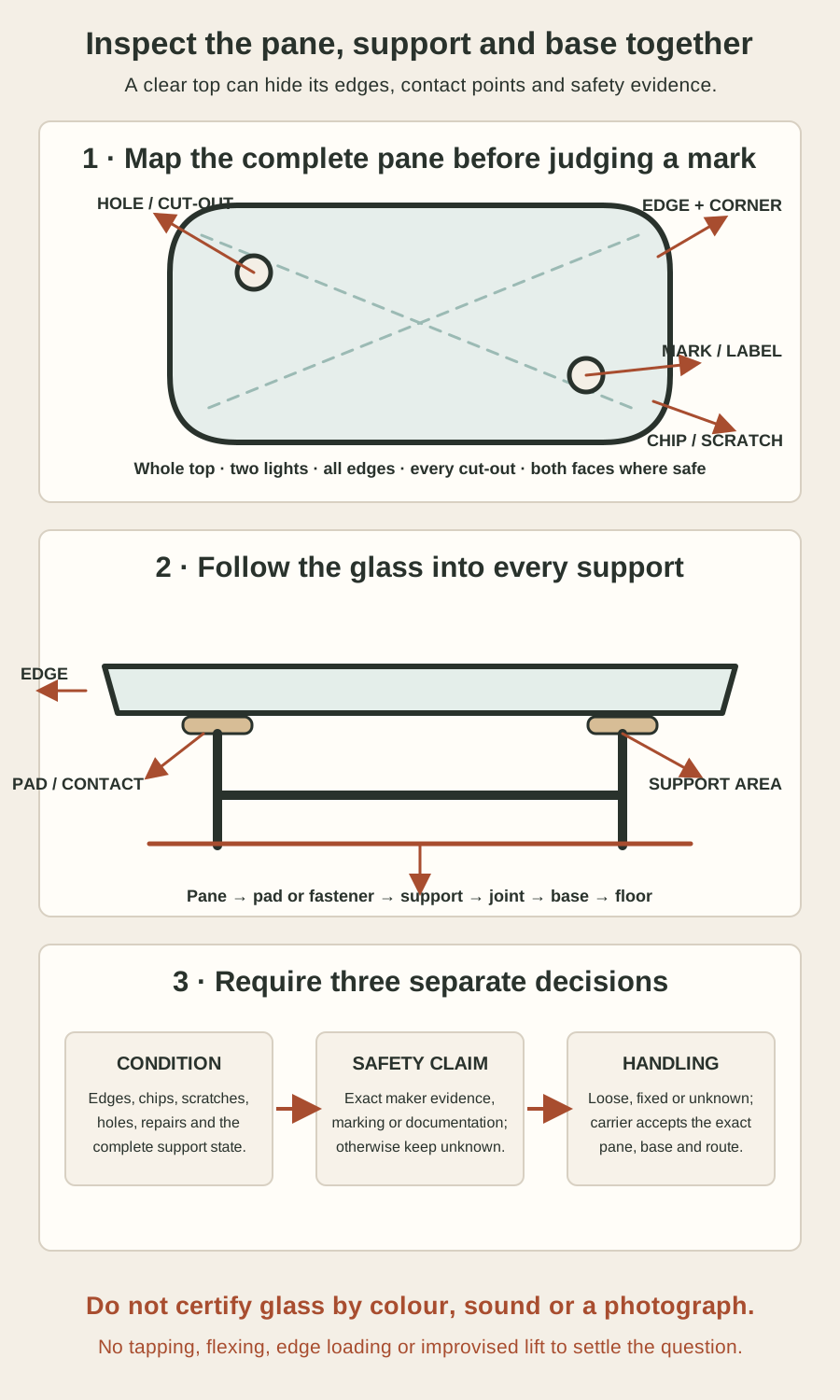
Trace the present load path
- Pads and separatorsCount every contact, compare thickness and position, and record hard contact, movement or missing material without substituting a new pad.
- Frames and support areasShow the complete bearing relationship, unsupported projections and any point support from multiple directions.
- Holes and fastenersKeep sleeves, washers, caps, clips and local glass edges visible; do not tighten or loosen them for inspection.
- Base jointsRecord movement, cracks, corrosion, repairs, added hardware and whether the base stands consistently on the real floor.
- Top movementUse only the seller's report of ordinary behaviour; do not push or rock the pane to discover a limit.
Treat replacement glass as a new specification
Replacement glass is not automatically a defect. It may make a table usable while the original was lost or damaged. The important point is that the later pane has its own date, fabricator, material claim, geometry, edge work, holes, support relationship and condition. A copied diameter and approximate thickness are not a complete specification.
| Feature | Record | Decision |
|---|---|---|
| Outline and overhang | Maximum dimensions, centre or datum points and projection beyond every support | Room fit, edge exposure and whether the top is centred as designed or merely placed |
| Thickness and edge profile | Safe visible measurement, polished, bevelled or other documented edge and all local variation | Whether the pane matches its support and specialist brief—without inferring capacity |
| Holes and cut-outs | Positions from fixed datums, diameters or shapes, sleeves and clearances | Whether fasteners contact or constrain the glass as intended |
| Support pattern | Every contact area and whether the pane sits consistently without added pressure | Whether the complete assembly needs a glass or furniture specialist before use |
| Documented specification | Fabricator, date, material, treatment and any referenced standard or drawing | What is actually known about the replacement rather than assumed from the design name |
Use the table-measurement Guide for overall room, chairs and circulation. Keep pane geometry, edge exposure and support evidence in this separate glass record.
Plan placement and ordinary use without experimenting on the top
CCI advises avoiding impact and rapid temperature change because glass can crack or break. A complete table adds its own support, use and room variables, so apply the principle conservatively: remove preventable collision and heat risks while leaving exact limits and repair decisions to the relevant professional.[3]
Review the occupied room
- Edges and cornersMap walking lines, seating, knees, bags, vacuuming and doors against the complete top projection.
- Heat and temperature changeRecord radiators, fireplaces, direct sun, hot equipment and ordinary serving use without conducting a heat test.
- Objects on the topList what is ordinarily placed, moved or dropped and leave load capacity unresolved unless responsibly specified.
- Floor and baseUse the actual floor, rug and transitions; do not correct movement with an improvised wedge during the inspection.
- Cleaning accessEnsure normal cleaning does not require lifting the pane, striking the edge or leaning on an unsupported area.
Do not test capacity by sitting, standing, leaning, stacking weight or pressing an overhang. If the intended use depends on a known load, obtain the exact manufacturer, fabricator or engineering evidence appropriate to the complete assembly.
Agree the handling state before collection
Canadian Conservation Institute handling guidance asks handlers to inspect condition, old repairs and attachments before movement, support weight from sound areas and plan enough people and suitable equipment. For a glass table, that establishes a professional planning boundary; it does not identify a safe handhold or travel orientation from a generic diagram.[6]
| Handling state | Carrier confirms | Buyer records |
|---|---|---|
| Top designed and accepted as loose | Separate pane and base plans, supported orientation, edge protection, people, equipment and temporary storage | Who separates it, where custody changes and how parts remain identified |
| Top fixed or captured | Support and packaging for the complete assembly without using the pane as a handle | Maximum protected dimensions, condition and agreed route |
| Handling state unknown | Inspection or responsible specialist decision before any lifting or release attempt | The unanswered attachment question and stop condition |
| Damage or support concern | Whether glass or furniture assessment must precede movement | Named handoff instead of an improvised collection-day decision |
Send the carrier actual dimensions, reported weight, every condition view and the complete routes, then use the delivery-route Guide for protected envelopes, turns, stairs, lifts and temporary resting space. Do not lift one corner to see whether the top comes off.
Send one complete glass-table request
Message to copy
Ask for the exact pane, support and handling state
Hello—I'm considering this glass [coffee/dining/side/other] table for [intended use]. Could you identify every glass pane and state the basis for any claim that it is original, replacement, tempered, laminated or safety glass? Please show the complete top from above, below where safely visible, in diffuse light and gentle raking light; all edges, corners, holes, cut-outs, markings, chips, scratches, possible cracks and repairs in context; and every pad, clip, sleeve, fastener, support, base joint and floor contact without moving the top. Please provide maximum top dimensions, thickness at a safely visible edge, overall table dimensions, reported weight and any maker, fabricator, replacement or repair document. Is the top known to be loose, fixed or unknown, and has a specialist carrier accepted that exact state and the collection route? Please do not tap, flex, scratch, heat, edge-load, tighten, loosen or lift the glass for the inspection. Thank you.
Buy when the exact pane and base are coherently recorded, present condition and room exposure suit the intended use, important material or safety claims have evidence appropriate to your decision, and a responsible carrier accepts the handling state. Pause when a possible crack, edge damage, unsupported area, moving top, replacement specification or safety-glass claim changes use or cost. Decline when safe use depends on a photograph proving what only documentation, testing or professional examination can establish.