
Learn the sale format and rules before inspecting
‘Flea market’, ‘antiques fair’ and ‘estate sale’ describe settings, not one transaction contract. The person at the table may be the owner, a dealer, an estate-sale operator, an auctioneer or an agent. Prices may be fixed, negotiable or bid-based. The venue may limit photography, handling, payment, returns, holds, collection times and who can move or load furniture. Ask at entry or before a detailed inspection so urgency does not rewrite the rules later.
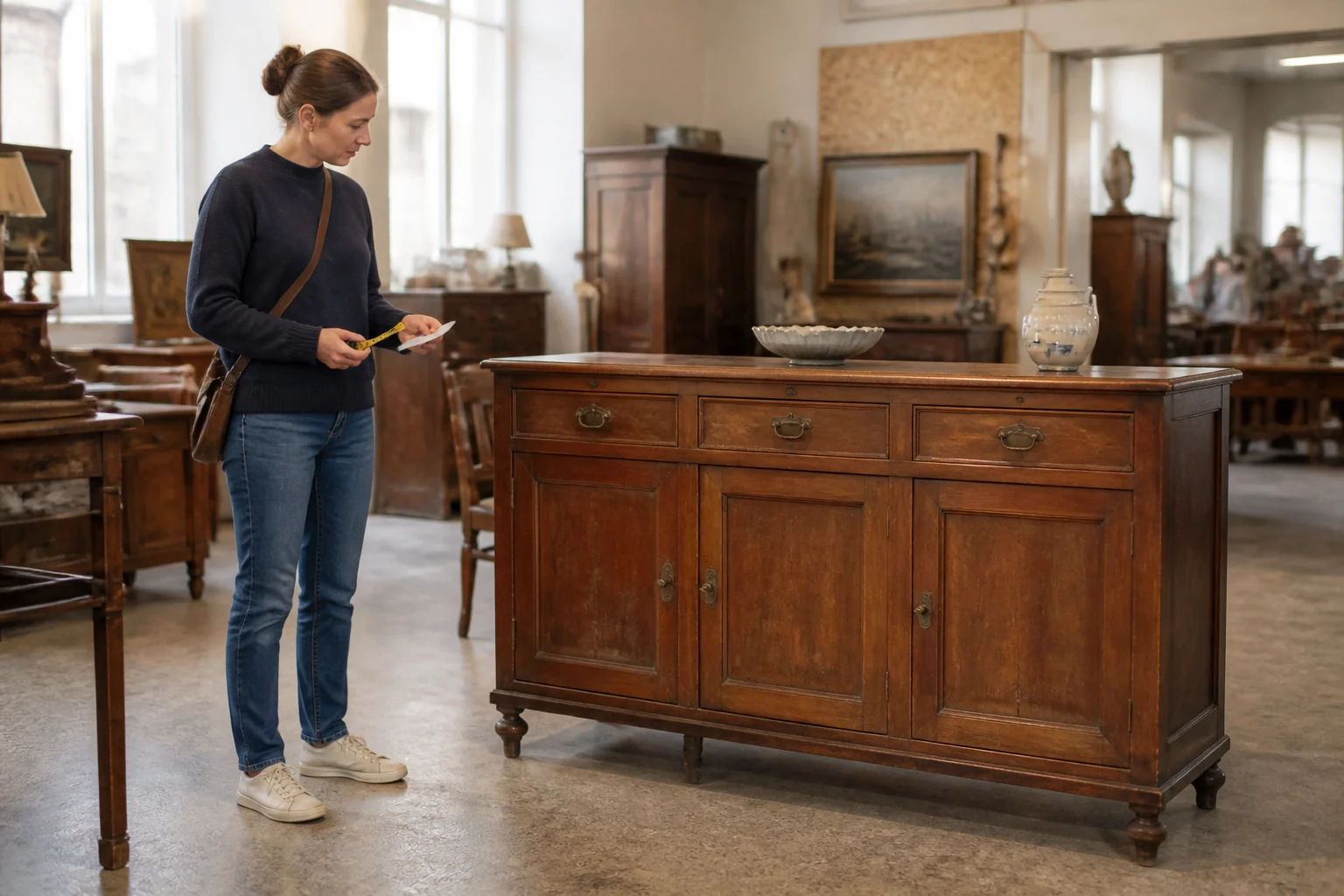
Your Europe distinguishes purchases from a trader and a private individual and explains that EU consumer protections do not apply in the same way to both. It also notes that shops are not generally required under EU rules to accept a return merely because the buyer changed their mind, although a seller may offer its own policy. Use this as a reason to identify the actual seller and obtain the current terms—not as legal advice for another sale or jurisdiction.[2]
| Sale field | Ask | Do not infer |
|---|---|---|
| Seller and operator | Who owns or offers the furniture, who takes payment and whose receipt or terms apply? | That the venue, house contents and person answering are one legal party |
| Price method | Is the ticket fixed, are offers accepted, or is there a bid process and deadline? | That bargaining is expected because the setting feels informal |
| Fees and payment | Are tax, buyer fee or card charge additional, and which payment recipient is authorised? | That the visible number is the final paid total |
| Returns and claims | What written policy applies to this seller, object and sale method? | A universal change-of-mind, condition or misdescription remedy |
| Hold and collection | When is it sold, how is a hold created, when must it leave and who may release it? | That payment includes storage, loading or an open-ended collection window |
| Handling and images | What may be opened, measured, photographed, moved or tested, and by whom? | That public display authorises physical manipulation |
Identify the exact object and every included part
Begin with the complete furniture and its tag before a beautiful handle or label takes over the decision. Match the item number, description and price to the object in front of you. Ask whether a pair, dining set, stacked module or styled group is sold together or separately. Photograph or write an inventory only with permission, and keep detachable parts tied to the same object.
Freeze the sale unit
- Item identityRecord the lot, booth or tag number and a plain description that distinguishes this piece from nearby furniture.
- QuantityState one, pair, set or group and identify any mismatch, substitute or separately priced element.
- Loose componentsCount keys, shelves, shelf supports, leaves, extension rails, cushions, glass, brackets, cables, shades and fittings.
- Current locationNote room, floor, booth or warehouse position and whether another component is stored elsewhere.
- Seller statementsKeep maker, date, material, condition, repair and provenance claims in the exact qualified language used.
- StatusConfirm available, reserved, sold or subject to bidding rather than relying on a moved or handwritten tag.
Set boundary
A styled group is not an included inventory
Lamps, ceramics, cushions, keys, shelves and adjacent chairs may be display context. Name every included component in the offer and receipt.
Make a whole-object first pass
Stand back and decide whether the complete form, scale and present state still justify a closer look. Observe stance, level, symmetry, missing elements, colour variation, obvious movement, open cracks, stains, tide lines, active-looking dust or debris, strong odour and repairs visible across the whole piece. Then move around all accessible sides. A ninety-second orientation can prevent ten minutes of examining a label on furniture that cannot fit, function or travel responsibly.

Move whole → zone → detail
- Whole formView front, both sides, rear, top and base where accessible; note lean, twist, sag, mismatched height and missing parts.
- Load pathLocate feet, legs, rails, joints, supports, seat or top attachment and any visible break or loose connection without loading it.
- Operating envelopeAllow space for doors, drawers, leaves, recline, rotation or extension before asking permission to operate anything.
- Surfaces and edgesMap wear, lifting, loss, repairs, coatings, stains and vulnerable corners in relation to normal handling and use.
- Underside and backObserve only what is already safely visible or what authorised staff can expose without turning or dismantling the object.
- Decision changersWrite the few unknowns that could alter use, price, safety, professional work or collection before inspecting smaller detail.
Use the condition Guide for a complete observed, seller-reported, inferred, professionally assessed and unknown record. At a crowded sale, prioritise facts that can change the decision rather than trying to complete every specialist inspection in public.
Ask permission and stop at observation
The UK Office for Product Safety and Standards advises buyers of second-hand products to examine condition, wear, modifications, missing safety features or instructions and applicable recall information before purchase. For furniture, that supports a deliberate evidence check; it does not authorise a buyer to stress an uncertain structure, energise an electrical object or diagnose a hidden hazard.[1]
| Need to know | Responsible request | Stop boundary |
|---|---|---|
| Dimensions | May I measure the maximum width, depth and height and the open state? | Do not pull furniture away, climb, tip or remove a fixed component |
| Drawer or door operation | May I operate this once normally, or could authorised staff demonstrate it? | Stop at resistance; do not force, lubricate or adjust |
| Chair or table stability | May staff explain known movement and provide a level unloaded view? | Do not sit, rock, bounce, lean, twist or apply a test load |
| Loose cushion or shelf | Is this removable, included and safe for staff to lift? | Do not expose interiors, fasteners or underside by dismantling |
| Electrical component | Is there a current professional inspection or test record for the exact item? | Do not plug in, open, rewire or treat illumination as safety evidence |
| Material or hazardous substance | Is there documented identification, testing or professional assessment? | Do not scratch, sand, swab, smell closely or take a sample |
Inspection boundary
Limited access remains limited evidence
Record that the rear, underside, interior, joint, wiring or material was not inspected. A seller's refusal, a crowded room or an immovable object may be understandable; it still cannot become a positive condition fact.
Before bringing upholstered or stored furniture home, use the separate home-entry Guide. Odour, pests, mould, lead, electrical condition and structural capacity each have specialist boundaries that a quick market inspection cannot remove.
Calculate the total commitment before offering
The ticket price is only one line. Write the amount payable today, every additional fee or tax stated by the operator, immediate stabilisation or professional work, cleaning within a known material boundary, missing components, storage, and the complete collection route. Confirm whether the furniture can leave now, must leave later or must wait for an authorised release. A bargain that cannot fit through the route or travel safely is not yet a complete purchase.
| Cost or obligation | Confirm now | If unresolved |
|---|---|---|
| Sale total | Item price, currency, fee, tax, payment method and required timing | Ask for one written total or keep a conservative ceiling |
| Immediate work | Known cleaning, stabilisation, electrical, upholstery, conservation or repair scope | Do not insert the cheapest imagined fix |
| Object and home fit | Maximum object and route dimensions, operating space and intended use | Measure before paying or decline the fit risk |
| People and handling | Who is authorised and competent to move, lift, dismantle if appropriate and release it | Do not recruit an improvised lift after payment |
| Vehicle or carrier | Accepted packing, support, restraint, weather, custody, quote and timing | Use self-collection or professional-delivery planning before purchase |
| Hold and storage | Written deadline, location, access, charge, risk and consequence of delay | Treat an informal promise as unresolved |
Check object and route geometry with the home-measurement Guide. If you will control the move, prepare the self-collection plan; otherwise define a professional delivery brief before the purchase depends on one route.
Make one clear offer without inventing a ritual
Ask whether offers are accepted and who can approve one. If the answer is yes, name the exact item, included parts, one clear amount and any condition that genuinely belongs to the offer, such as payment now and collection by the stated deadline. A respectful offer needs no universal percentage, invented defect, bundle threat or story about what another buyer might do. The seller can accept, counter or decline; you can continue or leave.
| State | Useful wording | Avoid |
|---|---|---|
| Fixed price | ‘I understand the price is fixed; may I confirm the final total and included parts?’ | Repeated offers after the rule is clear |
| Offers accepted | ‘Would you accept [amount] for item [identifier] with [listed parts]?’ | A percentage formula unrelated to this object or sale |
| Condition uncertainty | ‘This joint was not available to inspect, so my decision is [amount / pause / decline].’ | Declaring a hidden diagnosis to manufacture leverage |
| Multiple pieces | List each item, individual or combined amount and included component | Assuming display neighbours or accessories join a bundle |
| Counteroffer | Recalculate the same total commitment and state yes or no | Letting momentum erase the collection or work budget |
Price boundary
A lower price does not close an evidence gap
A discount may compensate for an unknown you knowingly accept; it cannot prove a joint safe, a label authentic, a substance harmless, a part included or a collection route workable.
Record the sale before leaving the object
Once an amount is accepted, slow down. Match the receipt or written confirmation to the exact object and components. Record the seller or operator, amount, payment state, any fee or tax, stated condition or claim that formed part of the agreement, return terms if any, and the current physical status. A payment confirmation does not by itself tell the next staff member that a sideboard is sold, where its shelves are or who may collect it.
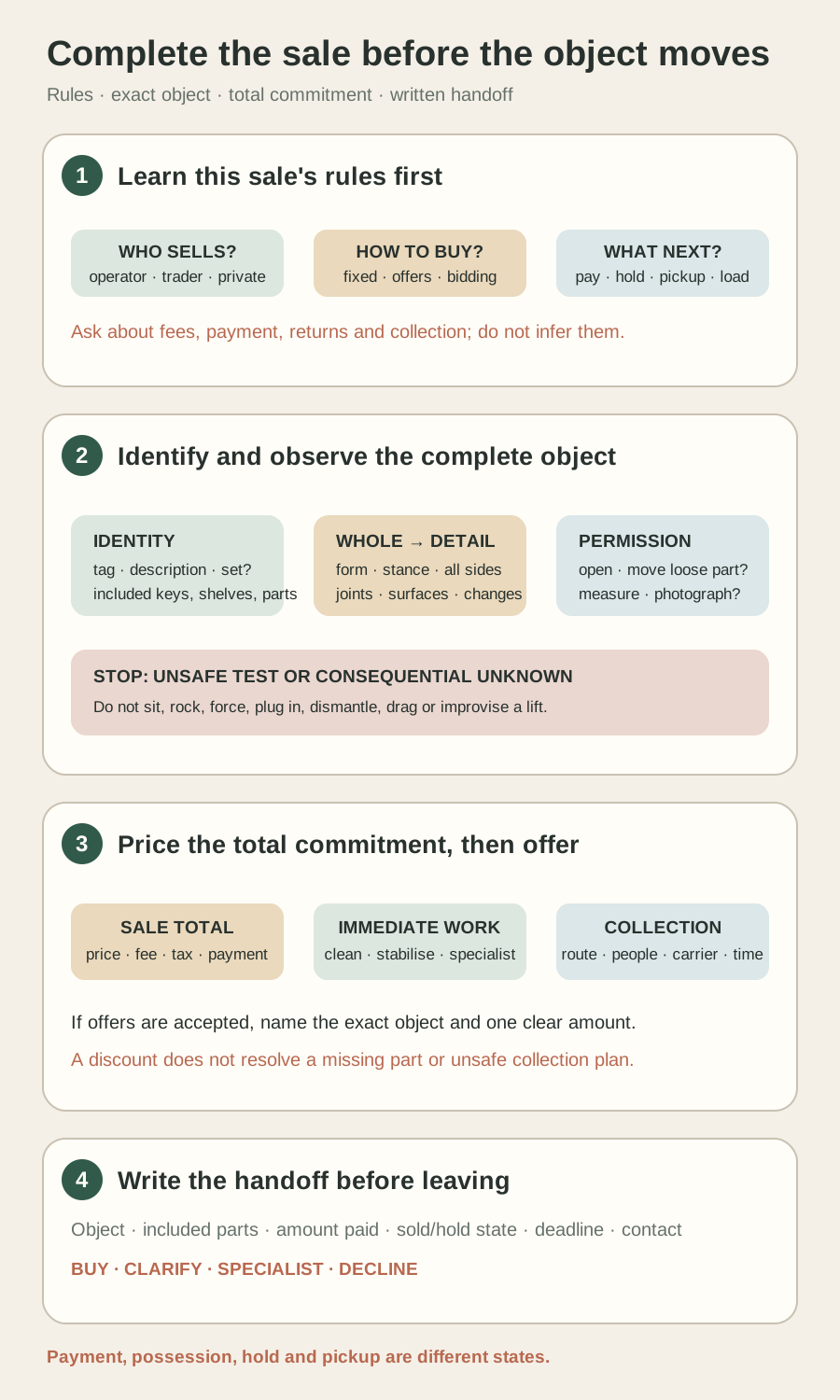
Put the handoff in writing
- Object and componentsUse the tag or lot identifier plus a plain description, quantity and complete loose-part inventory.
- Amount and paymentRecord price, fee, tax, total, currency, method, recipient and paid, deposit or balance state.
- Sold or hold statusState whether the furniture is sold, conditionally held or still available and how staff will mark it.
- Location and deadlineRecord where every part will remain, earliest access, final pickup time and any storage consequence.
- Release authorityName who may collect, which receipt or identification is required and who can authorise a change.
- Contacts and termsKeep the operator's current telephone or email, collection contact and the written sale and return terms.
Keep custody clear until collection
The Canadian Conservation Institute's furniture-care guidance recommends checking for loose joints or damage before moving, lifting furniture from sound structural areas rather than dragging it and treating loose or removable parts deliberately. These preventive-care principles support a planned handoff. They do not specify a consumer load test, prove that a particular object is sound or replace the method accepted by a competent carrier or handler.[3]
| State | Record | Owner of the next step |
|---|---|---|
| At purchase | Whole object, included parts, visible condition, location and sale status | Seller or operator preserves the agreed object until release |
| Before movement | New damage or missing part, route, authorised handler and accepted method | The responsible mover or carrier defines handling within their competence |
| At release | Collector identity, date/time, complete parts and custody acknowledgement | Seller/operator and collector complete the handoff |
| At loading | Condition change, packing, orientation and responsibility for the move | The party controlling transport owns the accepted plan |
| At arrival | Object, parts, packaging and any change before cleaning, repair or disposal | Buyer follows the relevant seller or carrier notice route promptly |
Collection boundary
Do not let a deadline create an unsafe move
If the object, route, people, equipment, weather, packing or release authority no longer matches the accepted plan, stop and contact the seller or operator. Renegotiate the handoff or use a competent carrier; do not drag, tip, overload or abandon the record.
Make the in-person decision while the evidence is honest
Checklist to copy
Resolve the object, sale and collection
Sale: Who is the seller or operator; are prices fixed, offered or bid; what fees, payment, returns, holds and handling rules apply? Object: What exact item or set is offered; which keys, shelves, leaves, cushions, brackets, glass and other parts are included; which designer, maker, date, material, condition and repair statements are claimed? Inspection: What did I observe whole-to-detail with permission, what could not be inspected and which professional question remains? Commitment: What is the final paid total, immediate work, home fit and collection cost? Handoff: What is paid, sold or held; where will every part remain; who may release and collect it; and by what exact deadline?
| Decision | Appropriate when | Record |
|---|---|---|
| Buy | Sale rules, exact object, evidence, total commitment and collection handoff are acceptable | Receipt, inventory, accepted unknowns, sold status and pickup plan |
| Clarify | One included part, rule, measurement, condition fact, price field or deadline could change the decision | One exact question and the authorised written answer |
| Specialist before purchase | Structure, electrics, hazardous material, infestation, attribution or repair scope is consequential | Named remit, access, evidence, limit and written conclusion |
| Decline | Pressure, unsafe access, missing evidence, unsuitable fit or an unworkable handoff exceeds your boundary | The unresolved fact and consequence without arguing or diagnosing |
The advantage of buying in person is not that every uncertainty disappears. It is that you can connect the complete object, the person offering it, your own observations, the exact amount and the physical handoff before they drift into separate memories. Leave with one coherent record—or leave without the furniture.