Begin with the space between
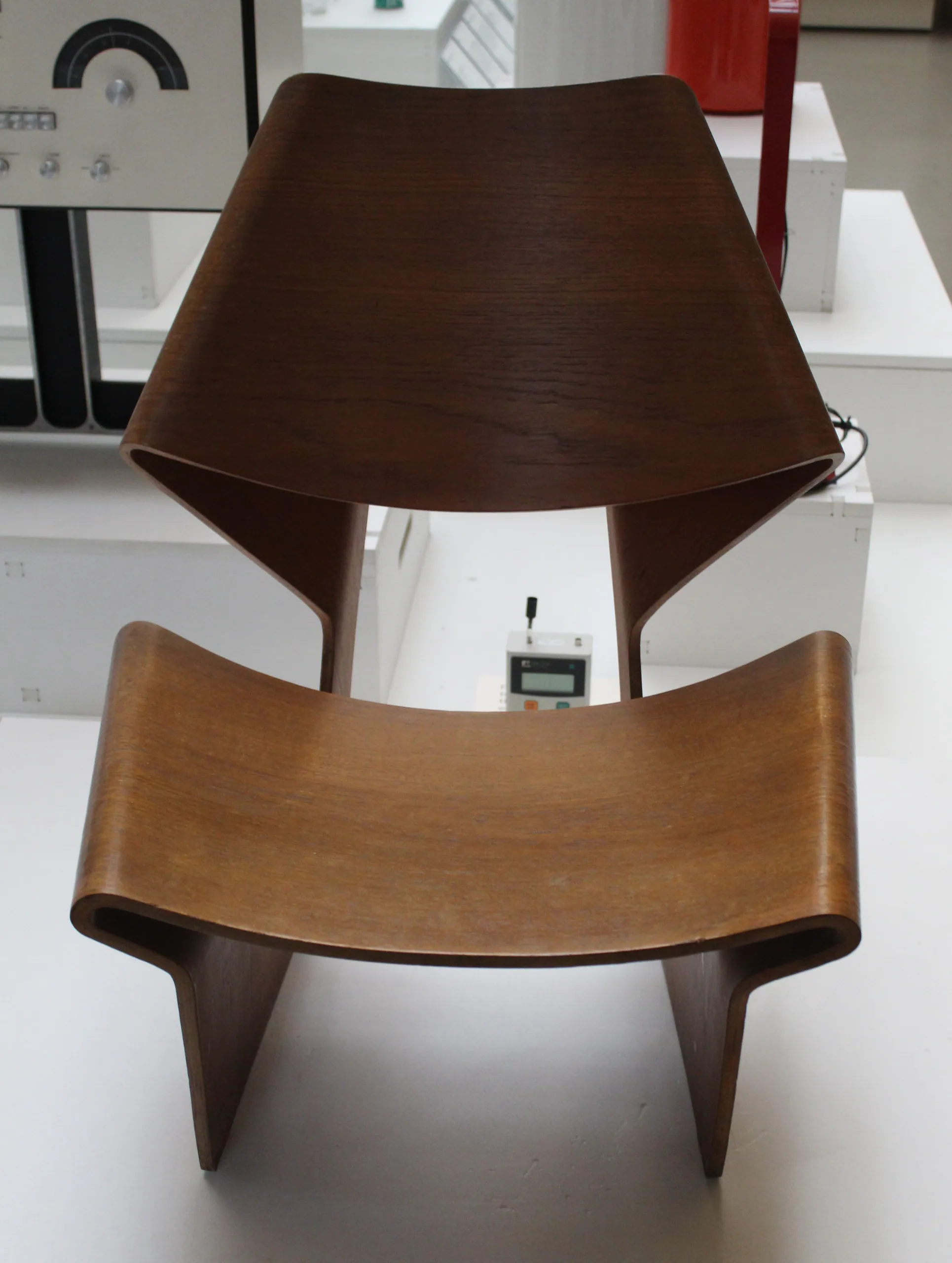
The most revealing part of the GJ Chair is the part that is not there. A band of air separates the back from the seat. Nothing attempts to fill it, upholster it or hide it behind a decorative rail. Yet the eye is tempted to complete a single loop.
Designmuseum Danmark describes that trick with unusual precision. The bow curves in one dimension, while two composite parts make the chair appear stretched to its limit. Its construction plays on the idea of a chair made in one piece even though it is not.1
That distinction matters. Calling the GJ a one-piece chair makes the object sound more miraculous, but less interesting. Jalk's achievement is not the elimination of the joint. It is persuading two plainly separate shells to share one visual tension.
Plywood has a direction
Moulded plywood encourages loose language. It can produce a broad curve, so it is easy to imagine the material behaving like cloth, clay or a ribbon drawn in the air. The GJ Chair is more disciplined than that image suggests.
Each shell remains a recognisable sheet. Across its width it cups the body; along its edge it turns down and narrows. The museum's observation that the bow bends in one dimension helps explain the clarity. Jalk does not ask one sheet to swell in every direction. She repeats a controlled family of curves, then places upper and lower shells so that their edges answer one another.
The front view makes the result legible. The upper shell is broad where it receives the back, then contracts as its sides descend. The lower shell opens into a seat and turns down towards the floor. Furniture still needs a back, a seat and supports; Jalk changes where one duty appears to end and the next begins.
Two parts can draw one line
Imagine tracing the chair without naming its components. The line runs across the top of the back, turns down one side, jumps the bright interval, catches the rolled edge of the seat and continues towards the floor. The jump should break the drawing. Because the two curves are so closely related, it instead makes the eye more alert to their connection.
This is why the opening is not merely an economical omission. It gives the chair a moment of suspense. A solid panel between seat and back would explain too much; a conventional frame would turn the shells back into separate seat and backrest inserts. The narrow absence lets each part remain independent while the silhouette proposes continuity.
Look, too, at the different tones in the museum photograph. Light strikes the seat more directly than the back, so the two pieces do not even need to match perfectly in colour to hold together. Form carries the relationship.
Simplicity was expensive in effort
MoMA catalogues its chair as two folded pieces of teak plywood made by Poul Jeppesen. The museum also supplies the useful corrective to any fantasy of an effortless ribbon: the lamination process was so complex that only about 300 were produced in the 1960s. It records a 2009 reissue separately. 2
The number matters less as a rarity slogan than as design evidence. A form can look visually inevitable and remain stubborn to reproduce. The chair pares away the visible vocabulary of conventional joinery, but the difficulty has not vanished; it has migrated into the control of layers, pressure, curves and the meeting of the two shells.
MoMA also notes that Jalk trained as a cabinetmaker before studying furniture at Copenhagen's Royal Academy of Fine Arts with Kaare Klint. That background does not reduce the GJ to either handicraft or industrial experiment. It helps explain why the chair can be radical in outline while remaining intensely concerned with how material becomes structure.
The museum labels do not describe one universal chair
The design has several familiar names: GJ Chair, Bow Chair and Shell Chair. Its catalogued materials are similarly easy to flatten into a single standard description, but the records resist that shortcut.
MoMA lists teak plywood for its object. MFAH dates its Shell Chair as designed in 1963 and made in 1963–64, but records Oregon pine and plywood. It also documents the P. Jeppesen manufacturer mark and Danish Furniture Control mark on that exact chair.3 The Commons record for the photographed V&A object W.26-2016 describes teak-faced moulded plywood with steel fittings.4
Those are not three competing universal specifications. They are three object records. Together they establish a stable design identity and documented Jeppesen manufacture while warning against using one museum's material field to complete the missing history of another chair.
The same restraint applies to marks. A documented mark on MFAH's chair is useful evidence about that object. It is not permission to declare that every genuine example must present an identical, equally legible mark in the same condition.
The bow is an action, not an ornament
The nickname can make the chair sound as though Jalk began with a pleasing bow shape and found somewhere to sit inside it. Read in the opposite direction, the design becomes stronger. Two surfaces have to receive a body and carry it to the floor. Their curves solve those duties, and the repeated motion produces the bow.
That is why the GJ remains rewarding after its silhouette is familiar. Its most memorable image is also a compact account of its construction:
- two shells remain visibly two;
- their edges follow the same visual grammar;
- the gap makes the relationship active;
- and manufacturing difficulty sits behind apparent ease.
For a useful contrast, look at the Ant Chair. Arne Jacobsen joins seat and back in one pinched plywood shell and makes the shared room lighter. Jalk uses two shells and makes the interval between them feel charged. The comparison is not a claim of direct influence. It is a way to see how differently a designer can spend the possibilities — and accept the limits — of moulded plywood.