The design begins with something missing
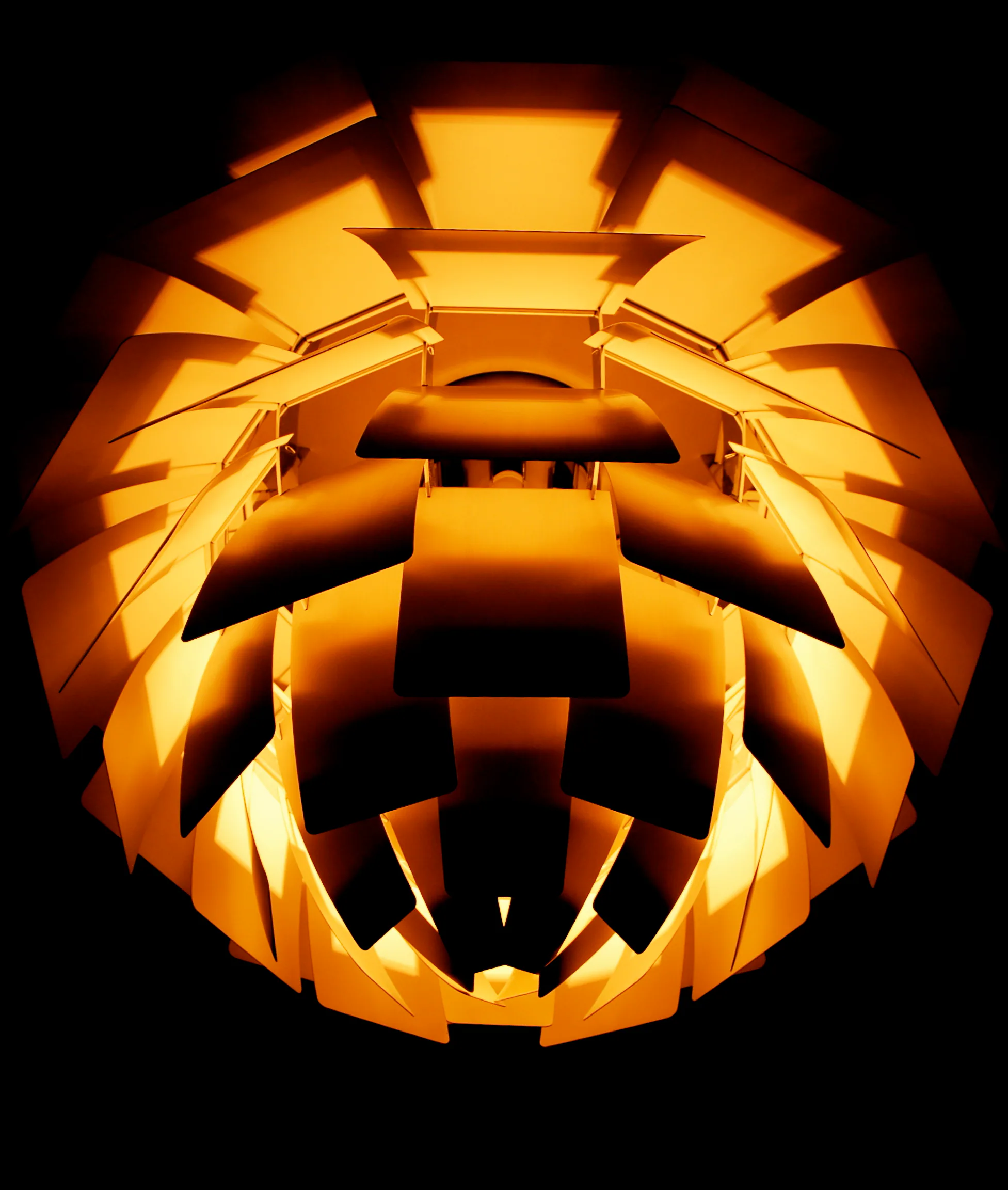
Look into the switched-on PH Artichoke from below. There is plenty of light, but no naked bright point at its centre. The bulb is present physically and absent visually. That disappearance is the lamp's real subject.
Designmuseum Danmark describes 72 leaves in 12 rows, positioned to give glare-free light regardless of viewing angle.1 Louis Poulsen makes the count more exact: each row contains six metal leaves, and the light is distributed both inwards and outwards. 4
The Artichoke therefore is not one shade pierced with decorative openings. It is a system of small shields. Each leaf removes some direct lines of sight to the source while leaving routes for reflected light. Seventy-two partial answers add up to one remarkably complete effect.
A glare problem is a geometry problem
Glare is not simply 'too much light'. A useful lamp may need a strong source, but the eye should not meet that concentrated brightness unmediated. Change the route between source, surface and viewer, and the same lamp can illuminate a room without advertising the bulb at its centre.
That concern occupied Henningsen long before the Artichoke. Designmuseum Danmark traces his systematic pursuit of softer, glare-free electric light to the mid-1920s. Its account describes tiered shades used to deflect rays and direct light where it was needed.2
The Artichoke turns the principle into a three-dimensional viewing problem. A table lamp can control the most likely relation between a seated eye and a source. A pendant in a public room will be approached from many directions. The leaves wrap the shielding logic around a core, so moving sideways reveals another overlap rather than the bulb.
Seventy-two leaves make one volume
From a distance, the lamp reads as a continuous, roughly spherical object. From below, the construction becomes countable. Six leaves establish a radial rhythm; the next row is staggered and extended; successive layers turn that rhythm into depth.
Overlap does two jobs at once. Optically, it closes direct sightlines. Visually, it prevents the object from becoming a heavy metal globe. Dark slots remain between leaves, bright undersides float in front of them and the silhouette keeps changing as the viewer moves.
This is a useful distinction between repetition and sameness. The leaves belong to a strict system, but their position relative to the bulb changes how each one appears. In the photograph, one surface is almost black, the next is an orange edge and another is a broad luminous plane. The object acquires variety without abandoning order.
Three months rested on three decades
Louis Poulsen's history says Henningsen completed the 1958 Langelinie Pavilion commission in three months. The speed sounds heroic until the same account supplies its missing context: he based the lamp on the PH Septima idea he had developed around 1927–31, with clear and sandblasted areas controlling light across a sequence of glass shades.4
The Artichoke was not a sudden botanical doodle enlarged for a restaurant. It was a rapid answer made possible by a much longer investigation. The material and arrangement changed — metal leaves gathered around a central frame rather than Septima's glass sequence — but the underlying question remained: how can a shade redirect a bright source before it reaches the eye?
That history also explains why the lamp can be both spectacular and practical. Its silhouette gives the pavilion a centre. Its internal logic prevents that centre from punishing everyone who looks towards it.
Was it 1957 or 1958?
The chronology is not perfectly uniform. Designmuseum Danmark labels the Artichoke as a 1957 design for the Langelinie Pavilion. MoMA catalogues its PH Artichoke Lamp as 1958, and Louis Poulsen also places the commission in 1958. 3 The disagreement is only one year, but hiding it would create false precision.
There may be a design, commission or completion distinction behind the two dates, but the reviewed records do not resolve it explicitly. The responsible summary is therefore plain: the design belongs to the 1957–58 pavilion project; 1958 is the date used by MoMA and the current manufacturer, while the Danish museum uses 1957.
That uncertainty does not weaken the account of how the lamp works. It does set a useful limit on what the sources allow us to say.
One design is not one universal specification
MoMA's exact object is copper and steel, made by Louis Poulsen & Co., and measures 72.1 by 84.5 centimetres.3 Those fields are valuable because they are attached to museum object 294.1999. They should not be silently converted into the dimensions, finish or date of every lamp that shares the design.
The same boundary applies in the opposite direction. Louis Poulsen's current catalogue explains the design history and offers present-day configurations. It is evidence of a continuing production relationship, not a time machine that fills gaps in an undocumented vintage object.
Pedro Ribeiro Simões photographed the copper lamp shown here in Lisbon in
- Wikimedia Commons records the image under CC BY 2.0.
5 The upward angle is exceptionally good at explaining the overlap, but it is not a photograph of the original Langelinie Pavilion installation.
Nature supplies the nickname; geometry supplies the light
In English the object is an Artichoke. Designmuseum also gives its Danish name, Koglen — the pinecone. Both names help the clustered silhouette lodge in memory, but neither explains the performance by itself.
The more revealing reading is procedural:
- repeat six leaves around a core;
- stagger the next row so its gaps are covered;
- continue until every ordinary line of sight meets metal before it meets the source;
- let reflected light reveal the leaves that conceal it.
The result looks organic because repetition, growth and overlap are familiar in plants. It works because those relationships have been made exact.
For another famous 1950s object whose nickname can distract from its action, read the Egg Chair. The Egg uses one enclosing shell to edit views across a lobby. The Artichoke uses many separate shields to edit views towards a bulb. In both, the memorable outline is only the beginning of the design.