A canteen problem came before the silhouette
The Ant began with a mundane operation: people needed to move chairs so a shared floor could be used and cleaned. That practical beginning matters because it explains why the design feels reduced without feeling meagre.
Arne Jacobsen Design records that Jacobsen and Fritz Hansen launched the chair in October 1952 and first used it in the new canteen at Novo Terapeutisk Laboratorium in Frederiksberg. The brief supplied the order that made production possible for a small, lightweight chair with seat and back shaped from one sheet of plywood.1
Fritz Hansen's historical account makes the routine more specific. Jacobsen wanted a lightweight chair that could be stacked so the canteen floor could be washed.3 Stacking was therefore not a bonus feature added to an autonomous object. It connected furniture to a daily sequence: lunch ends, chairs lift, the floor clears and the room is made ready again.
That is the Ant's first economy. It spends less effort on occupying a room so the room can do more.
One surface has to perform two jobs
The Ant looks simple because its largest decision is easy to see. There is no separate timber back fixed above a separate seat. A single plywood shell bends up to support the back and out to receive the body.
Designmuseum Danmark describes model 3100 as the first industrially mass-produced wooden chair to combine seat and back in one piece. 2 The achievement was not merely cutting an arresting outline. The Jacobsen archive explains that the shell needed double curvature for strength, and that its familiar narrow waist occurs where the curvature is most pronounced.1
The pinch is therefore not an insect reference drawn onto an ordinary chair. It is the visible consequence of asking one thin surface to change direction and responsibility. Above it, the shell spreads to meet the back. Below it, the surface fans out into the seat. The place with the least material is also the place where the transition becomes most legible.
This is a useful correction to the usual idea of minimalism. Removing parts does not remove engineering demands. It concentrates them.
Three legs complete the argument
Jacobsen developed the Ant with three legs and defended the decision as both functional and aesthetic. The archive places it within his effort to rationalise form and material use; Designmuseum adds his view that three legs stand steadily on an uneven surface.1 2
Three points define one plane, whereas a fourth contact can expose an uneven floor by rocking. That geometry does not make every three-legged chair the best answer to every setting. Here it clarifies the larger design logic: if three supports can carry the chair, the fourth is not automatically entitled to remain.
The open base also changes the room visually. Thin steel tubes touch the floor without building a box beneath the sitter. Several chairs can repeat as a light rhythm rather than a thicket of rigid frames. Flexibility and apparent fragility become part of the expression, even though the chair was intended for hard everyday use.
A four-legged version followed and became more popular, but the archive notes that it did not become a standard product until after Jacobsen's death in 1971.1 Reading the original three-legged form keeps the 1952 proposition intact: enough structure, and no more.
Reading a silhouette without inventing a specimen
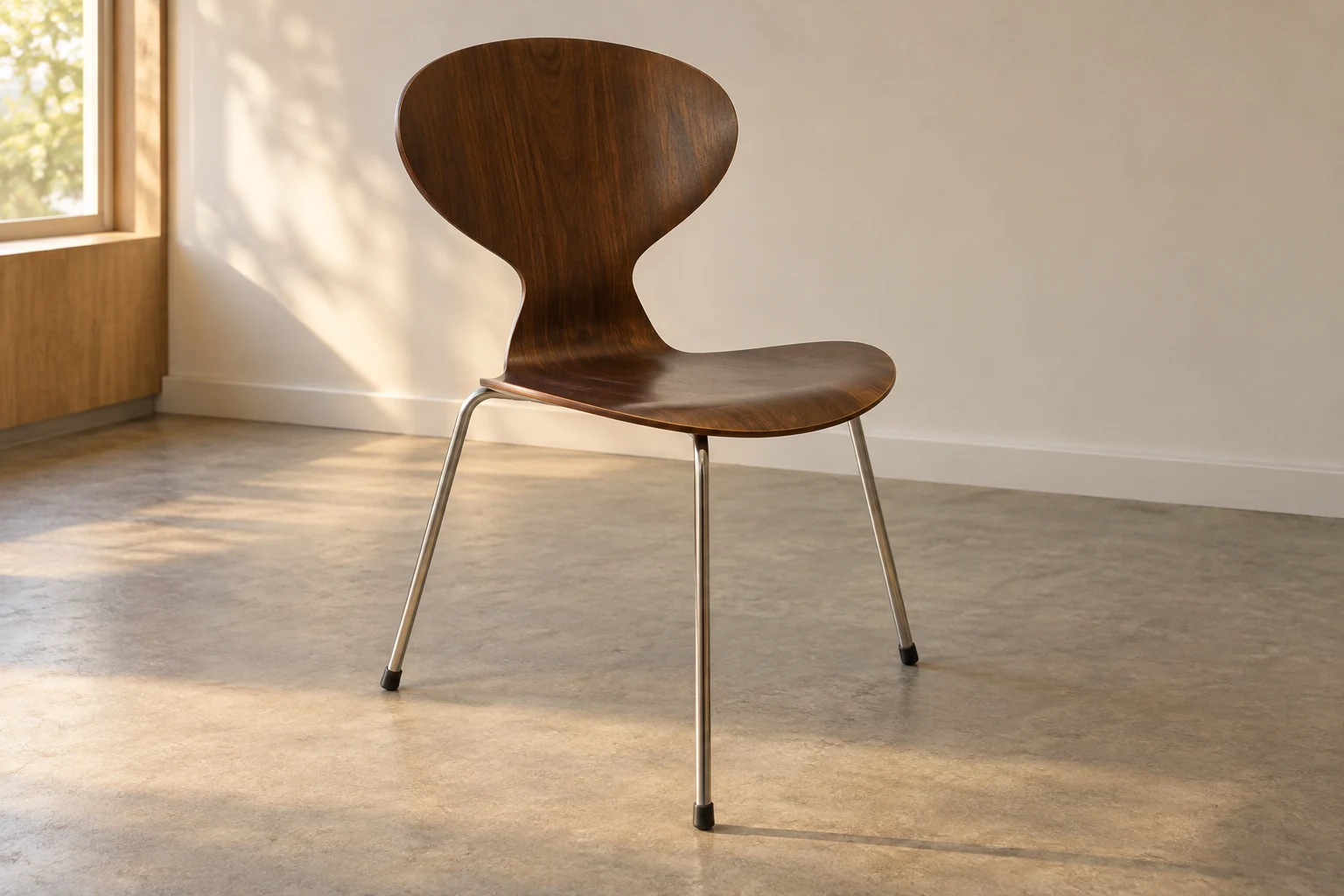
The editorial reconstruction illustrates the Ant’s broad back, rising seat and narrow waist from the reviewed design account. It is not a record of the 1952 canteen or a photographed museum object.
The dark shell reads as one shaped surface. The upper back bows, the seat edge rises and the narrow waist links their opposing curves. Three slender legs leave a large interval beneath the shell. These are interpretive visual relationships, rather than a measured mounting or construction record.
The source records supply the history; the illustration supplies orientation. It cannot date a chair, establish its finish or authenticate another example. Visual recognition remains separate from provenance.
Economy is a way of organising behaviour
The Ant's lasting lesson is not that every chair should have one shell or three legs. It is that a familiar object can be redrawn from the operations around it.
- What has to happen before and after somebody sits down?
- Which parts help that sequence, and which merely repeat convention?
- Can structure remain understandable after material has been removed?
- Does a group of chairs make the shared floor more adaptable or less?
Those questions move attention away from an isolated silhouette and towards a small system of bodies, furniture and maintenance. They also explain why the Ant belongs in the wider story of Danish Modern: industrial production, practical use and a precise visual character are not opposites here.
For Jacobsen's opposite answer to a public interior, continue to the Egg Chair. Six years later, instead of clearing space around the sitter, he wrapped space around them.