Begin with three tables, not one famous chair
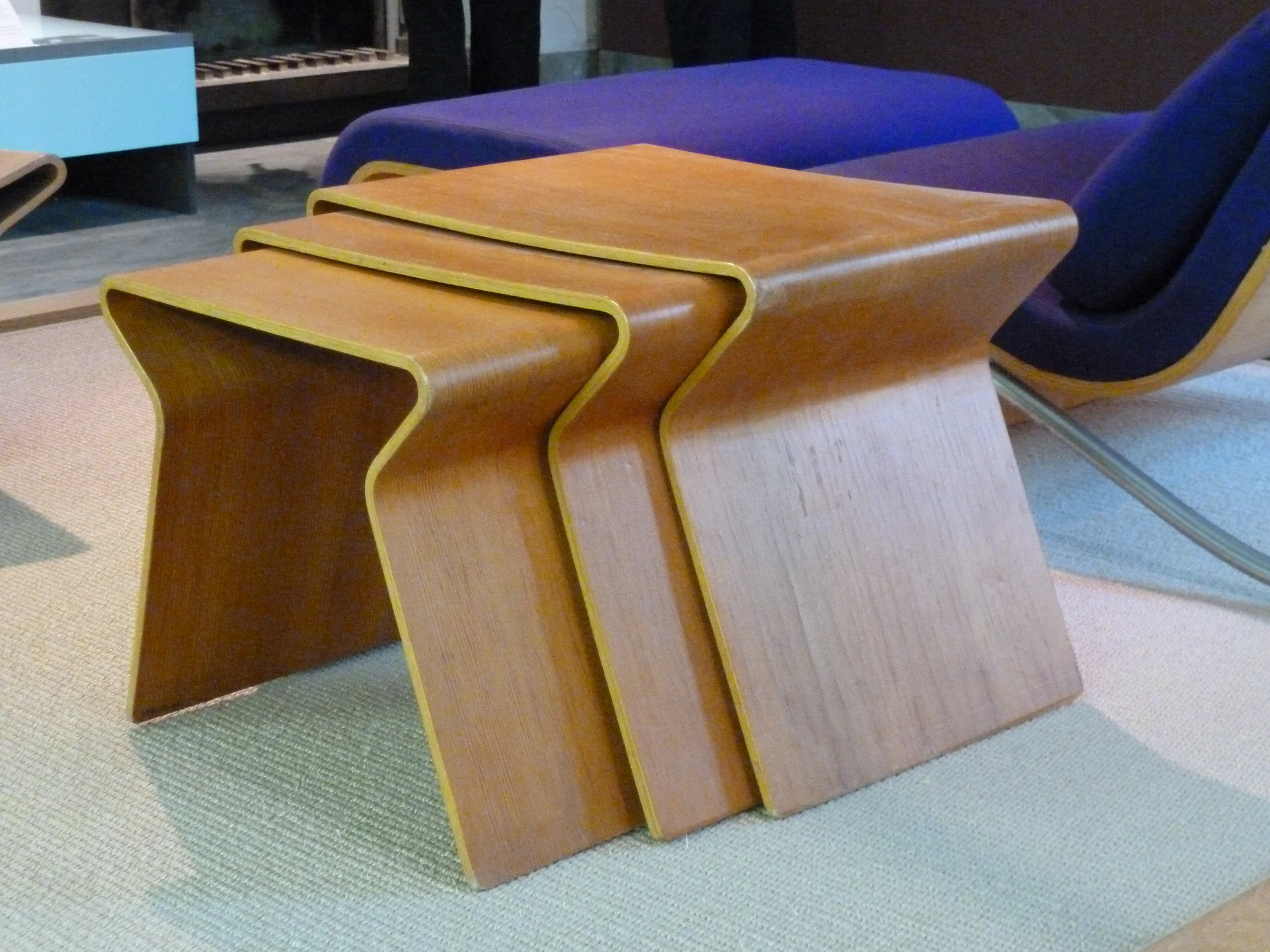
Three low tables stand together in Ramblersen's museum photograph. Each is a single broad surface that rolls down at both ends, but the sizes change. One slides beneath the next. Repetition turns a strong profile into a small, orderly system: tables when needed, a compact stack when not. 5
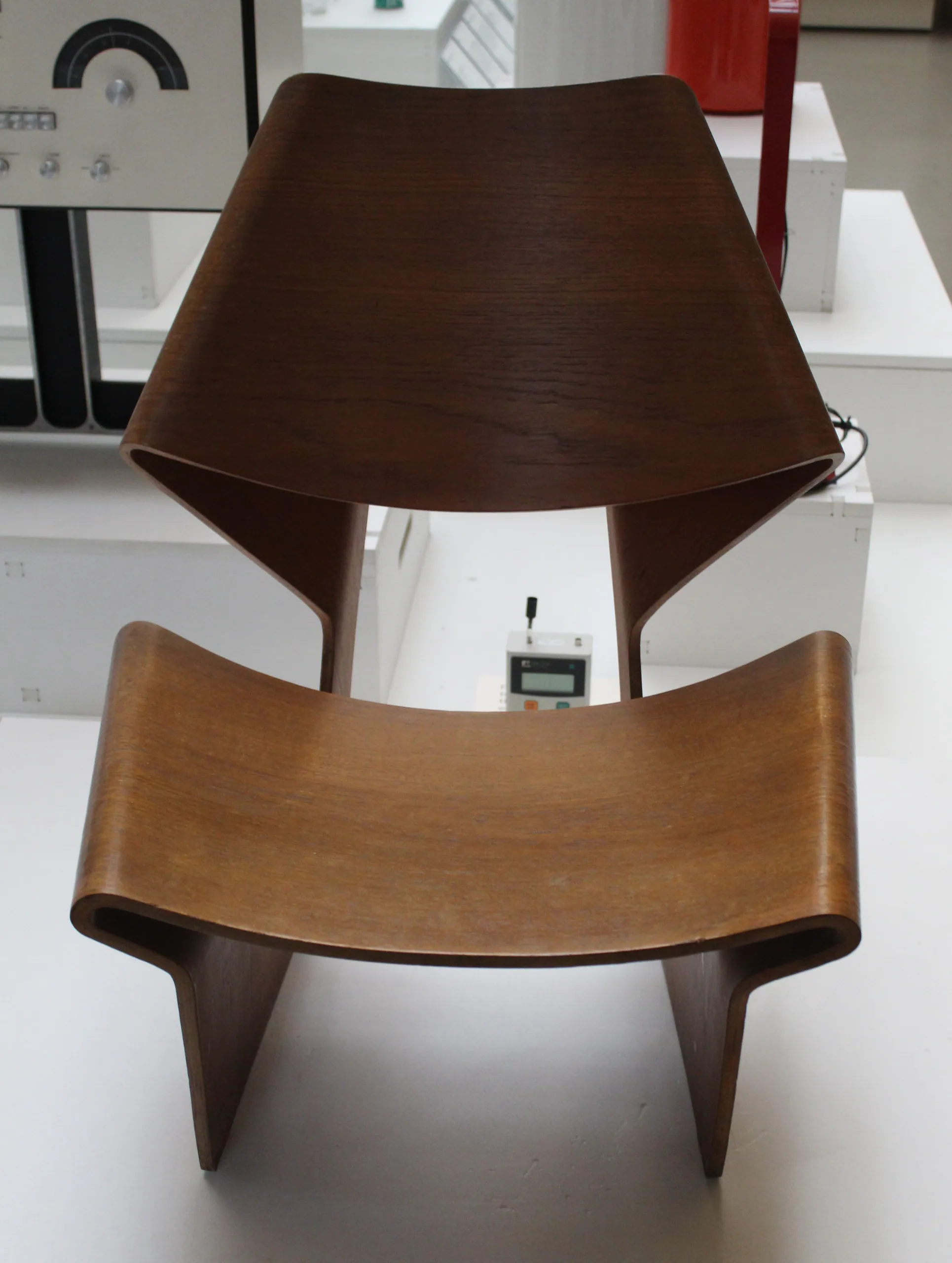
This is a useful way into Grete Jalk's career. She is often introduced through the astonishing 1963 GJ, or Bow Chair, whose two plywood shells almost complete one continuous loop. PatinaHall has a separate article about exactly how that GJ Chair works. The tables show another part of her intelligence. One material operation can organise several objects, several uses and the space between them.
Jalk applied that connective habit beyond furniture. She moved among the workbench, classroom, magazine, exhibition and archive. The roles were not decorative extras around a designer's “real” work. Together they helped Danish furniture travel: from prototype to reader, from temporary display to public argument, and from an exhibition that closed on Sunday to a record that can still be opened decades later.
The workbench came before the editorial desk
Jalk did not enter design through styling alone. The Danish Women's Biographical Lexicon records a year at Copenhagen's drawing and applied-art school for women, followed by a 1941–43 cabinetmaking apprenticeship with Karen Margrethe Conradsen. She then studied at the furniture school, with work under Kaare Klint in her final year, and later taught there from 1950 to 1960. 2
The sequence matters because it prevents a false choice between craft and industry. A cabinetmaking education gave Jalk intimate knowledge of how material, joints and labour constrain a drawing. It did not oblige her to pretend that every good chair should be made as a unique cabinetmaker's piece. The newer Lex account describes her as an advocate of industrial production capable of delivering quality to a broad public. It also identifies bent and laminated wood experiments by Alvar Aalto, Charles Eames and Ray Eames as important international context.1
This was not machine worship. It was an argument that production method and quality must be designed together. The three nesting tables make the point without a lecture: repeated curved shells offer a clear family resemblance, while different sizes and the ability to nest turn repetition into practical economy.
An experiment still has to meet a public
The Bow Chair is now a museum favourite, which can make its arrival seem inevitable. Designmuseum Danmark calls it a technical high point in moulded, laminated plywood and stresses the tension created by two parts appearing almost like one.3 Yet the biographical record describes the buying public as finding Jalk's advanced laminated models decidedly unconventional. Museums, exhibitions and collectors responded more readily.2
That gap between invention and reception is important. Furniture does not become culture merely because a designer has solved its form. Someone must show it, photograph it, compare it, write about it and give readers enough context to disagree intelligently. Jalk worked on both sides of that exchange: she produced objects and helped create the settings in which objects could be understood.
Her position also complicates the familiar picture of Danish Modern as a smooth procession of polite timber chairs. Jalk had workshop training and participated in the cabinetmakers' exhibition culture, but she was willing to push laminated construction towards shapes that strained available production. Tradition supplied knowledge; it did not receive a veto.
Mobilia made furniture debatable
Jalk's editorial work is unusually substantial for a designer whose name is also attached to canonical objects. The biographical lexicon records that she edited Mobilia with Gunnar Bratvold from 1956 to 1962, then again from 1968 to 1974 after his death. The magazine covered furniture, craft and interior design.2
It is tempting to treat a design magazine as a glossy conveyor belt: objects go in, admiration comes out. Editing is more consequential. An editor decides what shares a spread, which photograph is large, what needs technical explanation, which foreign experiment belongs beside a Danish one and where a claim deserves debate. The source does not tell us that Jalk personally made every one of those decisions in every issue, so this article will not invent an all-controlling editorial hand. It establishes something more useful: for long periods, communicating and debating contemporary design was part of her professional practice.
Most furniture magazines eventually become stacks under furniture. Jalk's editorial career suggests a better fate: the stack can become an instrument for thinking across objects and years.
The travelling exhibition packed its own room
Publishing was not her only way of organising attention. The same biography describes a travelling exhibition made for Denmark's Ministry of Foreign Affairs in 1974 and shown in more than twenty-five cities. Its white corrugated cardboard packing cubes carried screen-printed text and marks; once unpacked, the boxes became plinths and wall structures, supplemented by simple posts to form cases and light boxes.2
That is exhibition design with unusually little dead weight. Transport packaging becomes architecture. The thing protecting the story in transit helps tell the story on arrival. It also makes the exhibition repeatable across cities without pretending that every venue is the same room.
The project brings Jalk's design and editorial instincts together. A travelling show needs a sequence, a hierarchy and a visual grammar. It must survive handling, explain itself to new audiences and reassemble without an army of specialist builders. Those are material problems and communication problems at the same time.
Four volumes made forty temporary years searchable
Jalk's largest editorial object arrived in 1987. The CiNii bibliographic record identifies Dansk møbelkunst gennem 40 aar / 40 Years of Danish Furniture Design as four Danish-and-English volumes compiled and edited by Grete Jalk. They cover the Copenhagen Cabinetmakers' Guild exhibitions in four sequences: 1927–36, 1937–46, 1947–56 and 1957–66. 4
The newer Lex biography describes the long-researched series as a major work of Danish design historiography.1 Its value begins with a simple fact: annual exhibitions disappear. Rooms are dismantled, partnerships change, objects are altered or lost, and memory starts favouring the same few photogenic survivors. A chronological compilation lets a reader recover the less famous neighbourhood around an icon — the other stands, makers, experiments and repeated questions that made the celebrated object legible in its own time.
The books should not be mistaken for a neutral time machine. They preserve an exhibition system, and every archive reflects what was admitted, documented, captioned and kept. Their boundary is precisely what makes them usable. Jalk did not claim to contain all Danish furniture; she made forty years of one exceptionally important public forum available for close comparison.
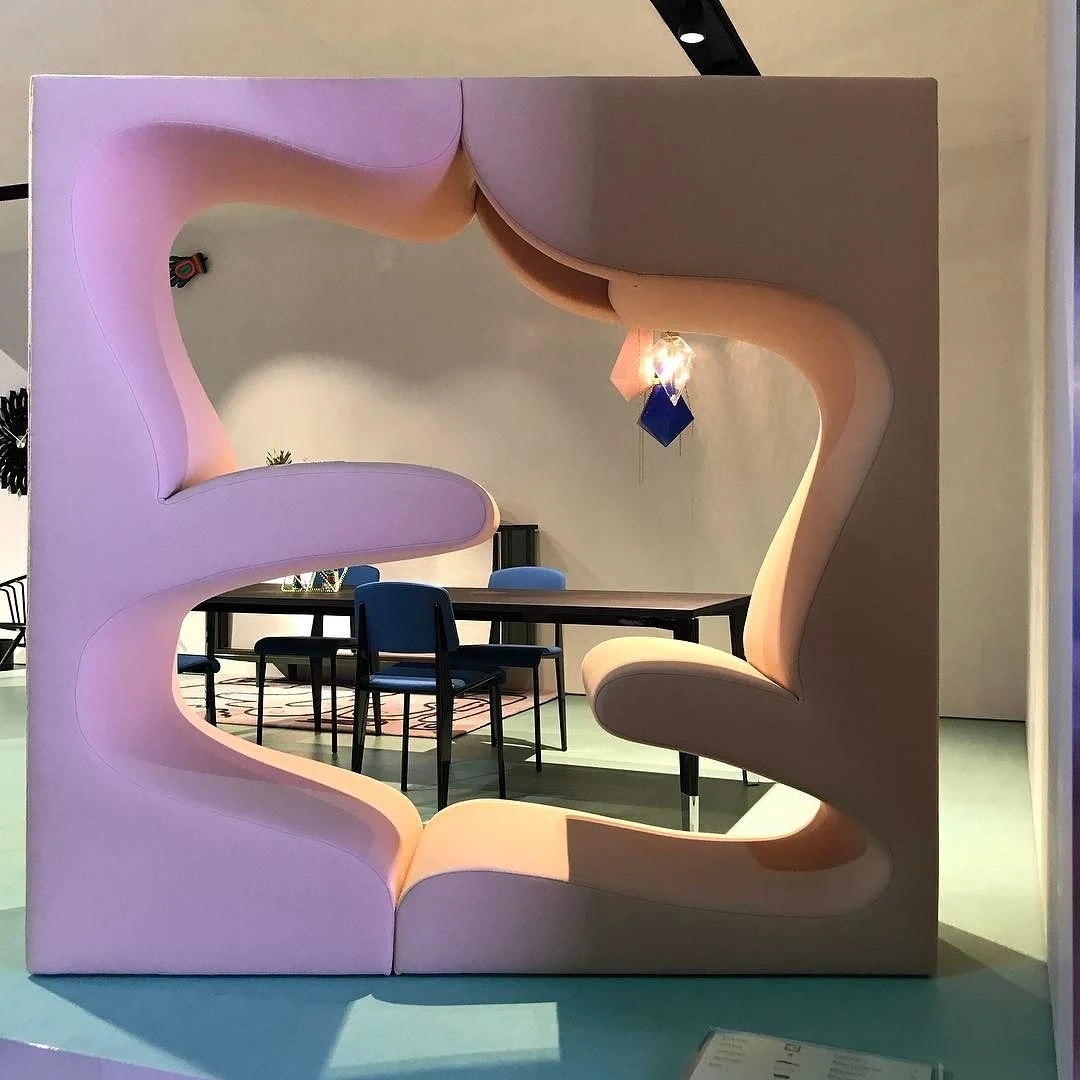
Continue with the Copenhagen Cabinetmakers' Guild Exhibitions to see how designers, workshops and temporary rooms worked together. Then the connected story of Verner Panton's Living Tower shows another way an object can exceed its category: instead of turning exhibitions into a durable record, it turns seating into a room people can occupy.