Why the method matters more than the myth
Kaare Klint is often introduced as a founding figure of modern Danish furniture. That description is useful only if it leads to his working method. He was not important because every later Danish chair looked like his. He was important because he made furniture design a disciplined investigation of use, proportion, construction, material and precedent.
Designmuseum Danmark records that Klint helped adapt its eighteenth-century hospital buildings for museum use in the 1920s, furnished the museum and designed its inventory. He lived and worked there and taught designers who would shape the following decades.1
That setting is revealing. Klint's furniture was not conceived as an isolated shape on a white background. It belonged to rooms, collections, movement and repeated everyday use.
Begin with a real place: Faaborg Museum
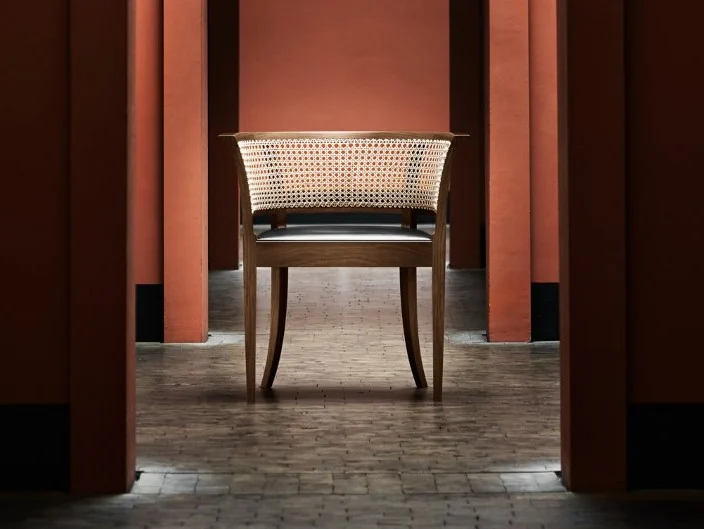
Faaborg Museum describes its furnishing as Klint's first formal project. In 1914, working with architect Carl Petersen, he developed furniture for a building conceived as a complete relationship among art, architecture, colour, mosaic and use.2
The Faaborg Chair had a practical brief. It needed to be light enough for visitors to move around the galleries and quiet enough not to compete with the paintings and floors. The museum records an initial group of 18 chairs and seven related stools, alongside other furniture made for the building. 2
This is more informative than saying that the chair is elegant. Its scale, weight and visual restraint answer a place. Form emerges from the way the object participates in the room.
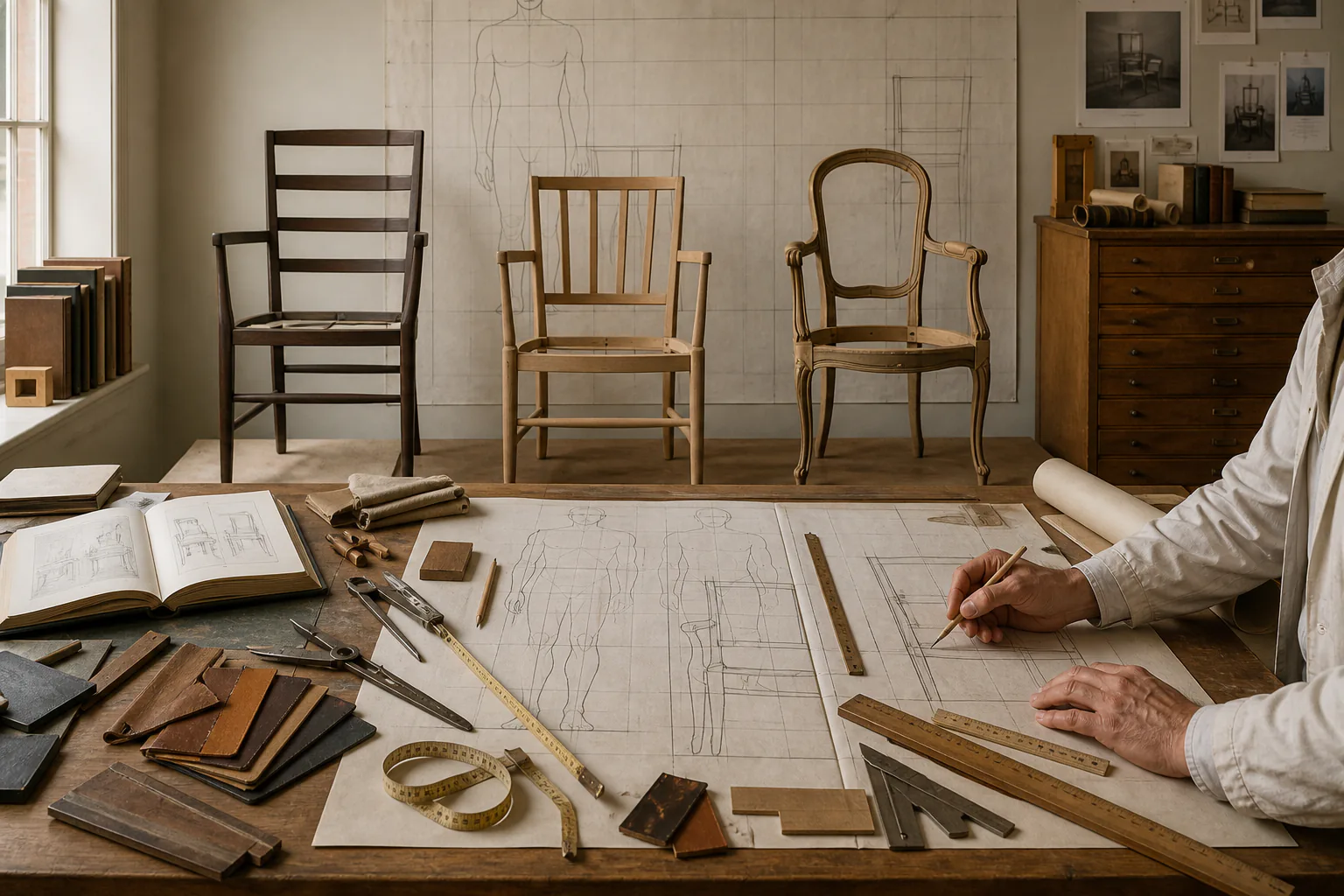
Measurement was a way to remove guesswork
Designmuseum Danmark describes Klint's teaching through analytical study of space.1 In a published discussion with the museum's director, Carl Hansen & Søn also describes his studies of human proportions and the way he brought considered measurement and rules into furniture education.3
Measurement did not mean that one average body generated one perfect chair. It created a common ground on which decisions could be tested:
- how high a seat meets the legs;
- how far a back support sits behind the body;
- how much space a person needs to rise and turn;
- how a chair relates to a table;
- how a cabinet fits what it is meant to store;
- how furniture dimensions shape circulation through a room.
The result could still be graceful, severe, generous or compact. Numbers did not replace judgement. They made the consequences of judgement more visible.
Historical furniture was evidence, not a style catalogue
Klint studied furniture that had survived across places and periods. The Carl Hansen account names examples ranging from Chinese chairs and English Chippendale furniture to Swedish vernacular chairs and Shaker work. 3
The useful question was not which old style to copy. It was which structural idea had proved durable and why. A well-resolved back, leg transition, folding principle or storage proportion could be studied, drawn and transformed.
Designmuseum Danmark makes the wider point through its chair collection: the modern Danish chair can be read as a family with historical and international roots.5 Klint gave that family study a method and a place in design education.
The Red Chair shows transformation clearly
Designmuseum Danmark describes Klint's 1927 Red Chair as a historical object transformed for the needs of a new age. The museum treats that act of adaptation as foundational to the modern Danish furniture tradition. 4
This is a better lens than originality understood as having no ancestors. Klint's modernity lies in selection and revision: preserve a useful structural family, reconsider its dimensions and expression, and make it coherent in its present setting.
The process also leaves researchable layers. A collector can ask which historical type informed a design, which version Klint developed, which maker executed it, and when a particular example was produced. Influence does not erase authorship, and a design date does not date every later object.
Material and workmanship were part of the calculation
Proportion alone cannot make a good piece of furniture. Timber moves, upholstery compresses, joints carry force and surfaces acquire wear. Klint's method joined dimensions to close knowledge of material and craft.
The Carl Hansen account places his long workshop relationship with Rud. Rasmussen inside this history.3 A drawing could be tested through skilled making, while the maker's experience could expose where a refined line was structurally weak or unnecessarily difficult.
That designer-maker relationship is also why attribution should remain precise. The designer, executing workshop, model, edition and manufacture date are related facts. They are not interchangeable labels.
Teaching multiplied the method
Klint's greatest influence cannot be understood only by listing his own chairs. Designmuseum Danmark notes that he taught several of the best-known Danish architects and designers of the twentieth century. 1
The later generation did not produce one uniform Klint style. The method could support very different results because it offered questions rather than a surface formula:
- What must this furniture do?
- What dimensions follow from body, contents and room?
- Which historical solutions deserve study?
- What can the material and workshop do honestly?
- What should be removed, retained or transformed?
A tradition becomes productive when students can argue with it. The variety of later Danish furniture is evidence that Klint's legacy was larger than imitation.
What a collector can take from Klint
Klint's method offers a practical way to examine an object even before its attribution is settled.
Measure relationships, not one headline dimension
Record seat, back, arm and overall dimensions, but also compare how they work together. A copied overall height cannot rescue different proportions.
Compare construction before decoration
Look at how rails meet legs, how the back is supported, how upholstery is fixed and how loads travel through the frame. Surface finish can be changed more easily than structure.
Identify the maker and version
A documented Klint design may have a long production history. Establish which workshop or manufacturer made the object and which period or edition its marks and construction support.
Treat wear as information
Repairs, replaced leather, refinishing and altered caning do not automatically destroy value. They do change which evidence is original and should be described clearly.
Keep resemblance provisional
An object can share Klint's logic without being designed by Klint. Good proportion, traditional joinery and historical reference are methods, not a signature.
Measurement does not make attribution automatic
A chair that matches published dimensions may still be a later copy. A maker label may be replaced. A design may have legitimate variants. A museum record may document the model but not the object now offered for sale.
Use Klint's precision as a standard for the research itself: separate each claim, name its source and leave uncertainty visible. The goal is not to make every object famous. It is to understand exactly what the evidence supports.
See the method continue
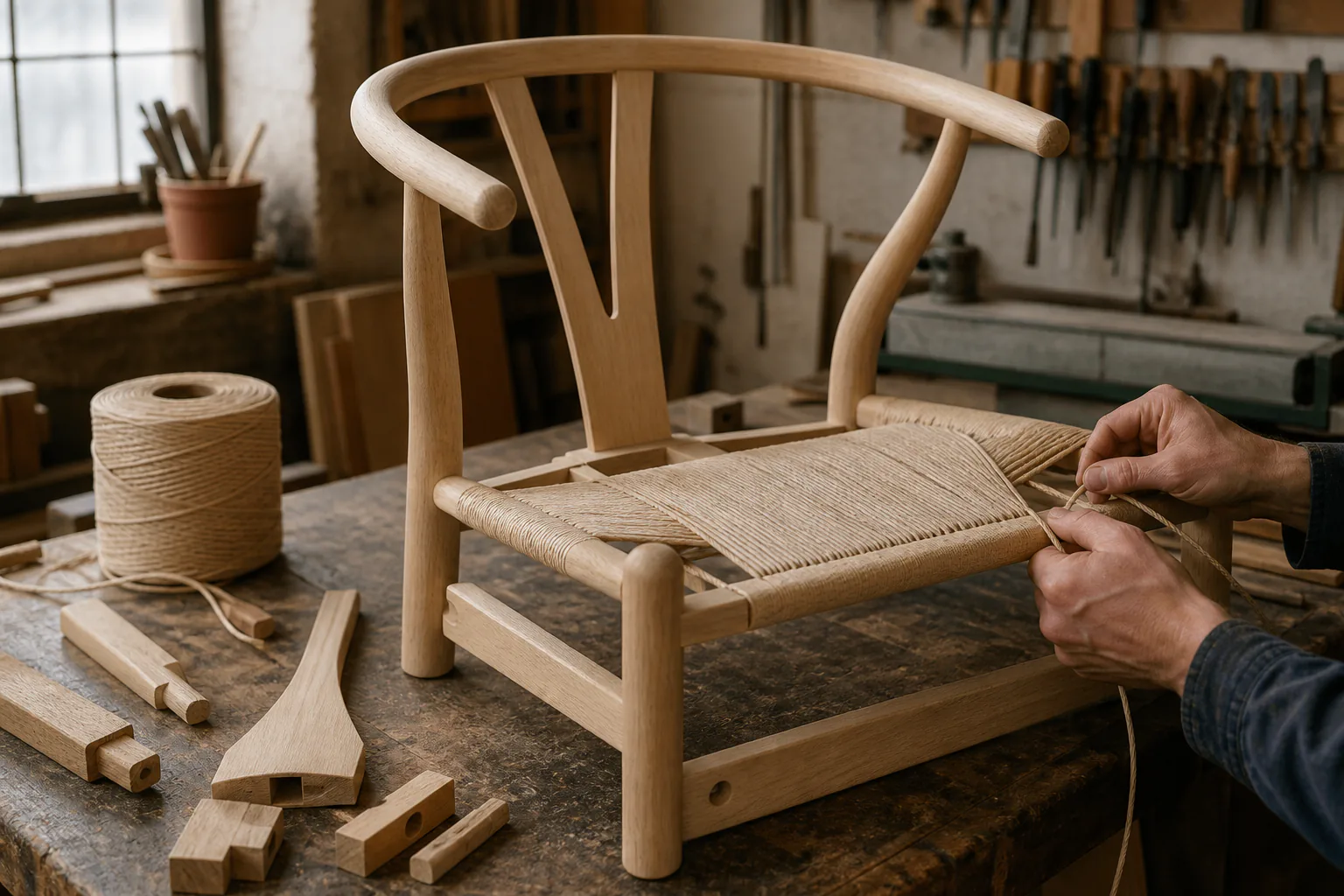
The broader guide to Danish Modern places Klint's work inside a design culture of historical study, craft and international circulation. The CH24 Wishbone Chair shows how a later designer transformed a historical chair family into a distinct frame for serial production.