The chair begins with permission to separate
Most armchairs advertise permanence. Their joints are glued, screwed or hidden; their upholstery turns several parts into one padded mass. The Safari Chair starts from the opposite instruction: make a complete place to sit, but do not erase the possibility that its parts may separate again.
Carl Hansen & Søn's current history describes Kaare Klint's 1933 design as a refinement of the portable Roorkhee chair type. That predecessor used glueless joints, required no tools for assembly and allowed the occupied structure to settle more firmly under load.1
The important word is not primitive. It is coordinated. Timber rails, uprights, leather straps and textile surfaces each do a limited job, and the chair succeeds only when those jobs meet. Portability does not excuse the construction from being furniture. It makes every connection answerable.
Soft material completes the frame
Look at the chair without its canvas and leather and the timber would resemble a low open scaffold. The soft parts do not merely decorate a finished frame. They tell the frame where the body will arrive.
The seat creates a suspended plane between the side rails. The back spans two rear uprights rather than filling the whole upper chair with padding. Leather arm straps connect front and rear posts while allowing a slight curve under the forearm. Together, these surfaces keep the timber structure legible and give the sitter contact where contact is useful.
This division makes the chair look relaxed without making it visually vague. You can count the principal members, follow the rails into their joints and see where textile begins to carry weight. Comfort is not expressed as thickness. It appears as the careful placement of flexible material inside an open frame.
The design also accepts change. Canvas creases, leather bends and timber gains marks. Those changes can make use visible, but they cannot prove who made a particular chair or when. Patina is a history of contact; it is not a maker's certificate wearing a good tan.
The Roorkhee ancestor was campaign equipment
The word Safari can make the chair's history sound like a stylish weekend away. Its structural ancestry is less innocent.
The National Army Museum catalogues a Roorkhee camp chair used by a British officer around the time of the Boer War. Its joints pull apart, its individual pieces are numbered, its leather straps form the armrests, and its canvas seat and back attach without producing a fixed upholstered shell. The museum describes the type as British military furniture used across rugged terrain in Africa and India, and traces its name to Roorkhee, a military cantonment and headquarters of the Bengal Sappers in what is now Uttarakhand. 2
That account matters because portability was not invented in a Copenhagen showroom. It developed within the logistics of empire: furniture needed to be broken down, transported and made serviceable in places occupied by British forces. The ingenious joint and the colonial system are part of the same object history even when later design culture prefers to retain only the adventure.
Klint's achievement was therefore not creation from nothing. It was editing. He treated a working furniture type as evidence, then reconsidered its proportions, material effects and suitability for a modern interior.
In 1933, transport furniture entered an exhibition
Carl Hansen & Søn says that Klint presented the completed Safari Chair at the Copenhagen Cabinetmakers' Guild Exhibition in 1933. Its account describes an unnamed American cinematographer and his wife whose safari photographs drew Klint's attention to chairs probably derived from the Roorkhee type. 1
The Museum of Furniture Studies likewise identifies KK47000 as a 1933 Klint design, produced by Rud. Rasmussen and launched at the Guild exhibition. It emphasises the chair's British predecessors while distinguishing Klint's more elaborated construction and considered proportions. 4
The exhibition setting changed the question. A chair developed for mobility under campaign conditions was now being judged as cabinetmaking and interior design. Klint did not conceal its knock-down genealogy beneath a conventional upholstered body. He made the inherited logic orderly enough to remain visible in a domestic room.
This is consistent with the method explored in our wider Kaare Klint profile: precedent was not a costume to copy. It was a tested arrangement to measure, criticise and refine.
One sales title can hide four different claims
“Vintage Kaare Klint for Rud. Rasmussen KK47000 Safari Chair” sounds like one identity. In fact, it compresses several histories.
- Safari Chair names the repeatable design.
- Kaare Klint states the designer relationship.
- Rud. Rasmussen states a manufacturer relationship.
- KK47000 names the model, while vintage makes a claim about one object's production period.
The first three connections have substantial documentary support. The National Gallery of Victoria catalogues a Safari armchair designed in 1933, names Kaare Klint as designer and Rud Rasmussens Snedkerier as manufacturer, and records beech, leather and canvas in its exact object D100-1974. It also describes the chair as light, easily stored and sold in Europe as a flat pack for shipping.3
The current Carl Hansen & Søn page uses the KK47000 designation and offers present variants in ash with canvas or leather. Those specifications explain what the current manufacturer offers; they do not retrospectively assign the same material, finish or dimensions to every Rud. Rasmussen example. 1
Most importantly, a correct design history does not authenticate a chair in a listing. An individual object still needs its own marks, construction details, measurements, provenance and condition evidence. A title can propose the right questions. It cannot answer them all at once.
An open frame, illustrated
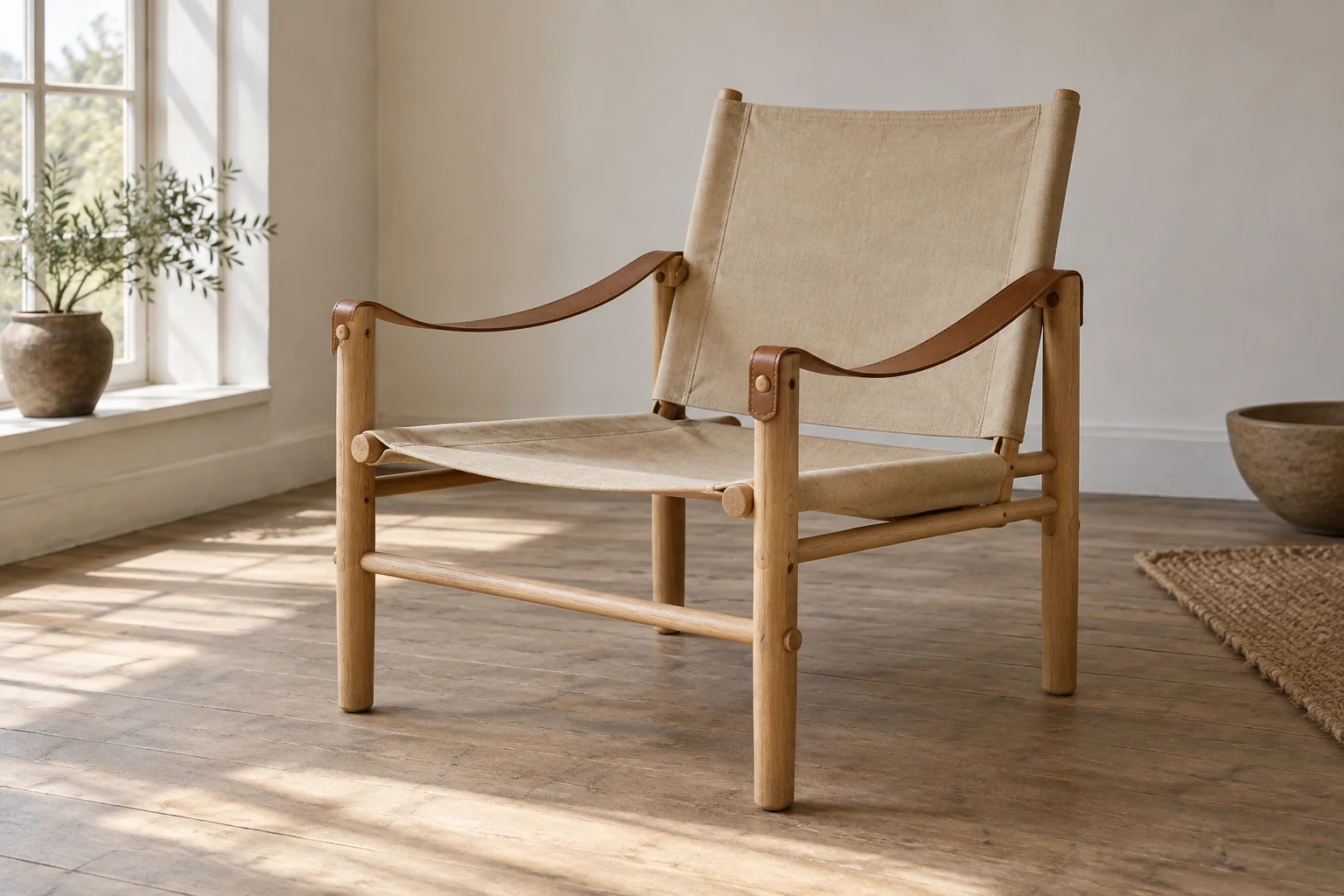
The editorial reconstruction illustrates timber uprights, separate textile planes and flexible arm straps from the reviewed design account. It is not a collection photograph, a view of the 1933 Guild display or evidence of another chair’s date, maker or exact joints.
Its three-quarter angle is especially useful because the chair refuses to flatten into a silhouette. Round-ended connections remain visible at the rails. Leather arms span the uprights instead of becoming rigid wooden rests. The canvas back and seat stay separate, their seams and attachment points making the body's two main contact planes easy to read.
Nothing in the view looks accidental, yet nothing needs to pretend it grew as one piece. That is the Safari Chair's most durable idea. A finished object does not have to deny assembly. Here, the ability to become a bundle is exactly what makes the chair feel intellectually complete.