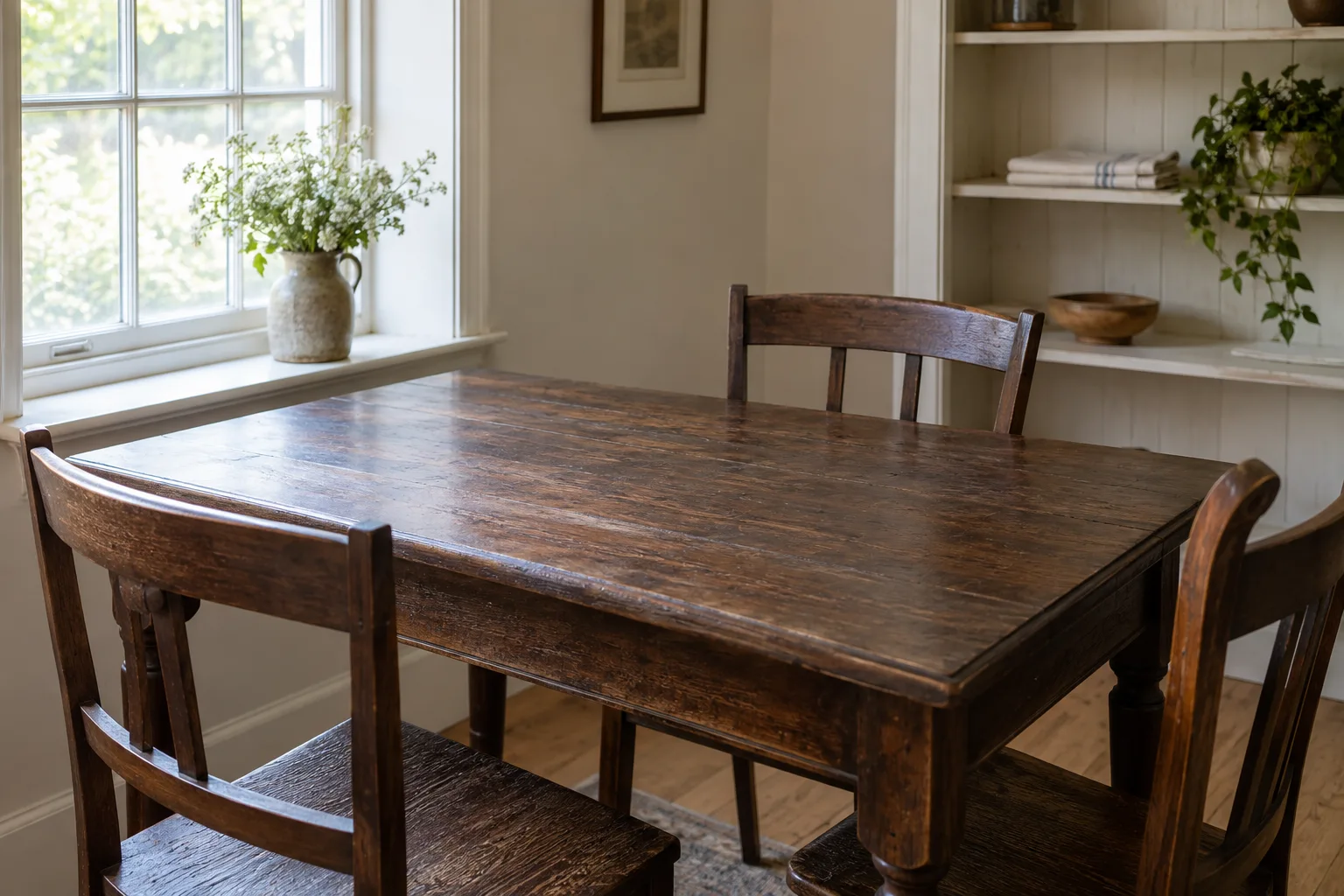
What happened before it felt sticky?
Was the table normal last week? Did it arrive freshly polished? Was it covered with a plastic cloth, used beside a hot window or treated with a product whose name nobody saved? Build a short timeline. The product name and application date are often more useful than another close-up of the shine.
Separate what you observed from what someone told you. “A seller says it was oiled” does not tell you the earlier finish or the exact product. “I applied this named product on Saturday and the top has remained tacky” gives a professional a specific change to investigate.
For a fresh spill, gently lift free liquid with a clean, dry, absorbent cloth without rubbing. Stop if the coating lifts, transfers or grips the cloth; get advice for that surface. Record what was spilled and when. Do not flood an older, already tacky coating in an attempt to rinse away its history.
Three different problems can feel similar
| Situation | What to establish | What not to assume |
|---|---|---|
| A local patch after a known spill | The spill, the coating and an appropriate immediate response. | That the same cleaner is safe on the whole table. |
| A top repeatedly treated with polish or oil | The exact products and whether deposits sit over an earlier finish. | That adding a fresh layer will dissolve the old problem safely. |
| A surface that grips paper or changes without a recent spill | Whether the coating itself is softening, failing or affected by contact. | That the stickiness is only removable grease. |
CCI warns that commercial restoration mixtures and polishes can create sticky accumulations and future coating-compatibility problems. Its guidance also stresses understanding the type, stability and previous modification of a finish before cleaning. These are reasons to identify the problem, not proof that polish is the cause in every case.[1]
An even-looking gloss is not evidence that a surface has hardened correctly. A table can photograph beautifully while feeling unpleasant in use. If you are buying remotely, ask directly whether the top grabs a dry hand, cloth or paper during ordinary use; do not ask the seller to stage a destructive sticking test.
Keep a temporary workaround from becoming another problem
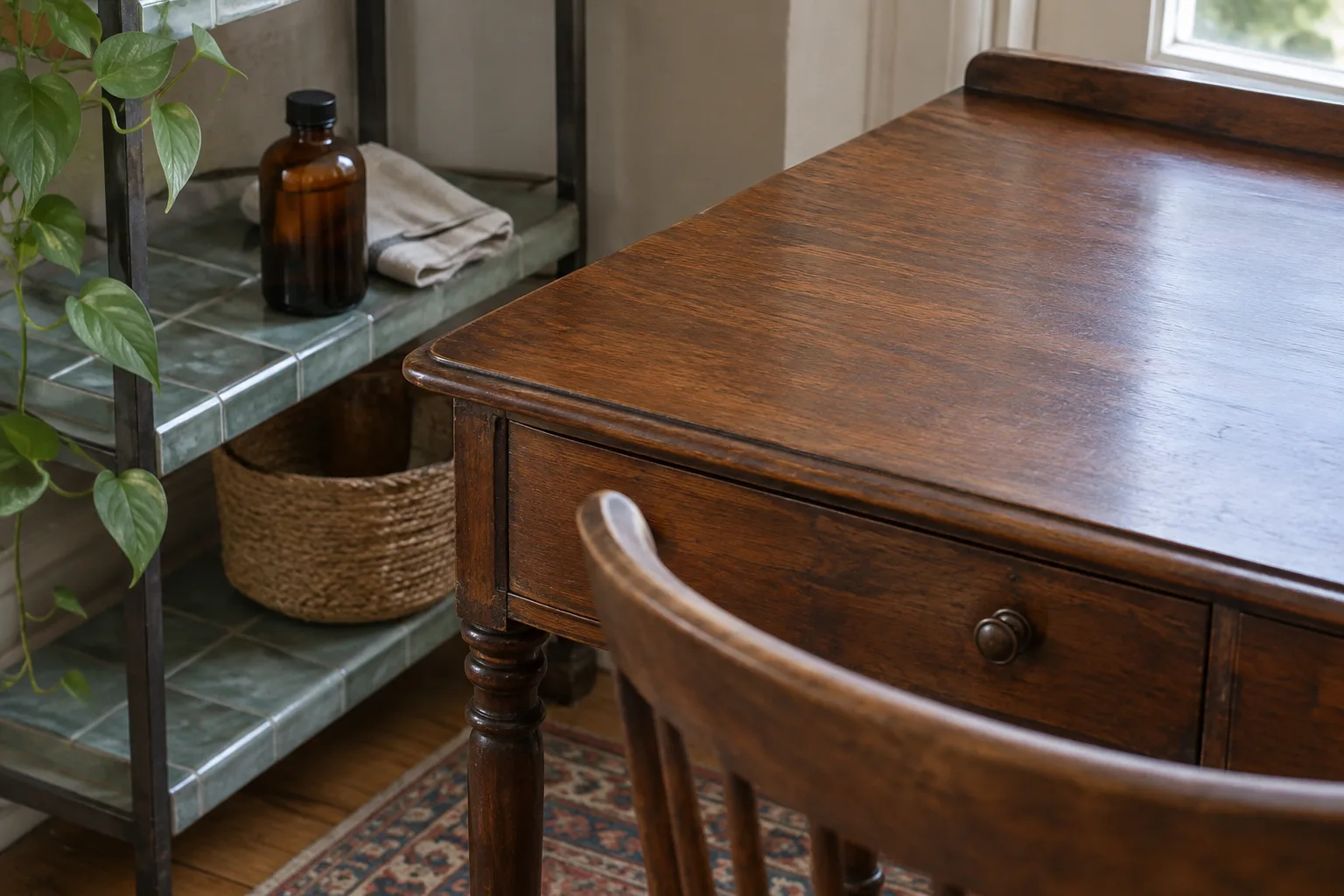
Remove ordinary objects gently if they release without resistance. Leave anything adhered to the coating for professional advice rather than peeling it away. Keep the surface out of routine service while it transfers material or grips things placed on it. Use another table instead of laying paper, a mat or a plastic cover onto the tacky layer.
Keep the room in normal, steady conditions. Do not apply a hairdryer, put the table against a heater or move it into strong sun to hurry a guessed drying process. If a known finish was recently applied, ask its applicator or manufacturer about that exact product and application, including the point at which an inspection is needed.
Avoid the temptation to polish until the cloth stops dragging. A change in colour or sheen on the cloth may be material removed from the furniture, not evidence that you are finally getting it clean. Stop if wiping changes the finish or catches loose areas.
Give the restorer a small, useful record
Photograph the complete top in diffuse light, then with light falling across it. Record where the problem occurs, whether it affects the whole top or particular contact areas, and any imprint, lifting or colour transfer already observed. Include the same information for extensions if the table has them; their histories can differ.
Send the product container’s name and instructions as information, not as a proposal that the restorer repeat it. Mention waxes, oils, sprays, disinfectants, adhesive coverings and earlier professional treatment that you know about. “Nothing has ever been done” is useful only if someone actually knows the entire history.
Ask whether the likely job is removal of a deposit, treatment of a failing coating or more extensive refinishing. Those outcomes preserve different amounts of the surface and can have different costs. Request an examination before accepting a fixed promise where the layer is still unidentified.
Agree what “ready to use” means
A successful result should suit the table’s job: ordinary meals, writing or occasional display. Agree the intended appearance, any colour or sheen change, maintenance instructions and when the treated surface can return to use. Keep the product and treatment record this time.
Message to a restorer
The top of this [table] became tacky [when]. It affects [areas] and I have observed [gripping, imprints, transfer or lifting]. The known products, dates and coverings are [details]. Could you assess whether the problem is a deposit or the coating, explain what can be retained, and quote the appropriate cleaning or finish treatment separately from full refinishing? I need it for [ordinary use].
Before a purchase, make the price and timing reflect that unanswered treatment question. A sticky top can be a manageable problem. It is not something you have to accept as the inevitable feel of old furniture.