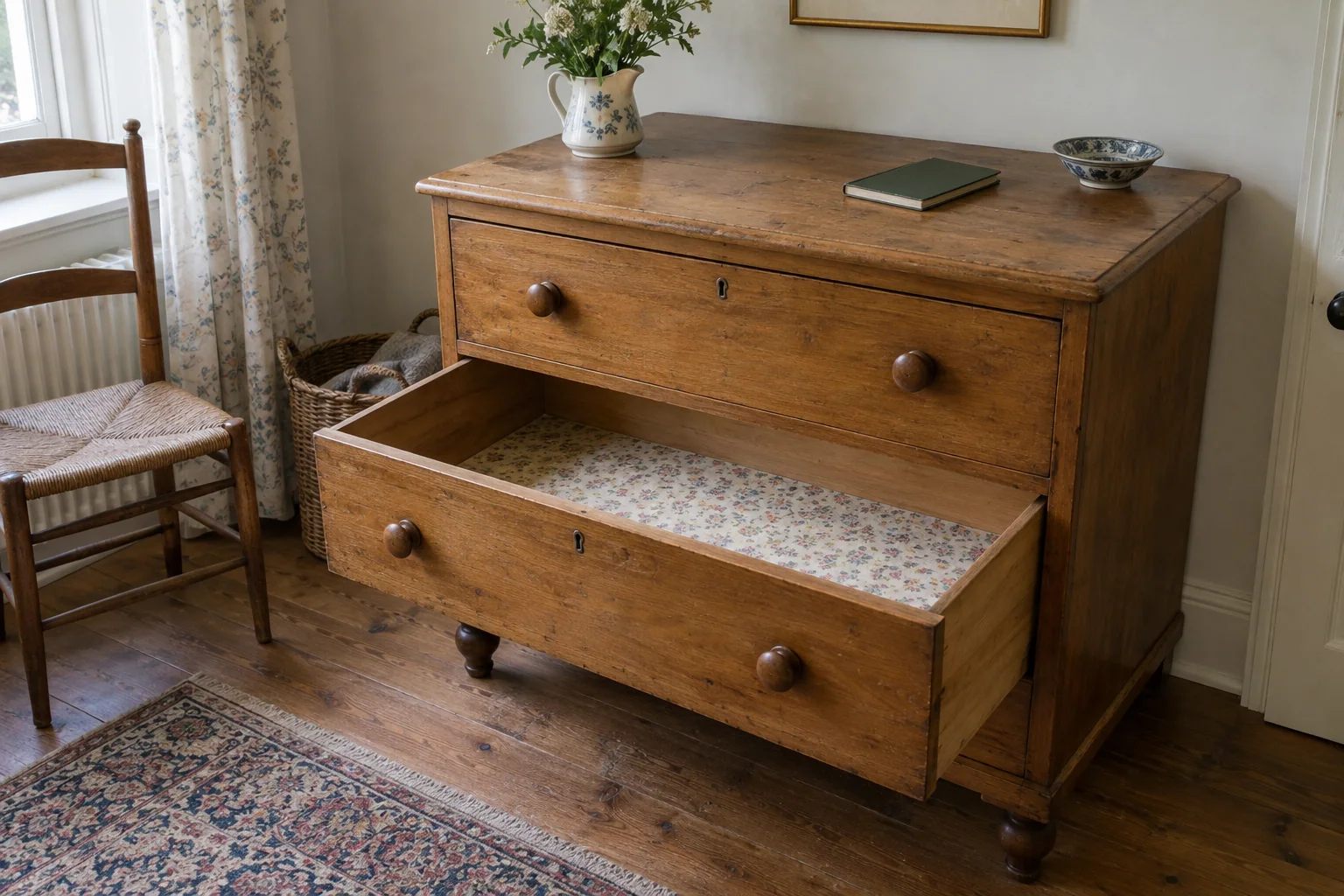
Four layers can hide under one cheerful pattern
Look at accessible edges, corners and existing damaged areas without lifting a firmly attached layer. Record whether the lining is a loose sheet, a self-adhesive covering or several materials added over time. Photograph labels, stamps and handwritten notes before deciding that every scrap of paper is disposable.
An older lining may be part of the furniture’s history, while a later covering may conceal damage or simply reflect someone’s taste. Neither conclusion follows from the pattern alone. Ask the seller when it was added and whether any drawer has already been uncovered.
| Layer | Question |
|---|---|
| Visible sheet or film | Loose, bonded, torn, powdering or stable? |
| Adhesive | Exposed, tacky, brittle or unknown beneath the sheet? |
| Existing finish | Present, fragile, already lifted or not visible? |
| Drawer base or veneer | Sound, split, distorted or still concealed? |
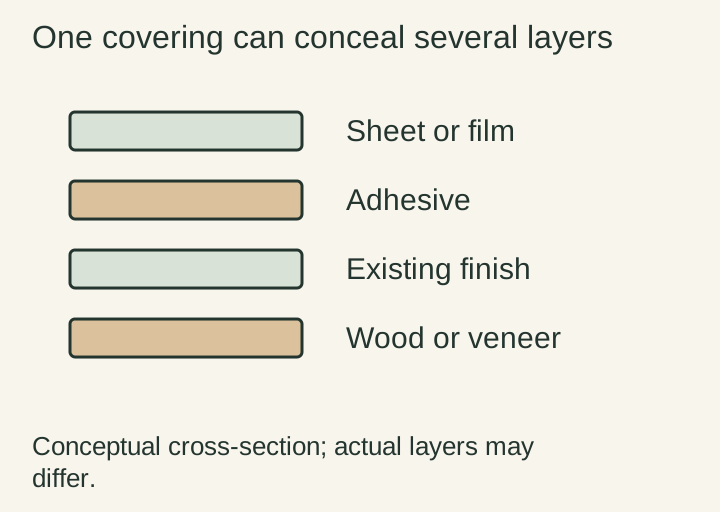
A loose, unattached insert can be lifted gently if it is not fragile or historically significant. A bonded sheet calls for a different decision. Stop if fibres, colour, finish or wood begin to move with it; that is damage, not progress.
Why weak adhesive can still be difficult to remove
Duke University Libraries documented contact paper and multiple adhesive layers on architectural drawings. Although the covering’s adhesive was relatively weak, the underlying drafting cloth was too fragile for simple peeling. Conservation treatment revealed further tape beneath the first covering.[1]
That is a paper-conservation case, not a furniture-removal protocol. Its useful lesson is the mismatch between a weak adhesive and an even weaker underlying surface. On a dresser, an apparently easy pull can still remove a vulnerable finish or thin wood layer. The treatment used on the drawings is not a recipe to copy onto furniture.
The Canadian Conservation Institute treats furniture finishes as materially varied surfaces with their own conservation value and vulnerabilities. Before choosing a cleaning or removal method, establish what surface you are trying to retain.[2]
Choose the smallest useful result
If a lining is stable, clean and suitable for the objects you intend to store, leaving it in place may be the least disruptive option. You do not need bare wood inside every drawer to enjoy the dresser. Keep photographs and any known history with the piece.
If the covering transfers adhesive, sheds material, obscures important information or prevents intended use, ask a suitable furniture restorer or conservator to assess removal. Specify which finish, labels and construction you want preserved. Ask for a bounded assessment of one representative area before agreeing to all drawers.
When evaluating a dresser before purchase, treat concealed condition as an uncertainty in the offer. Do not assume attractive wood lies underneath or accept a low removal estimate based only on the size of the sheet. If seeing the original surface is essential to your purchase, resolve that before paying.
A clean-looking peel can leave the harder job
Request separate consideration of removing the covering, dealing with residual adhesive and addressing underlying damage. A quote that ends with the film coming off may leave a sticky drawer you still cannot use. Ask what the finished, usable result includes and which appearance cannot be promised.
Avoid experimenting with heat, steam, household solvents or abrasive scraping on an unidentified old finish. A product described as an adhesive remover does not establish compatibility with the finish, veneer or glue beneath it. The appropriate method depends on those materials and the object’s condition.
A focused treatment brief
I want this drawer usable while retaining its existing finish and any labels. Please assess the covering and adhesive separately, explain the risk to the underlying surface, and quote a limited initial area before proceeding further.
Choose preservation, partial work or removal because it serves the dresser’s next use. Uncovering everything is not automatically an improvement, especially when the most interesting layer is the one a hurried peel would remove.