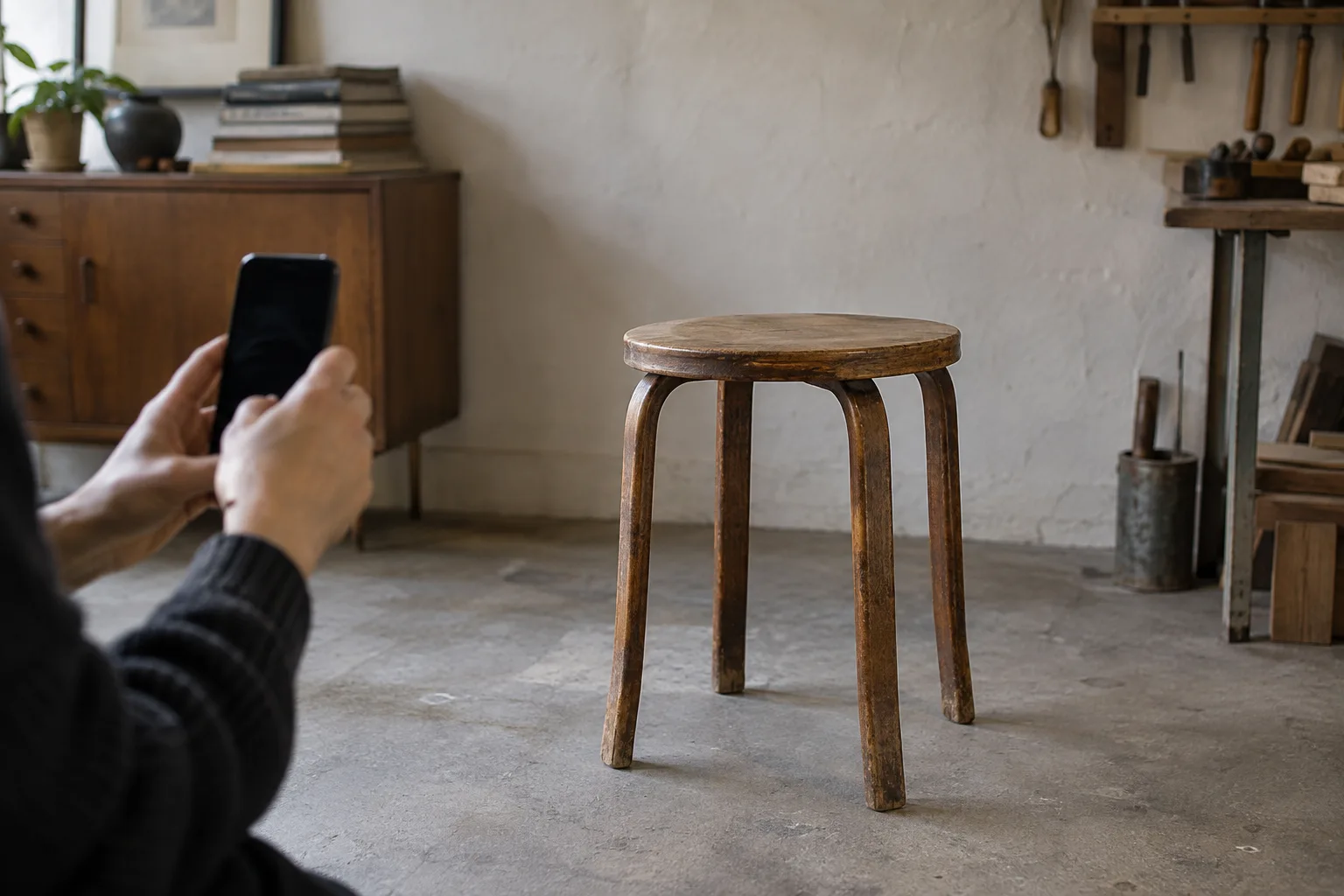
Give the search one object to look at
A seller calls it a Danish chair. You suspect it has a name. Five minutes later, image search has supplied three designers, two countries and a surprisingly expensive auction result. This is the moment to slow down: useful search results can arrive mixed with copied descriptions and superficial similarities.
Begin with a complete front or three-quarter view, a plain background where possible, and no heavy filter. Keep the feet, arms and back in frame. If a cushion hides the structure, ask for another safe view rather than expecting the search tool to reconstruct it.
Google’s own instructions allow an image upload, an image URL or a browser image search; adding text can refine the results. The exact controls vary by device. Use a photograph you can share and remove unrelated personal details before uploading it. There is no need to include an address label or private paperwork to research the shape of a chair.[1]
Save the original photograph and the listing URL separately. Cropping is useful for a second search, but the complete object remains your reference. A close-up of one handle can produce a good handle match on a completely different cabinet.
Describe the construction before the desired name
Try the whole object first, then a detail that is both visible and distinctive: the back-to-seat relationship, a bent leg, the side profile or an intact label. Change one thing at a time so you can tell what changed the results. Searching ten unrelated crops gives you more suggestions without necessarily giving you better evidence.
Add neutral words before a famous name. For a simple stool, “round seat bent birch four legs” is a more open starting point than “rare Alvar Aalto original”. The latter phrase encourages the search towards the answer you hope to find. You can add a candidate name once you have something specific to test.
Open a promising result and find out who is speaking. A manufacturer record, museum object entry, dated catalogue and seller listing have different jobs. A seller may supply an excellent photograph of one particular piece, while the date or designer in the heading still needs support.
Look for repeated photographs and copied wording. Ten shops repeating one unsupported attribution are not ten independent records. Record the earliest or most direct source you can identify, and keep the object’s construction in view while following the name.
For the documented design history, read the Stool 60 Library story. Keep that history separate from the evidence about the stool in your photograph.
A worked comparison: the fourth leg changes the question
Consider an illustrative search scenario: a result calls a round bent-leg stool “Aalto Stool 60”, but the seller’s complete photographs show four legs. Artek’s primary records describe Stool 60 as the three-legged 1933 design and E60 as the four-legged 1934 design. The visual family is promising; the exact model name in the search result is not yet right.[2][3]
| Step | Useful result |
|---|---|
| Observe | The offered stool has a round seat and four visible bent legs. |
| Check documents | Artek separates the three-legged Stool 60 and four-legged E60. |
| Test the match | The suggested Stool 60 name conflicts with the observed leg count. E60 becomes another candidate. |
| Keep the limit | Four legs alone do not establish Artek production, age or an unaltered assembly. Request further evidence. |
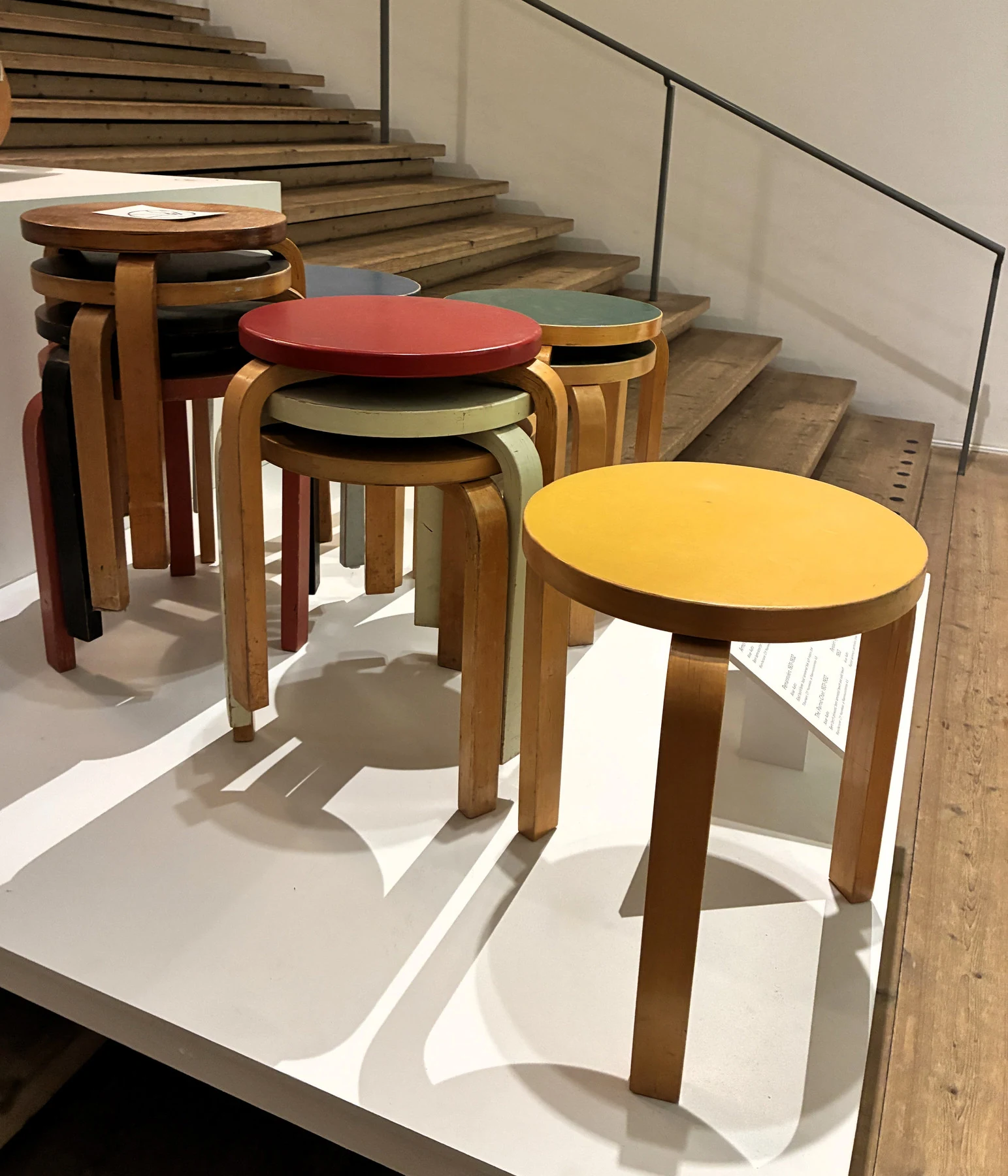
The photograph above shows Aalto stools at Millesgården, recorded by its photographer in January 2026. Nested legs and repeated coloured seats make it a useful reminder that a group image can hide individual construction. The date records the photograph, not the manufacture of each stool.[4]
For the hypothetical four-legged purchase, ask for the complete underside, measurements and any marks in place. Compare the assembly with the relevant documentation. A design date in a search heading should remain a design date until evidence connects a production period to the actual piece. The Artek buying Guide takes that particular model comparison further.
Make a short record you could explain to someone else
Keep one page of notes rather than a folder of unexplained screenshots. Record the listing, original photographs, candidate name, primary reference, matching observations and conflicts. Save the source URL and access date. If a catalogue provides a model number, record the page as well as the attractive photograph.
Write the conclusion at the level the evidence supports. “A four-legged bentwood stool; E60 is a candidate requiring further comparison” is useful. “1934 Aalto” is a much larger claim. Leave model, producer, date and replaced components as separate questions when they have different levels of support.
A seller request that advances the research
I found a possible model reference, but the current photos do not settle the match. Could you send the complete underside, actual dimensions and any mark in its location? Please also say which parts or finishes are known to have changed and what supports the maker or date in the listing.
When the price depends heavily on attribution, send the short record to an appropriate specialist before purchasing. Give them the disagreement as well as the possible match. A useful research trail is one another person can examine, including the point where it stops.