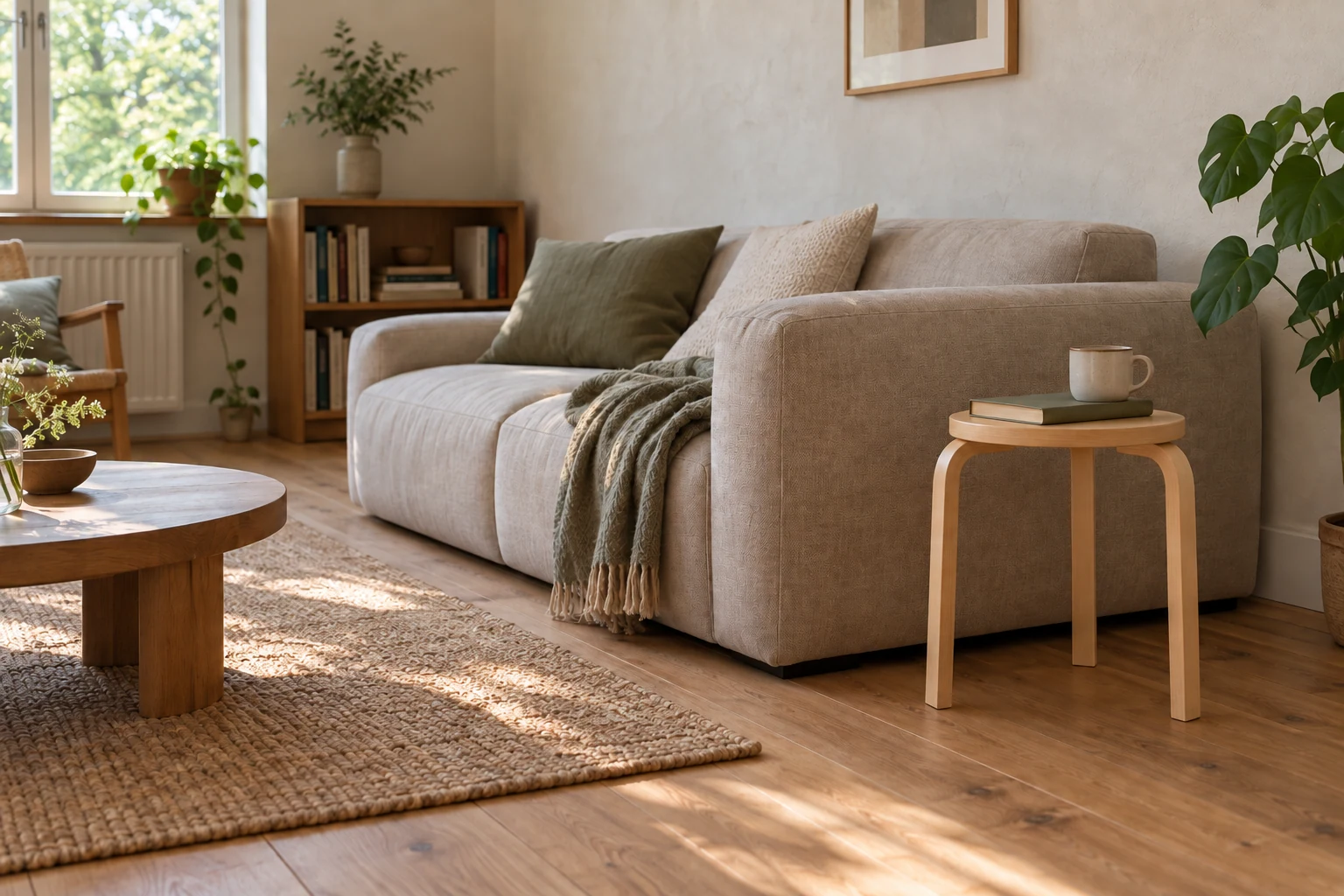
Two models with different leg counts
Artek dates Alvar Aalto’s three-legged Stool 60 to 1933. Its compact birch form has bent legs attached beneath a circular seat. That spare construction makes it easy to place among quite different furniture.[1]
The four-legged E60 followed in 1934. It is a separate model, not evidence that a fourth leg has been added to a Stool 60, and Artek describes it as stackable too. In a used listing, count the legs on the actual object and look at how each meets the underside. A familiar seat outline is not enough to identify the whole assembly.[2]
For the design’s history, read the Stool 60 Library story. Here, the aim is to choose an older stool that will be useful in your home.
There is no need to decide that one model is universally better. Three feet and four feet meet the floor differently, but the leg count cannot tell you whether a particular old stool is sound. Check it on a level surface and investigate any movement before a normal seating trial. Do not test stability by deliberately tipping it.
Start with the place it will live
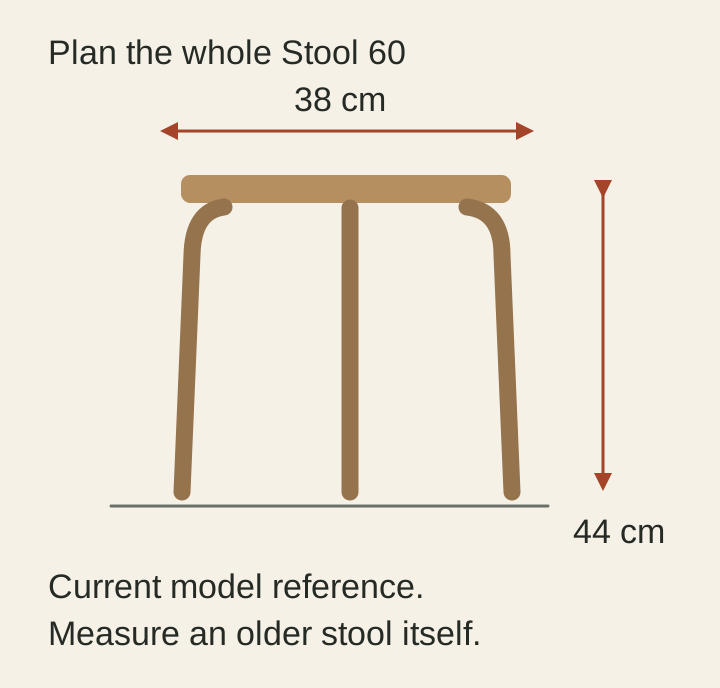
Artek’s current Stool 60 shop drawing gives an overall width of 38 cm and a height of 44 cm. These are useful planning references for that model; measure the older stool you are buying, especially where a cushion, new feet or altered legs affect its height.[3]
Beside a sofa, compare the top with the place where your hand naturally reaches for a cup. A stool that looks charming under a tall arm may be awkward to use there. At a dining table, compare it with a chair you already find comfortable: feet on the floor, knees below the table and enough room to move in and out.
Think about duration as well. A backless occasional seat may be just what you need when friends visit, while being a poor substitute for your preferred dinner chair. If you expect to use it every day, sit on the actual surface for a normal trial rather than choosing from a photograph of a stack.
A dark seat does not make a walnut stool
The current Stool 60 range shows why surface descriptions need care. Artek lists birch legs and seat edges, alternative seat cores, and surfaces including veneer, high-pressure laminate, linoleum and upholstery. A coloured top is a surface choice; it does not describe every material beneath it.[1]
| Seat offered | Useful buying question |
|---|---|
| Exposed wood or veneer | Do you like the present colour, edge wear and any refinishing? |
| Laminate or linoleum surface | Are edges secure, and are cuts, lifting or stains acceptable as they stand? |
| Painted or lacquered seat | Was it supplied this way or refinished, and what work is recorded? |
| Upholstered seat or added pad | Is it attached or removable, and how does it change sitting height and table use? |
Ask for the top, seat edge and underside in the same light. That makes a worn patch or changed surface easier to understand than a close-up on its own. Do not buy an unwanted coloured seat on the assumption that stripping it will reveal the wood appearance you had in mind. Price and assess that proposed work first.
For a mixed group, repeat one feature deliberately. Plain birch legs can connect different seat colours; two dark tops can balance a brighter one. Place photographs of the actual stools together before buying them separately. Similar names do not guarantee identical colour, finish or wear.
Buy a stack that you can live with
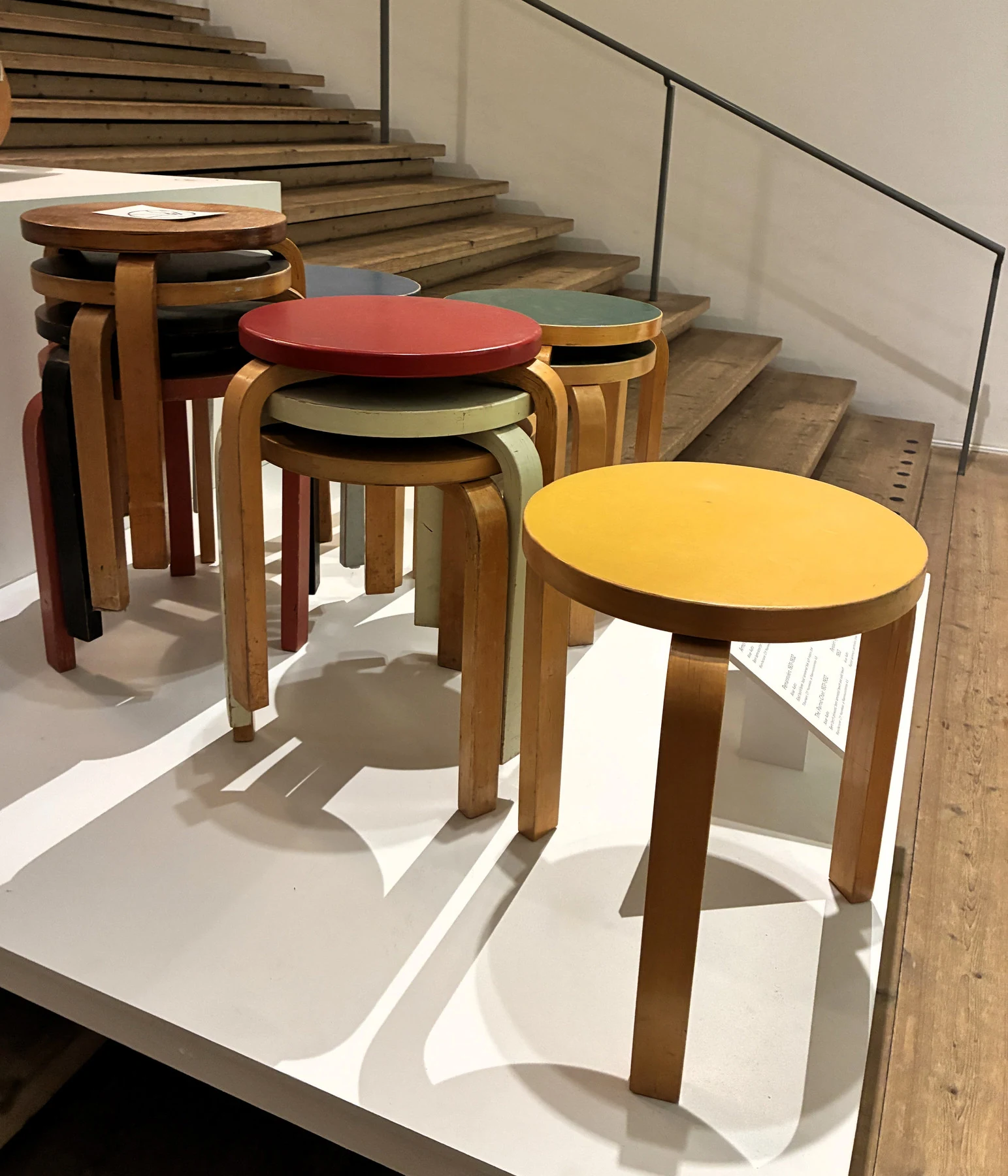
This photograph by Gotogo records Aalto stools at Millesgården in January 2026. It offers a real view of mixed colours and stacked forms, rather than a record of when those individual stools were made.[4]
At home, a stack also needs a place to stand and room for you to lift the top stool away. Ask to see the offered group stacked normally, without forcing legs past one another. Different models, added pads, replacement feet or surface work can affect how a particular combination nests; do not assume a mixed purchase will stack neatly.
Inspect contact areas before deciding that every rub mark needs refinishing. Some wear may be acceptable on a working stack. Splits, insecure attachments or damage around fasteners are a different matter and need assessment. Avoid repeated dismantling simply to make a parcel smaller; first confirm a suitable packing plan for the older stools.
Choose the complete purchase
Compare ready-to-use stools with projects at the same finish line. Include any necessary leg work, suitable feet, seat repairs and collection. One complete stool in a colour you like can be a better first purchase than a larger group whose repairs and final use are still uncertain.
A message for the seller
Could you show each stool’s top, underside, leg attachments and any marks in place? Please give its actual height and overall width, note any repairs or replaced parts, and say what is known about the seat finish. If the stools are sold as a stack, a photograph of that actual group stacked normally would be helpful.