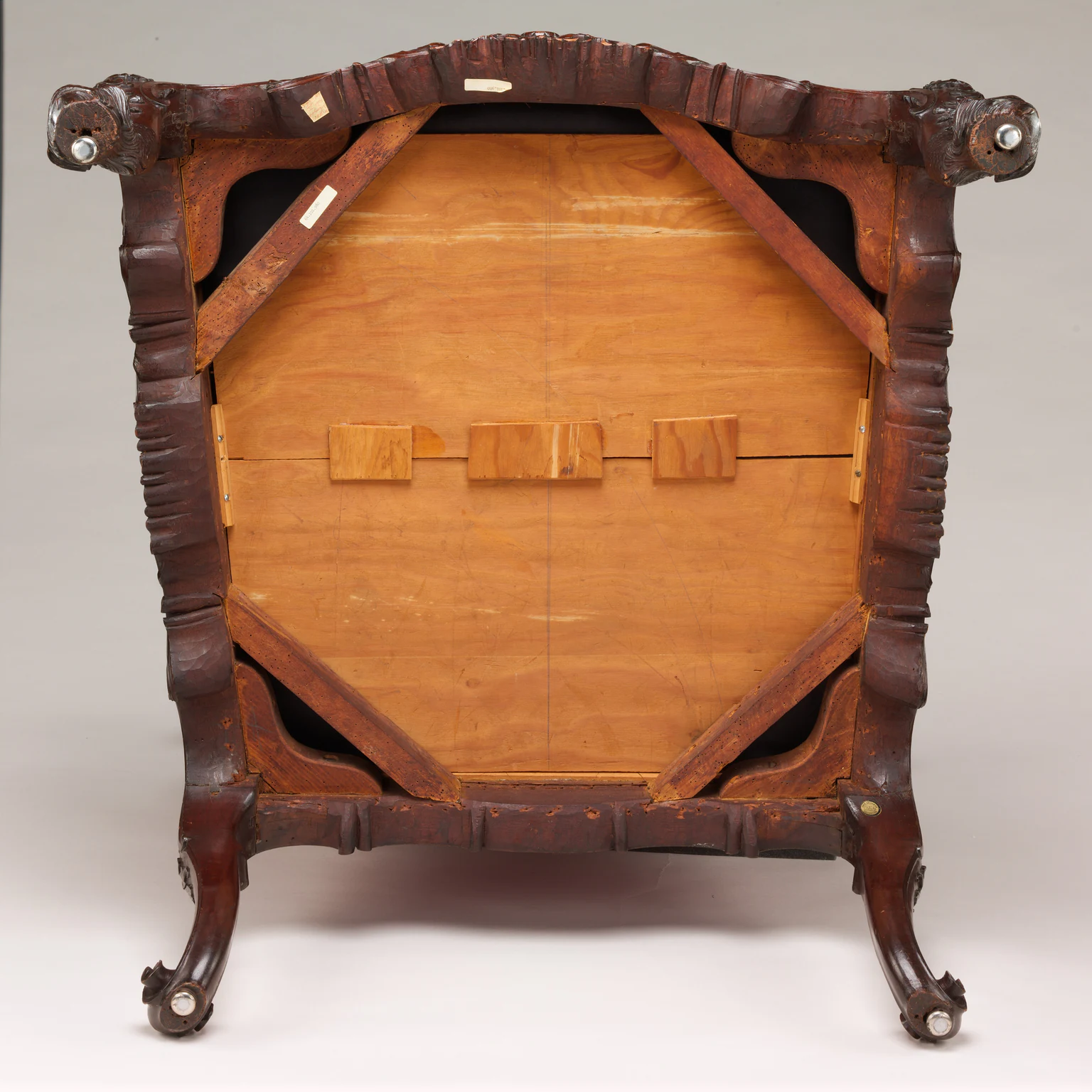
Start with the connection in the whole piece
Ask for one whole-object view, one view of the connected parts and one useful close-up. Name the location: a drawer corner, the front rail meeting a chair leg, or a table support beneath the top. Two similar-looking details can have different jobs. A corner in a drawer box and a connection carrying a seat belong in different parts of the buying record.
Record only what is already safely visible. An intact seam, an exposed end and a previously documented assembly view provide different evidence. Do not pull a joint apart, remove a plug or ask the seller to strip a finish for the comparison. A concealed connection is a legitimate unknown.
Compare four connection types
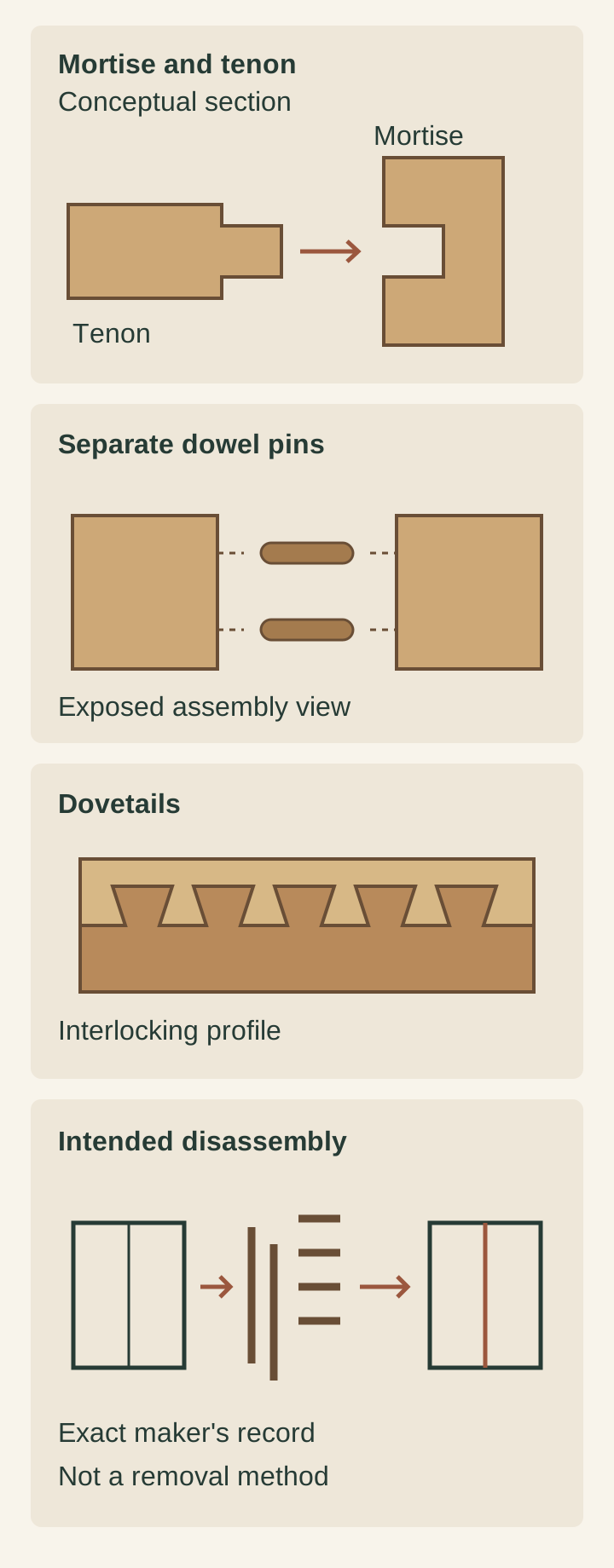
Mortise and tenon
A tenon projects from one member into a mortise in another. The V&A describes this relationship in its furniture-making demonstrations.[1]
On an assembled chair, most of that shape may be hidden. Describe the rail and leg you can see rather than drawing an unseen tenon from the seam. West Dean's chair-conservation case also records oak pegs securing mortise-and-tenon joints. A round wooden end can therefore be part of a pegged connection, rather than the separate pin joint described next.[2]
A separate dowel pin
Wolfcraft's documented dowel-pin examples use separate pins to join boards in several arrangements. An already exposed assembly view can make that relationship clear.[3]
A closed seam or circular plug on different furniture does not supply that assembly view. Ask what supports a seller's 'dowelled' description. Leave the answer qualified when the connection is concealed, and keep its current condition separate from the construction name.
Dovetails
Flared tails interlock with matching spaces, as the V&A's drawer-joinery example explains. Existing drawer-corner views can be useful comparisons.[1]
Follow the pattern around the corner and relate it to the complete drawer. Do not date the piece, declare hand manufacture or assume an absence of adhesive from one pattern. A photograph can also leave later work or a different concealed connection unresolved. Use the drawer-operation Guide for runners, stops and ordinary travel.
A connection intended for dismantling
IKEA's PLATSA frame 503.309.46 is a named modern comparison: the maker explicitly describes assembly, disassembly and reassembly, with its wedge-dowel connection. That evidence belongs to this product.[4]
The lesson is the documented intention, not a release method to copy. An ordinary glued pin, an old screw or a peg in another piece does not inherit PLATSA's instructions. For a vintage object, ask for its own documented construction, later changes and a responsible dismantling and reassembly plan.
Keep three decisions separate
| Question | Useful evidence | What the name cannot supply |
|---|---|---|
| How is it constructed? | Existing visible geometry and an appropriate object or maker record | A complete view through a concealed joint |
| What is its current condition? | The present object, reported movement and relevant specialist assessment | Strength, stability or repair adequacy |
| Can it separate for transport? | Intended method for this object and the responsible handler's plan | Permission to remove a peg, screw or pin |
A joint can be interesting to understand while still needing work. It can also be hidden in an otherwise well-documented piece. Do not turn either fact into a quality ranking. Use the wobbly-chair Guide when movement is the question and the delivery-measurement Guide when transport depends on separation.
Send a precise joint question
A seller enquiry
Could you show this connection in the complete piece, then the two joined members and an existing visible detail? What supports the stated joint type, and what remains concealed? Please describe known movement, repairs or later fasteners separately. If removal is proposed for delivery, who knows and accepts this object's method and reassembly? Please do not open or alter the joint for my photographs.
The useful result may be a modest description: 'visible dovetail pattern at this drawer corner' or 'rail-to-leg joint, internal construction unconfirmed'. Those words let the next conversation begin with the object, instead of a confident guess that later decisions must somehow justify.