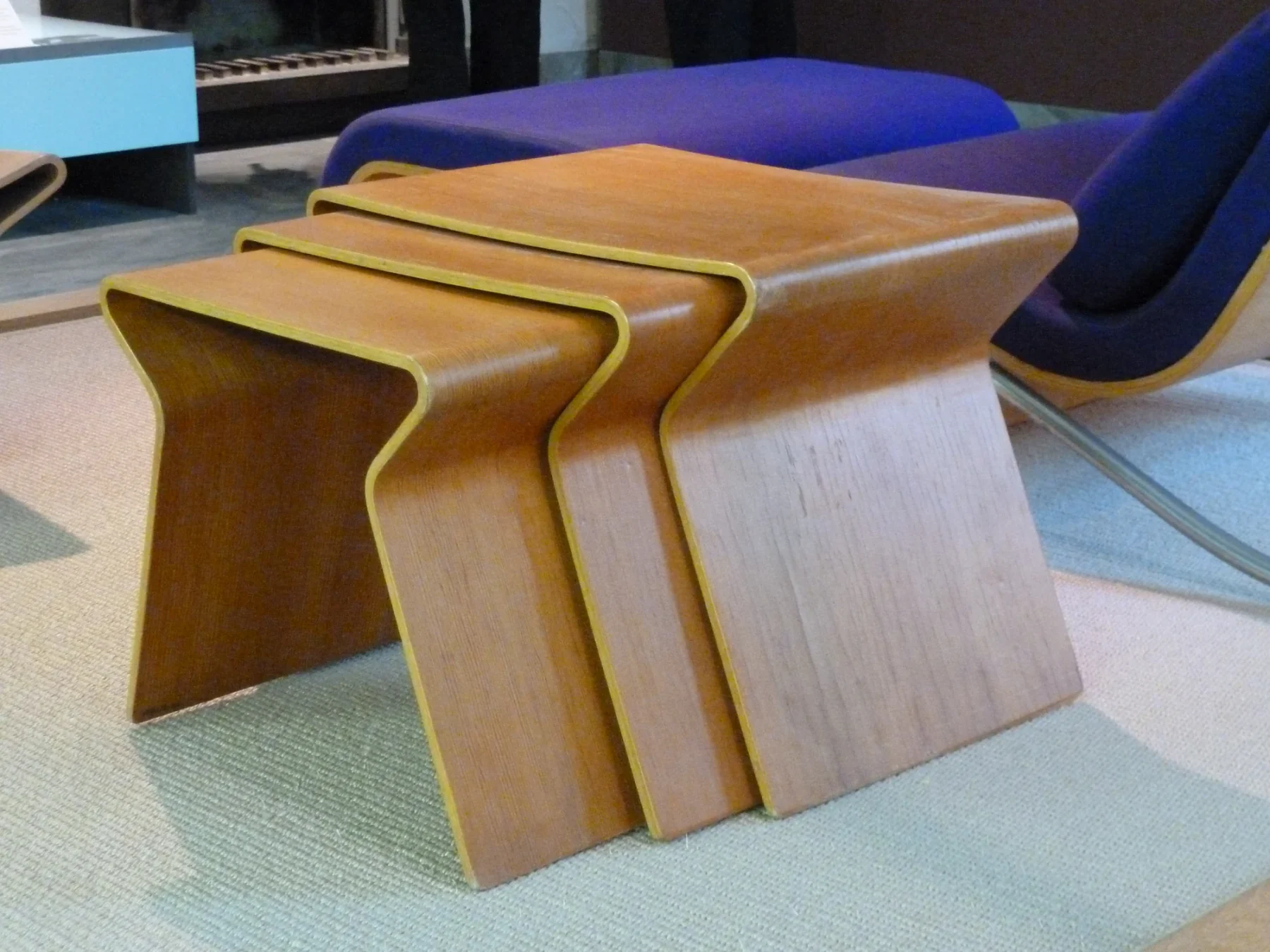
Give each table a job
One table might hold a reading lamp permanently while the others come out for guests. Another nest may need to move as a group each evening. Decide that routine first: a cable running across the extraction path can turn an elegant stack into a nuisance.
Measure the object you expect each top to hold. A cup and book need a different surface from a broad tray. Look at the usable area inside any raised edge, not just the widest point of a curved top. Do not assume that the smallest table is suitable for sitting.
Check the nest and the way out
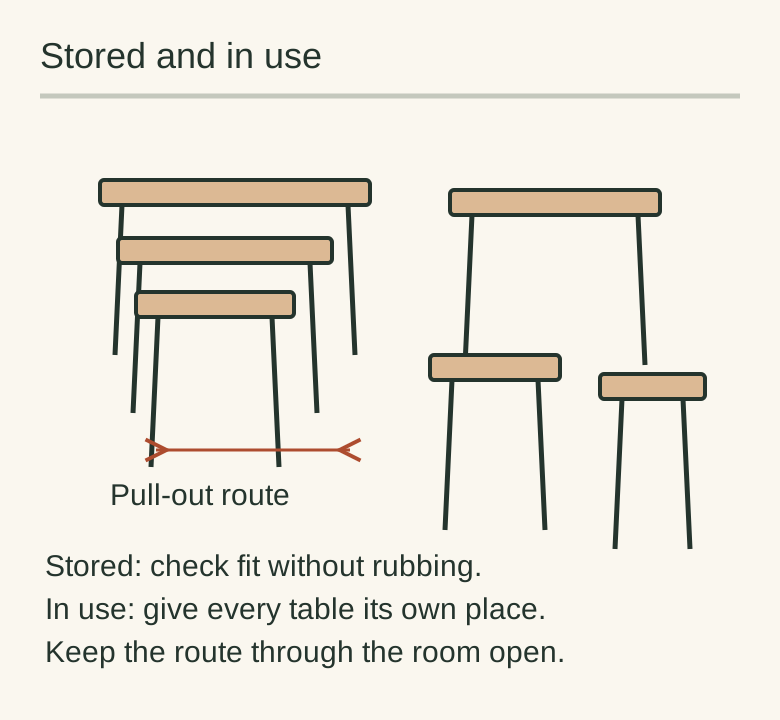
Record the largest stored footprint, then the height and width of every individual table. Include feet, stretchers and handles. Stand beside the nest and ask the seller to remove each piece in its intended direction. Does a smaller table slide out, lift out or require another table to move first?
Ercol’s Bosco nest description explicitly distinguishes two individual tables, with the smaller nesting inside the larger. Use that sort of product-level description to check the intended count; the phrase “nest of tables” alone does not tell you how many pieces should be included.[1]
Examine the smaller pieces just as carefully
A nest photographed from above can conceal a split leg on the lowest table. Ask to see all pieces separated, including their undersides and contact points. Check whether they stand without rocking on a suitable surface and whether any member rubs against the next table while being stored.
Look for scrape patterns that suggest a poor fit. A different finish is not automatically a problem, but an incompatible height or stretcher may indicate a replaced or married component. Compare construction, edge details and any markings across the group without assuming identical wear proves originality.
For every table in the nest
- Usable topWill the intended tray, cup or book fit without overhang?
- SupportAre the joints, legs or folded sides sound enough for the proposed use?
- Storage clearanceDoes it return without force or damaging contact?
- Individual recordCan you identify this exact piece in the seller’s inventory and delivery photos?
Try a guest-evening layout
For an illustrative plan, put the largest table beside the sofa, one small table beside an armchair and the third near a second seat. Now walk between the door and sofa carrying an empty tray. The trial often reveals that the useful place for a table is already part of the daily route.
Move the paper footprints before moving heavy furniture. Small tables can be easier to reposition, but a collection of them can fragment a room more than one coffee table. Choose the number you will use, not simply the largest complete set you can find.
Height is personal to the seat and task. Compare the top with an existing side table you find comfortable to reach. A low piece may work for occasional drinks but be awkward beneath a reading lamp whose switch you use repeatedly.
Buy the complete, workable group
Ask the seller
Please photograph the tables separated and nested, with an underside view of each. What are the individual dimensions, how are they removed, how many belong to the sale, and are any known replacements or repairs present?
If one table is missing, price and describe the purchase as the remaining group. It may still be useful, but finding a compatible replacement later is a separate search. Keep the inventory clear enough that every piece can be checked when it arrives.