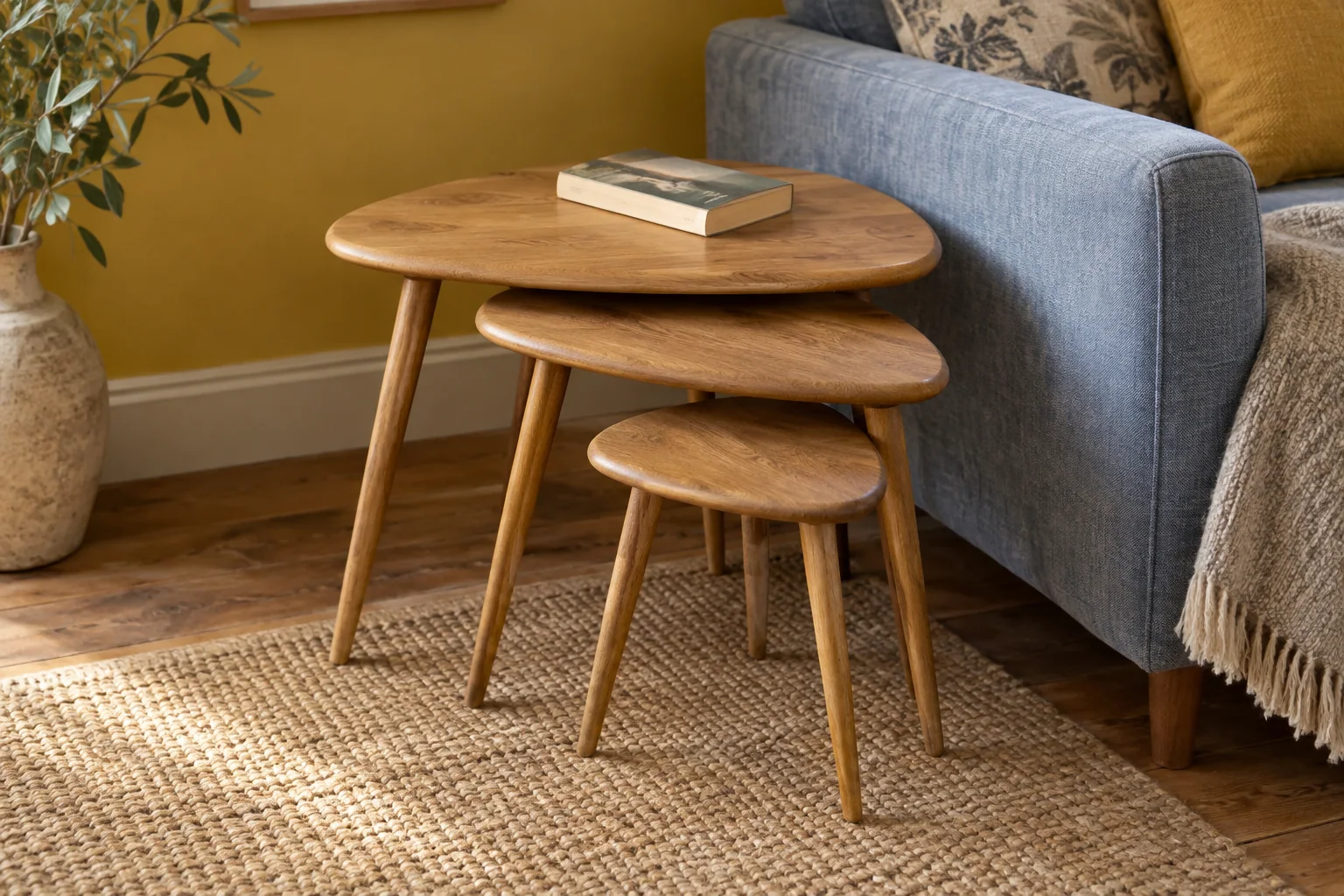
Not every Pebble listing should contain three tables
Ercol’s current 7354G is a three-table Pebble nest, with the largest table measuring 65 cm wide, 51 cm deep and 40 cm high. Its 7356G product sheet describes a larger two-table coffee nest, with overall dimensions of 91 by 66 by 44 cm. These are current product references, not dimensions to assign to every older set.[1]
The comparison matters in a real search. A listing with two large tables may be complete for its model; a small nest with only the largest and smallest may be missing the middle one. Ask for dimensions and underside identification before treating either as a bargain or a fault.[2]
Current wood and finish specifications are also edition-specific. Ercol lists ash for the current 7354G. Use records appropriate to the older set when discussing its timber, period and original finish rather than applying the current description backwards.[1]
For the design’s story, read Ercol Pebble tables: three places to put a cup in the Furniture Library.
Watch the middle table come out
Ask the seller to pull out each table normally and return it. The middle table is particularly revealing because it has to work both beneath the largest and around the smallest. Look for interference between legs and edges, unexplained rubbing and a table that only fits when turned awkwardly.
Wear from years of nesting can be ordinary information. It becomes a different question when a replacement leg, distorted top or mismatched component changes the clearance. Do not ask the seller to force the tables together to prove completeness.
| Record | Why you need it |
|---|---|
| Width and depth of each top | Tells you which temporary landing places the nest can provide. |
| Height of each table | Helps compare with the sofa seat and the reach to a drink. |
| Legs and underside | Reveals repairs, replacements and identification details. |
| Fit in the complete nest | Shows whether the set stores as intended. |
Plan for the tables while they are doing their job
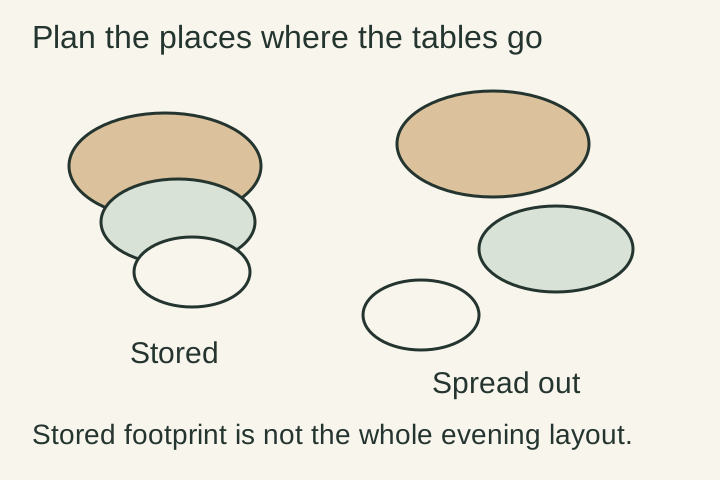
In a hypothetical small living room, the nest fits neatly beside the sofa but the smallest table is meant for a guest in an armchair. Mark that second position too. If it blocks the only walking route when used, the convenient stored footprint has concealed an inconvenient evening arrangement.
Try the height relative to the seats, including a lower lounge chair. A table that is easy to reach from a sofa may require an awkward lift from a low chair. Keep the small tables as surfaces for their intended use; their inviting shapes do not make them seats or steps.
When comparing with a single coffee table, count the places you need for cups and books. Three small surfaces let you distribute those places around people. A broad coffee table gives a continuous surface for a tray or game. Neither solves the other job particularly well.
One freshly refinished table can change the set
Compare the three tops in the same daylight. Different exposure and use can explain colour variation, and a modest mismatch may suit you. Ask whether one table has been stripped, repaired or replaced; do not assume the darkest or lightest one is the wrong piece solely from colour.
Inspect edges, legs and their connections. A rocking table needs checking on a level surface before blaming the legs, while visible movement at a joint needs assessment. New finish should not hide whether a leg repair was done or how an altered top affects nesting.
If only one table needs work, ask a restorer about the likely visual difference afterwards. Refinish all three only because that is the agreed outcome you want, not because matching a repaired spot has been promised casually.
Ask for one useful sequence
Message to adapt
Please show the complete nest, each table pulled out and the underside of all three—or both, if this is the larger coffee nest. Please include each top’s dimensions and height, identification details and any repairs or refinishing. Do they return to the nest without rubbing or being forced?
Choose a complete arrangement you can enjoy spread around the room. Their real pleasure is the little rearrangement when another person arrives and a table appears beside their chair.