Design story

Ercol Pebble tables: three places to put a cup

Ercol’s Pebble nest keeps three small tables in the space of one arrangement. Pull them apart and the room gains several places for a cup or book, each close to the person using it.

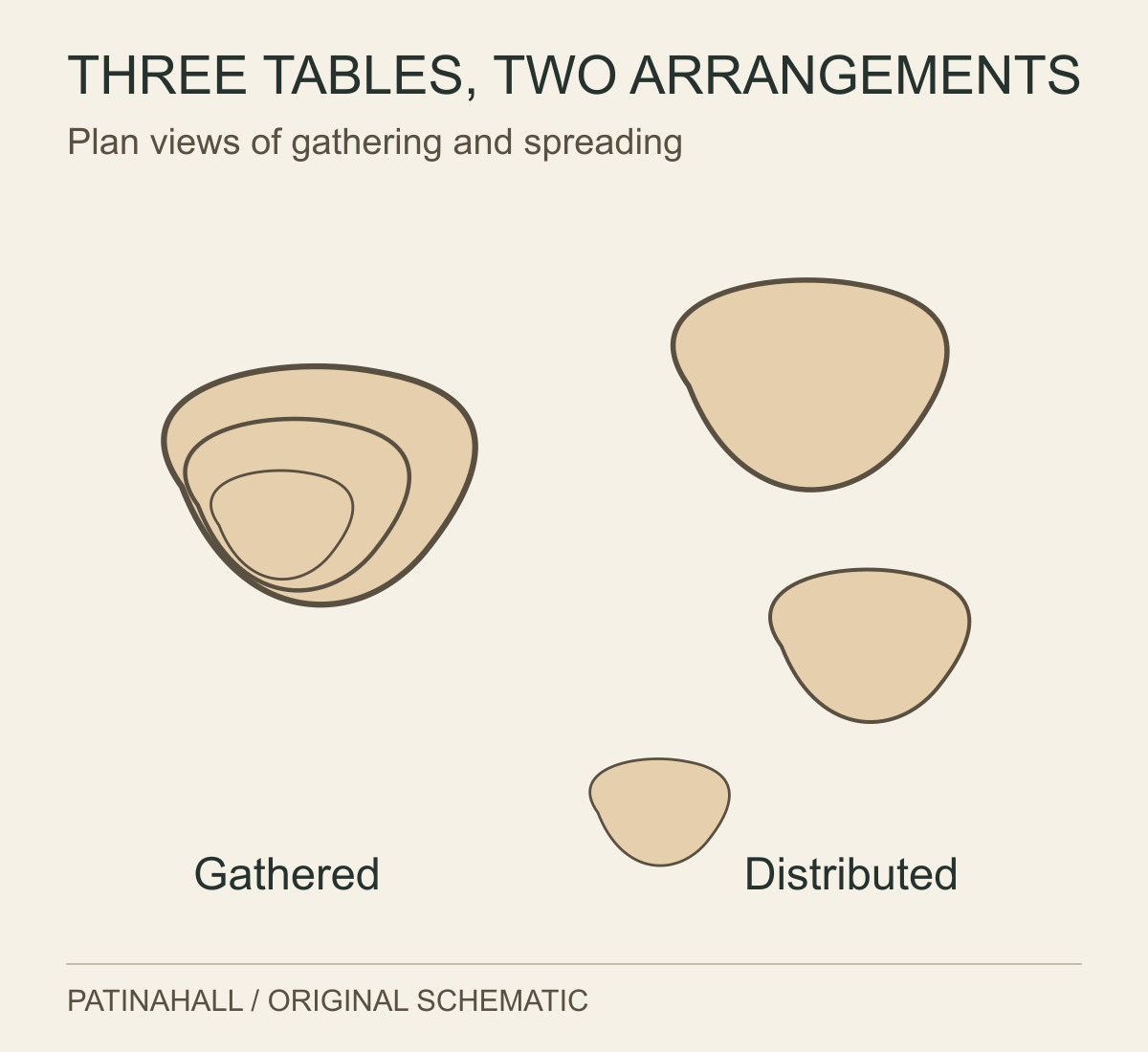
Three overlapping rounded tabletop shapes are compared with three separated shapes placed at different points in a room.
The tabletop shapes explain gathering and distributing a nest. Overlapping plan outlines abstract the stored arrangement; actual legs and clearances are omitted. Original PatinaHall schematic, not to scale.
On this page
Key facts & takeaways

At a glance

Subject
Ercol Pebble nesting tables
Entry
Design story
Last reviewed
6 September 2026

Three things to remember

  1. A nest uses graduated heights as well as different tabletop footprints.
  2. The tables remain separate objects that can be distributed around a room.
  3. The current three-table 7354G and larger two-table 7356G are distinct products.

A small table can travel closer

A large coffee table puts one shared surface in the middle of a room. A nest of small tables offers another possibility: bring a surface towards each person, then gather the tables together afterwards. Ercol’s Pebble nest gives that practical idea a soft, rounded appearance.

The manufacturer describes three individual tables, with the smaller ones fitting beneath the larger ones. Their curves and tapered legs make the arrangement legible even before anything moves. You can see a family of related forms, each slightly reduced for a different place in the nest.1

The smaller table needs somewhere to go

Nesting asks more of a design than simply drawing three similar tops. A lower tabletop needs to pass beneath the upper one; its supports also need to avoid the supports around it. Height, footprint and clearance work together.

The shapes make that relationship pleasant to look at. Seen from above, the rounded tops do not form the rigid outline of three rectangles. Seen from the side, their changing heights explain how one object shelters another. The diagrams separate those two views so the storage principle is easier to follow.

There is no transformation mechanism hidden inside this arrangement. Each table keeps its own form when moved. The room changes because the pieces change position, which is a different kind of flexibility from a hinged or extending tabletop.
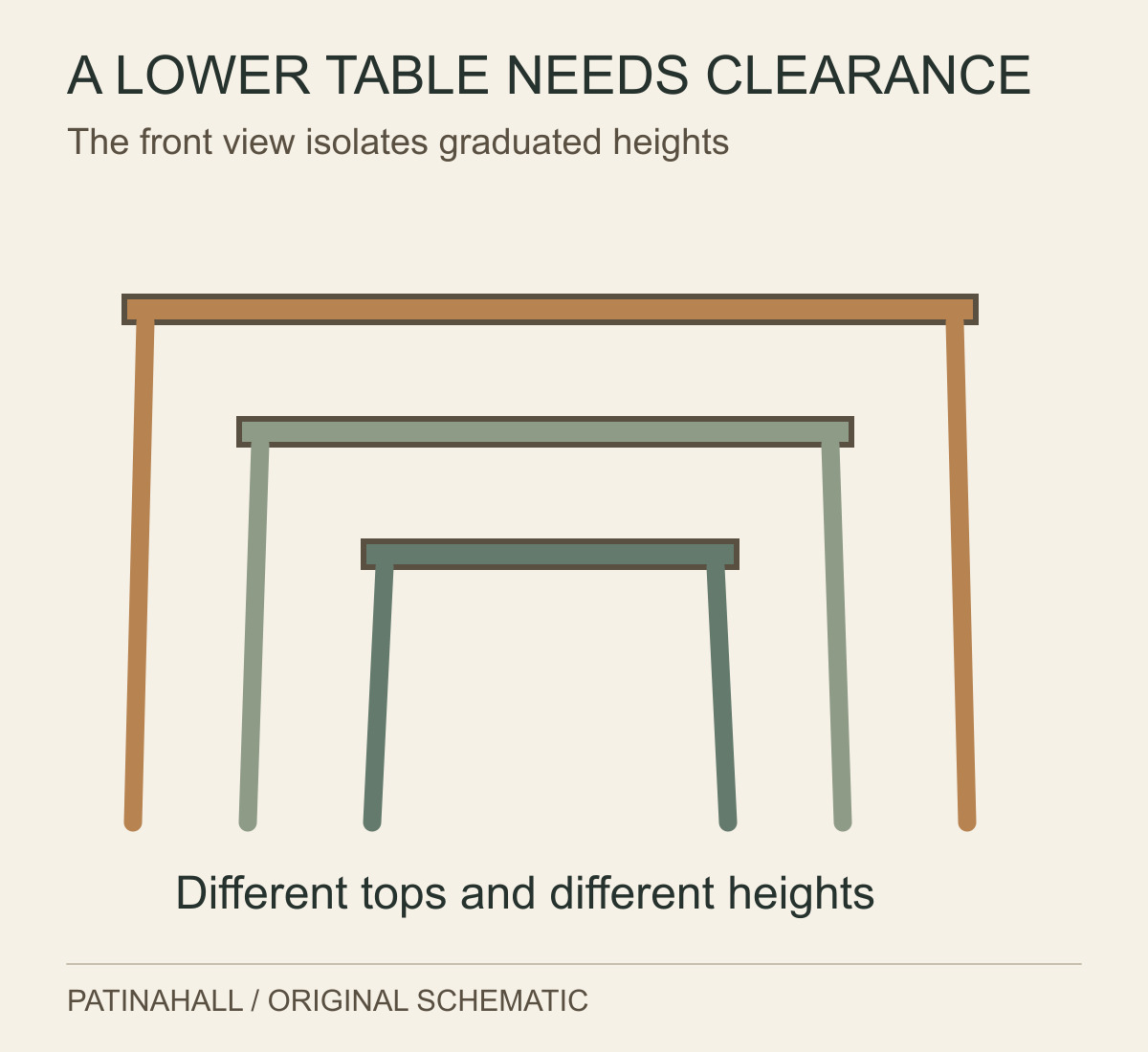
Three simplified table fronts nest at decreasing heights, showing why smaller tops must also be lower to fit beneath the larger table.
Graduated heights and widths explain the nesting principle. The flat front view omits Pebble’s curved top outlines and does not supply dimensions for matching separate tables. Original PatinaHall schematic, not to scale.

A Pebble family, with different members

Ercol’s account of the larger coffee-table nest traces the earlier Pebble design to its founder, Lucian Ercolani, in the mid-1950s. The current 7354G data sheet credits Lucian R. Ercolani and specifies solid ash for the three-table nest.23

The same sources make it possible to separate related objects. The 7356G coffee-table nest consists of two larger tables and carries an in-house design-team credit. It develops the earlier idea at another scale. Calling both products Pebble describes a relationship, not an identical specification.2

For the 7354G, Ercol also describes its work with Grown in Britain and the use of British-certified ash. That is information about the current product. An older table’s wood should be understood through its own production record rather than borrowed from today’s catalogue.1

Three surfaces, one conversation

Imagine the nest beside a sofa. One table moves to an armchair with a cup, another carries a book, and the largest stays where it began. Nothing has become longer or wider, but the usable surface has been distributed through the room.

When the smaller tables return, their familiar curves assemble into one compact group. That is the particular charm of the design: the stored arrangement is itself a considered piece of furniture. The tables do not have to disappear into a cupboard to stop occupying separate places on the floor.

Research notesEvidence, connections and limits

Ercol’s current product accounts supply the family history, designer credit and ash specifications. They do not establish a single exact design year, the timber of every vintage example or a promise that separately sourced tables will form a correctly matched nest.

Evidence map

Connected subjects and evidence

Reviewed connections

  • Ercol Pebble nesting tablesdesigned byLucian Ercolanidocumented

    Ercol documents Lucian Ercolani in the designed by role for Ercol Pebble nesting tables. This relation describes the design family, not the origin of an individual secondhand object.

    Reviewed 6 September 2026 by PatinaHall editorial.
    • Source 3Design, material or production account; scope described in the evidence note
  • Ercol Pebble nesting tablesmanufactured byErcoldocumented

    Ercol documents Ercol in the manufactured by role for Ercol Pebble nesting tables. This relation describes the design family, not the origin of an individual secondhand object.

    Reviewed 6 September 2026 by PatinaHall editorial.
    • Source 1Design, material or production account; scope described in the evidence note

Research trail

Sources and further reading

  1. Ercol Collection Pebble Nest of Tables, 7354GErcolAccessed 6 September 2026
  2. Pebble Coffee Table Nest, 7356GErcolAccessed 6 September 2026
  3. 7354G Pebble Nest of Tables: data sheetErcolAccessed 6 September 2026

Last reviewed 6 September 2026. Found an error or a stronger primary source? Contact PatinaHall.