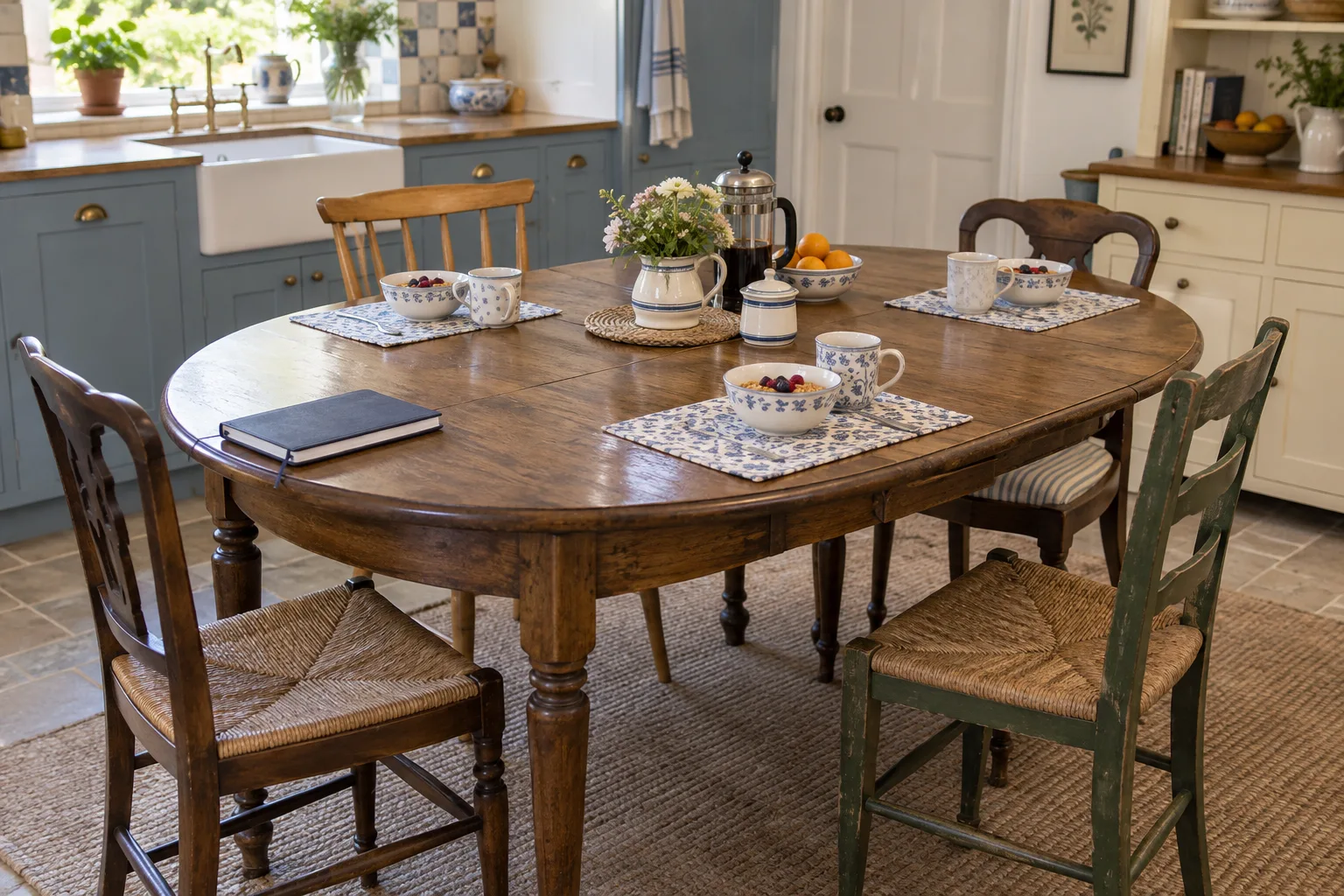
Describe your Tuesday before your dinner party
Breakfast may be followed by a laptop, a puzzle, homework and dinner at the same table. Write down those actual jobs before comparing silhouettes. A delicate surface can still belong in a busy home when you enjoy protecting it. It becomes a poor fit when every ordinary meal feels like supervising a museum visit.
Decide which marks you can accept and which would bother you. A worn farmhouse top, a glossy veneered surface and a patterned laminate can each make sense, but they ask different things of your eye and routine. “Practical” needs to mean practical for the people who will clear and wipe this table.
Try the everyday arrangement first: the chairs you already use, their arms and the space beneath the apron. Lay out your usual plates and serving dishes with paper templates if you cannot visit with them. A table that accommodates eight occasionally may still place a leg exactly where one of four regular diners wants to sit.
Keep delivery and room circulation in the separate measuring Guide. Here the aim is to discover whether the table works between deliveries, birthdays and other exceptional occasions. Most of its life happens on an ordinary weekday.
Choose the surface routine, not just the wood name
Ask what is on the top now and what work was done to it. A teak name does not establish an oil finish, and “refinished” does not explain the coating. CCI’s discussion of furniture finishes makes the distinction useful: a finish is a separate layer that can be difficult to identify. Obtain the restorer’s actual record where possible.[3]
| Candidate | Question before choosing it |
|---|---|
| Known coated or restored wooden top | What exact cleaning method and protection does the maker or restorer specify? |
| Older top with an uncertain finish | Can it be assessed before you commit to the way you intend to use it? |
| Laminate top | Are the face, edges and supporting panel sound, and what instructions apply to this surface? |
| Top with existing marks | Which marks can stay, and which need a priced, agreed repair? |
Carl Hansen’s wood guidance advises prompt removal of liquid and avoiding excessive water and harsh cleaners. Those principles support a restrained routine; they do not identify the finish on an unrelated antique table. Use the care instructions that belong to the known surface.[1]
The same maker describes its laminate surfaces as straightforward to clean while warning about staining substances, unsuitable abrasives and wax-based products. That is a useful counter to both “laminate needs polishing” and “laminate cannot be damaged”. A vintage laminate top still needs its face, edges and core assessed.[2]
Think through where hot serving dishes, wet glasses and drawing materials will go. Choose appropriate trivets, coasters or a protective working mat for the known finish and remove them when no longer needed. A cloth can be part of the routine you enjoy; it should not be the only thing making an unexplained failing surface usable.
Buy the extension you will actually operate
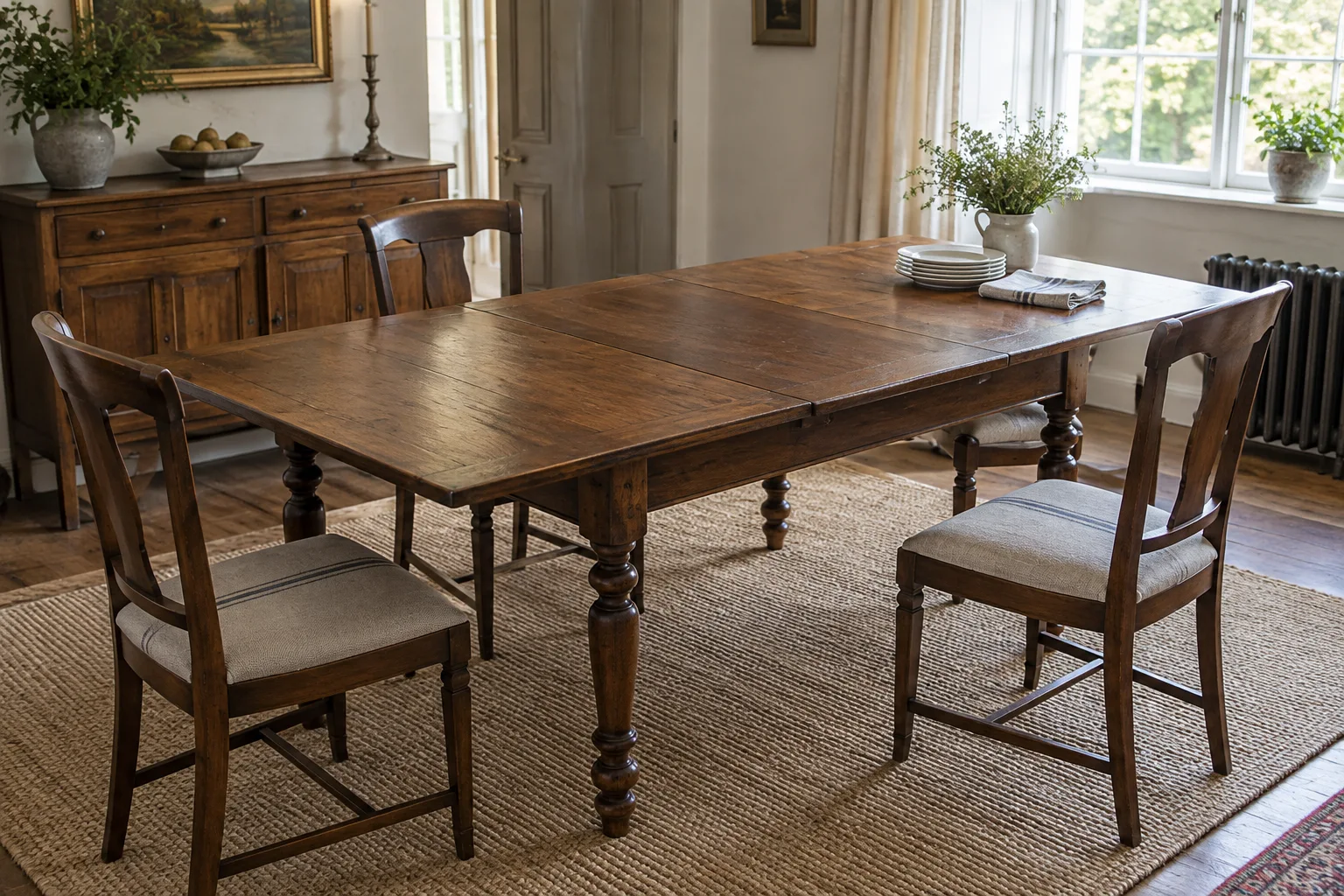
Ask the seller to demonstrate the table from its everyday size to the configuration being offered, using only normal handling. Count the leaves, supports and fasteners and confirm which belong in the sale. A photograph of the larger arrangement does not show the effort, space or loose pieces needed to reach it.
Consider who will extend it. If two people are needed and you usually set the table alone, that matters more than a clever mechanism in an old catalogue. Do not force a stiff runner or lean on an unsupported leaf to test it. Have unexplained movement, poor support or a binding mechanism assessed.
Ask where a loose leaf will live. Measure the actual leaf and the route to that storage place, including its protection. A table with an appealing compact size may be inconvenient if its extra top spends the rest of the month leaning against a radiator.
Compare the colour of the leaves and main top in daylight. A leaf stored away may look different from a surface that has remained exposed. Decide whether that contrast suits you before planning broad refinishing. The maker’s wood guidance notes uneven colour changes when parts of a surface are covered; colour difference alone does not explain every case.[1]
Compare the finished week, including the work
Put the candidates through a small written scenario. Four people eat here every day; one works at the table in the afternoon; six visit twice a month. Candidate A needs extending for six and has separate leaves. Candidate B stays large but narrows the route to the kitchen. Neither wins by size alone. Choose which repeated compromise you prefer.
Add agreed repairs, delivery and any protection you will actually buy to each price. Ask who will assess the frame or mechanism, which marks remain and when the finished surface can enter normal service. Do not treat the seller’s “just needs a coat of oil” as a scope of work.
Ask about ordinary use
I want to use this table for daily meals and occasional work, with this number of chairs. What finish or surface is present, what care does it need, and what repairs are known? Please show the underside, the full extension sequence and all included leaves, and identify any movement or work still required.
Pick the table whose everyday compromises you understand. Some people will happily lay a cloth; others will prefer a surface they can leave visible through most meals. Both can be good vintage choices when the object’s condition and the household routine agree.