Murano is a place of production, not one lamp model
A coloured glass lamp can do a lovely small job in a room: warm a dark cabinet, soften the corner of a desk or add colour without another large piece of furniture. Start with that use. You can enjoy an unidentified glass lamp, provided its description and price do not depend on a story that has not been established.
“Murano”, “Italian”, a furnace name, a designer and “1970s” are separate claims. A seller may have good evidence for one and little for the others. Ask which claim is documented and what the document actually identifies: the glass, the complete lamp, a similar design or a previous owner’s description.
The Glass Museum’s record of Linea Vetro Murano, for example, describes a particular workshop founded in the 1970s and known for lighting as well as sculptural glass. A source naming that workshop does not attribute every similarly coloured light to it. The useful next step is an exact catalogue, model record or documented comparison that connects the proposed name to the object.[2]
Compare the complete outline and construction, not only a striking swirl. Ask about dimensions, whether the shade and stem are separate, the shape of the opening, how the glass is supported and the location of any mark. Similar decoration can appear on different forms, and a photograph can conceal the point where a lamp has been adapted.
Read the label in its own time
The current Vetro Artistico Murano origin scheme has a specific history. Promovetro explains that it was established under a 1994 Veneto law and that its label gained a serial number and datamatrix code in 2016. Its purpose is to certify Murano production through the participating company; it is not a universal dating label for older glass.[1]
| What you have | What still needs establishing |
|---|---|
| A current traceable origin label | Verify it through the scheme and connect the result to this glass object; it does not independently prove a 1970s manufacture date. |
| An older maker or retailer label | Identify whose label it is, its documented use and where it sits on the lamp. |
| A missing label | Continue with construction, provenance and exact records; absence alone does not settle origin. |
| A handwritten designer name | Ask who wrote it and on what evidence. A later attribution is not a maker’s record. |
For a worked example, suppose a listing calls a lamp “1970s Murano” and offers only a photograph of a current serial-and-datamatrix label. That evidence needs an explanation connecting the label, the glass and the proposed date. It does not prove the lamp is modern, but it does not establish the 1970s claim either. Keep the date unresolved until the seller supplies that connection.
Record a mark in place and transcribe only the characters you can read. Do not rub a fragile label, peel it back or polish an inscription to make it more convincing. If a substantial part of the price rests on a named furnace or designer, seek a specialist opinion before treating an uncertain match as settled.
Glass and hardware may have different histories
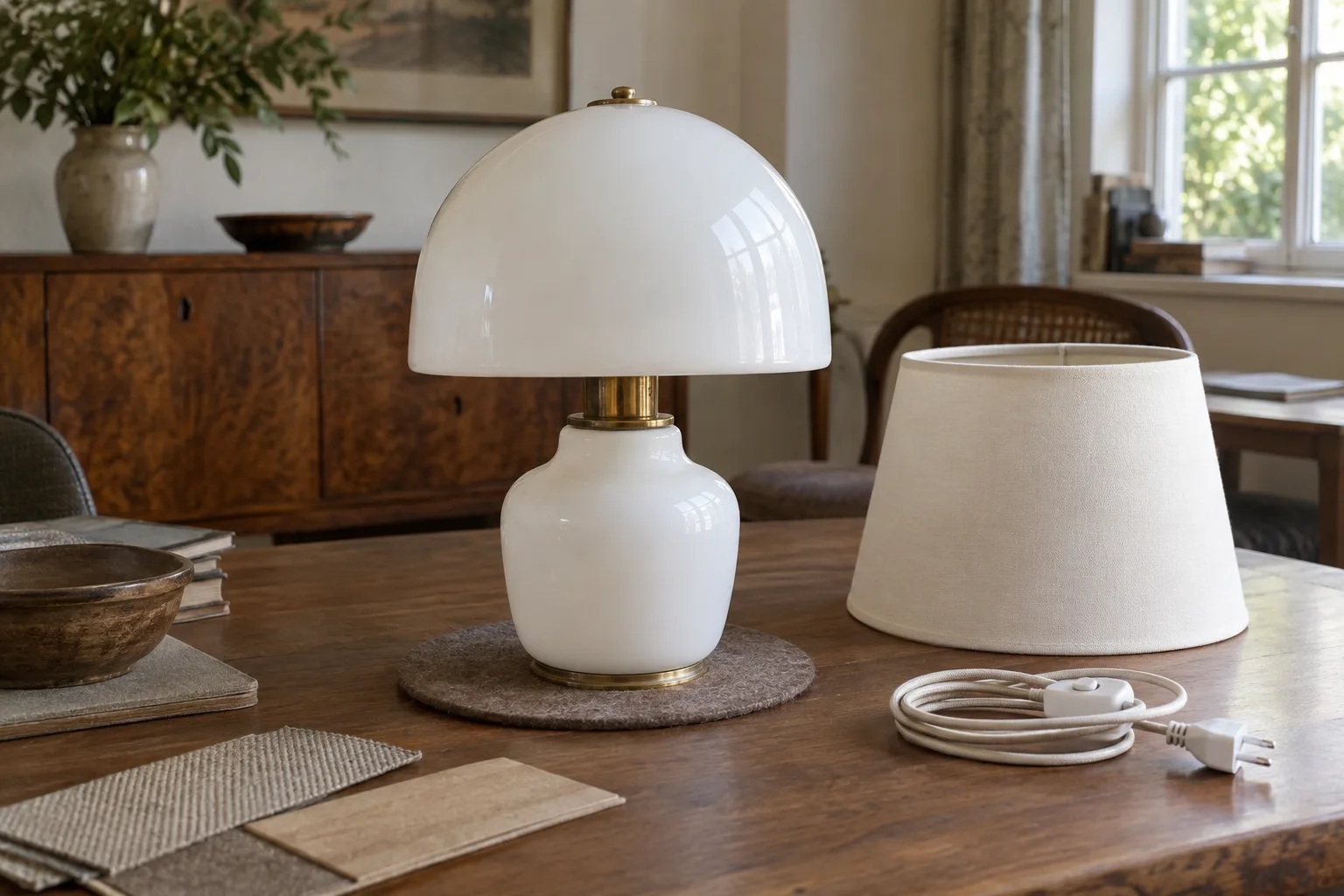
Ask for the lamp unpowered, with clear views of the rim, base, supports and any opening that is already safely visible. Look for chips at contact points, repaired breaks, unstable seating and washers or supports that seem improvised. Note the observation and location; let a competent specialist determine the significance.
A replaced cable can be a sensible service decision. A drilled glass body, a substituted support or a different shade is a more involved assembly question. Ask what was altered, who did it and whether the glass and fittings were assessed together. “Rewired” does not explain whether the weight is properly supported or whether a replacement part bears against a vulnerable edge.
Do not ask the seller to take apart fragile glass to satisfy a photo request. If an important opening or fitting cannot be seen safely, make inspection part of the service plan. The electrical professional should establish the requirements for the actual lamp and where it will be used, including its holder, cable, switches and installation as applicable.
Think about light as well as glass. If the lamp is already professionally cleared for use, view it in the intended lighting condition and from the seat beside it. A beautiful unlit colour may produce a very different effect when illuminated. A photograph with a glowing shade is not evidence that the electrical assembly has been checked.
One missing piece can decide the purchase
Before buying an incomplete lamp, send the identified model, dimensions, support arrangement and photographs to a suitable glass or lighting specialist. Ask whether a replacement is available, whether it fits this assembly and what will remain visibly different. A similar colour or diameter is not a compatibility specification.
Ask for the complete offer
Please state which origin, maker and date claims are supported, and send the relevant records with full and detail photographs. Identify replaced or repaired glass, altered fittings, missing parts and documented electrical work. I need to understand the complete lamp, including the cost and route for any further service.
Compare the purchase plus that confirmed work with a complete alternative. If the name remains uncertain but the shape, condition and useful light justify the price to you, describe the uncertainty honestly. If the value depends on the attribution or the replacement shade, resolve that part before arranging delivery.