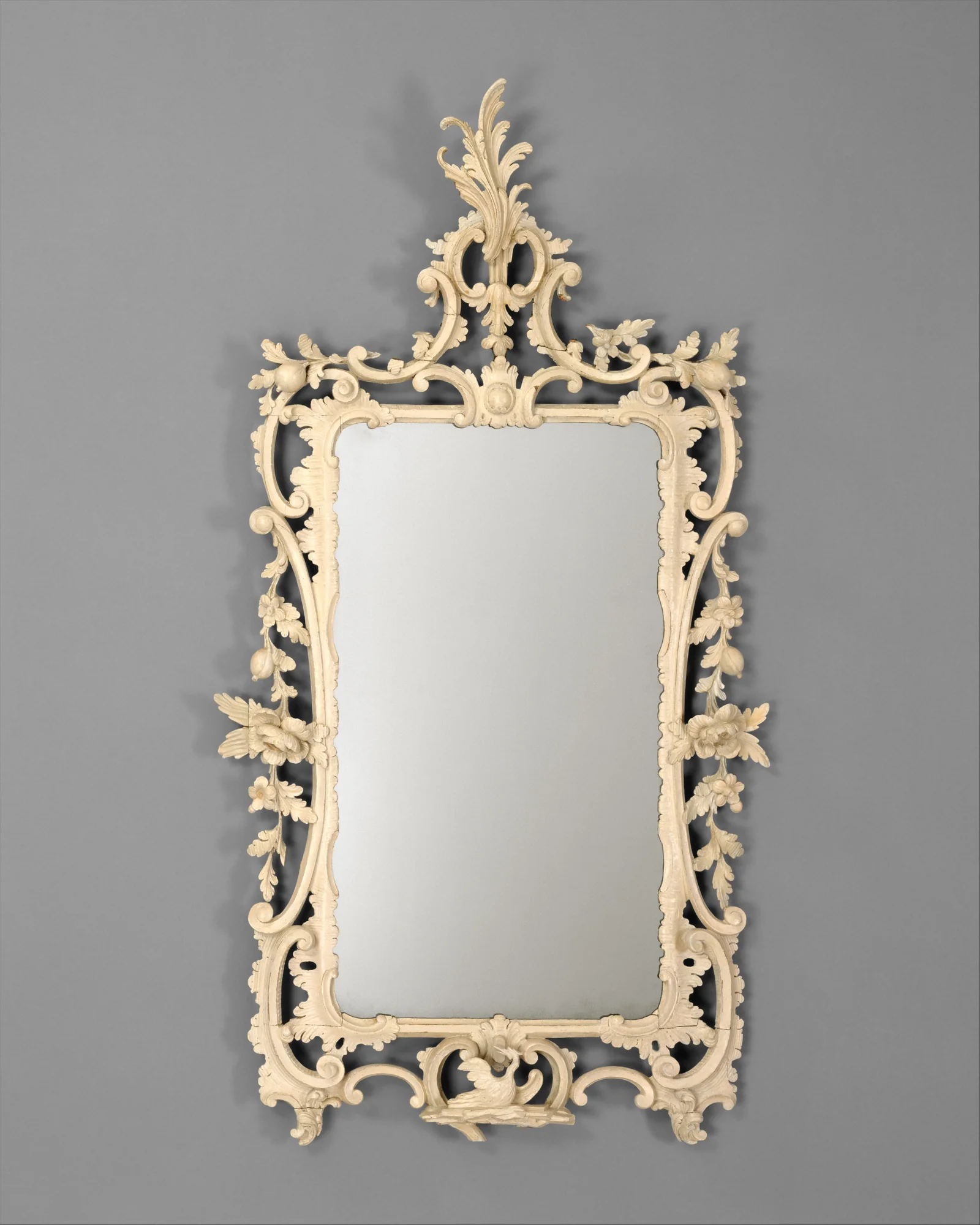
Start with the view you need
Do not begin with a generic rule for how high a mirror should hang. Begin with the job and the person using it. Mark the intended wall area without drilling, stand at the real distance and record what must be visible: face at a dressing surface, upper body in an entrance, a useful full-length view, a reflected artwork, or more light from a particular window. The required opening and position belong to that room and view.
Write the viewing brief
- Primary user and positionRecord who uses it, whether they stand or sit, and the normal distance and route in front of the wall.
- Required reflectionName the useful top, bottom and side limits rather than asking only for a decorative size.
- BackgroundCheck what the mirror will actually reflect from the intended position, including doors, clutter, direct light and private areas.
- ToleranceDecide whether old glass distortion, scattered silvering loss or a deliberately small opening is welcome, acceptable or wrong for the job.
No universal height
Test the view, not a styling formula
A full outer frame does not guarantee a full-length reflection, and a smaller mirror can provide a useful view at the right distance. Use a paper or tape outline for orientation only; a competent installer still owns the final position and attachment.
Measure the object, reflection and wall
Ask for metric measurements from named reference points. Decorative crests, feet, side scrolls and projecting ornaments belong to the outer envelope even when they do not enlarge the reflection. Measure the visible glass at several points if the frame curves or overlaps it, then record the deepest part of the complete back and fixed hardware—not only the front moulding.
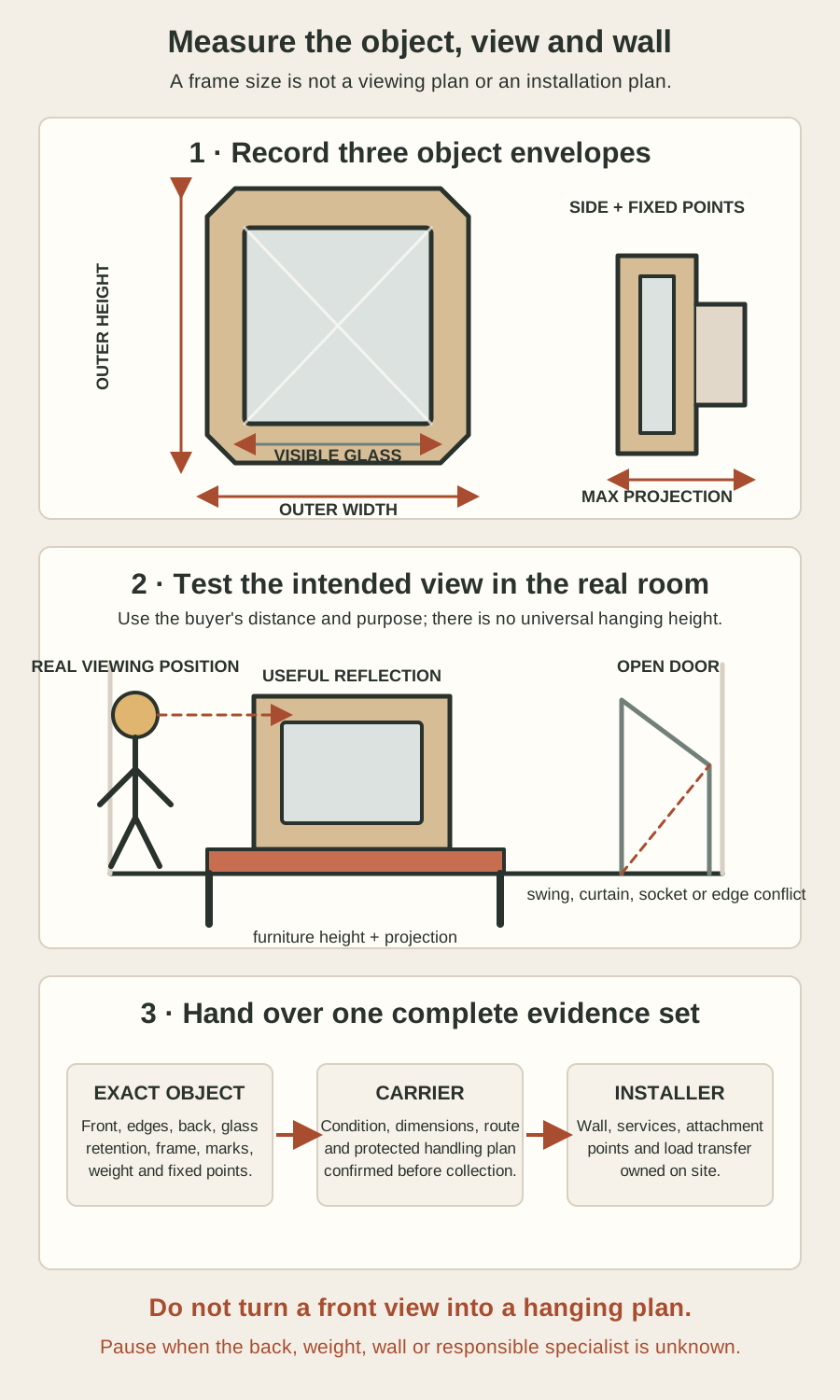
| Envelope | Record | What it decides |
|---|---|---|
| Outer object | Maximum width and height including decoration, maximum depth, fixed projections and actual or documented weight | Wall space, route, packing, handling and professional installation brief |
| Reflective opening | Visible glass width and height at the narrowest and widest relevant points plus the intended viewing position | Whether the mirror provides the useful reflection the buyer needs |
| Occupied wall | Available width and height, furniture, skirting, sockets, switches, doors, curtains, edges and circulation | Whether the full object and its everyday surroundings can coexist |
| Protected route | Carrier-confirmed packed dimensions, orientation, turns, lifts, stairs, doors and temporary resting space | Whether the exact fragile assembly can reach the wall responsibly |
Ask for front, edge and back evidence
A straight-on front view is the beginning, not the inspection. Ask for the complete mirror in diffuse light, the reflection from the buyer's likely position, and low oblique light across the glass without using heat or a harsh improvised test. Then connect every close view to the exact front location and corresponding back area.
Build one complete mirror record
- Whole frontShow the complete outline, reflective opening, colour and any obvious loss without cropping the crest, feet or side decoration.
- Glass surfaceUse diffuse and gentle oblique views for cracks, chips, scratches, clouding, spotting, edge loss and local distortion.
- Every edgeShow frame joints, layered construction, projecting ornament, exposed glass edges and changes in maximum depth.
- Complete backShow backing, retention, repairs, labels, inscriptions, fixed attachment points and every area that is safely visible without opening it.
- Relationship viewsFor each crack, loose area, repair or missing element, keep one whole, one close and the corresponding reverse or edge.
Use the photograph-request Guide for the three-distance method. Do not ask a seller to lift, turn or dismantle a large or unstable mirror merely to complete the sequence; a responsible specialist can own the missing view.
Inspect the glass without diagnosing from spots
The Canadian Conservation Institute describes glass as hard but brittle and vulnerable to cracking or breaking on impact. Treat chips, cracks, loose-looking edges and an uncertain frame relationship as handling questions before they become cleaning or display questions.[3]
| Observation | Ask next | Do not conclude |
|---|---|---|
| Dark, cloudy or missing reflective areas | Extent in consistent light, corresponding back condition and known treatment history | Exact coating, age, cause or future stability from the front |
| Wavy or uneven reflection | Whether it is local or whole-sheet, acceptable from the intended distance and associated with visible damage | That distortion alone proves hand-made age or authenticity |
| Scratch, edge chip or crack | Full path, nearest edge, corresponding reverse, movement history and conservator or glazier assessment | Remaining strength or safe transport from size alone |
| Glass seems loose in the frame | Seller report, retention views and professional handling assessment without shaking or pressing | That adding pressure, wedges or tape is an acceptable test |
| Surface appears dirty | What is on the glass versus behind it and whether decoration or old coatings are adjacent | That liquid, solvent, scraping or polishing is safe |
Glass boundary
Do not test a reflection by stressing the assembly
Do not press, flex, tap, shake, scrape, wet, heat or remove the back to identify glass or silvering. When the exact state changes transport, repair or use, a conservator or appropriately qualified glass/frame specialist owns the assessment.
Inspect frame, retention and back as one assembly
The Met records Looking Glass 1990.18 with a carved painted-wood frame and mirror glass. It also notes that the object's label names a retailer rather than the maker. The record is a useful reminder that frame, glass and marks carry different facts; even an exact front photograph cannot answer for the unseen back or present hanging points.[1]
Trace the load path without testing it
- Frame corners and joinsRecord gaps, movement reported by the seller, old glue, pins, screws, plates, added blocks and previous structural work.
- Applied decorationMap missing, lifting, cracked or overpainted ornament and every projection vulnerable during wrapping or lifting.
- Glass retentionShow the safely visible rebate, clips, points, strips, backing and changes without removing or tightening anything.
- Backing and labelsKeep boards, paper, seals, inscriptions and labels in place; record tears, openings, moisture traces and later alterations.
- Fixed hanging pointsShow every ring, plate, cleat, wire or cord and its connection to the frame, while leaving capacity unresolved.
CCI's conservative guidance for framed works says to inspect loose parts, weak frame joints and glass before handling; never carry by wire, one edge or the top; and use a trolley where a large or heavy frame requires it. A mirror has its own exact construction and may need a stricter specialist plan, but the principle is clear: decorative moulding and old hanging wire are not assumed handling points.[2]
Map the wall, room and reflection
Draw the full outer outline on a wall elevation and the maximum projection on a side view. Add the furniture below or in front, open doors and drawers, curtain movement, sockets, switches, skirting, corners and ordinary walking route. Then stand at the real viewing position and check the background and light at the times the mirror will actually be used.
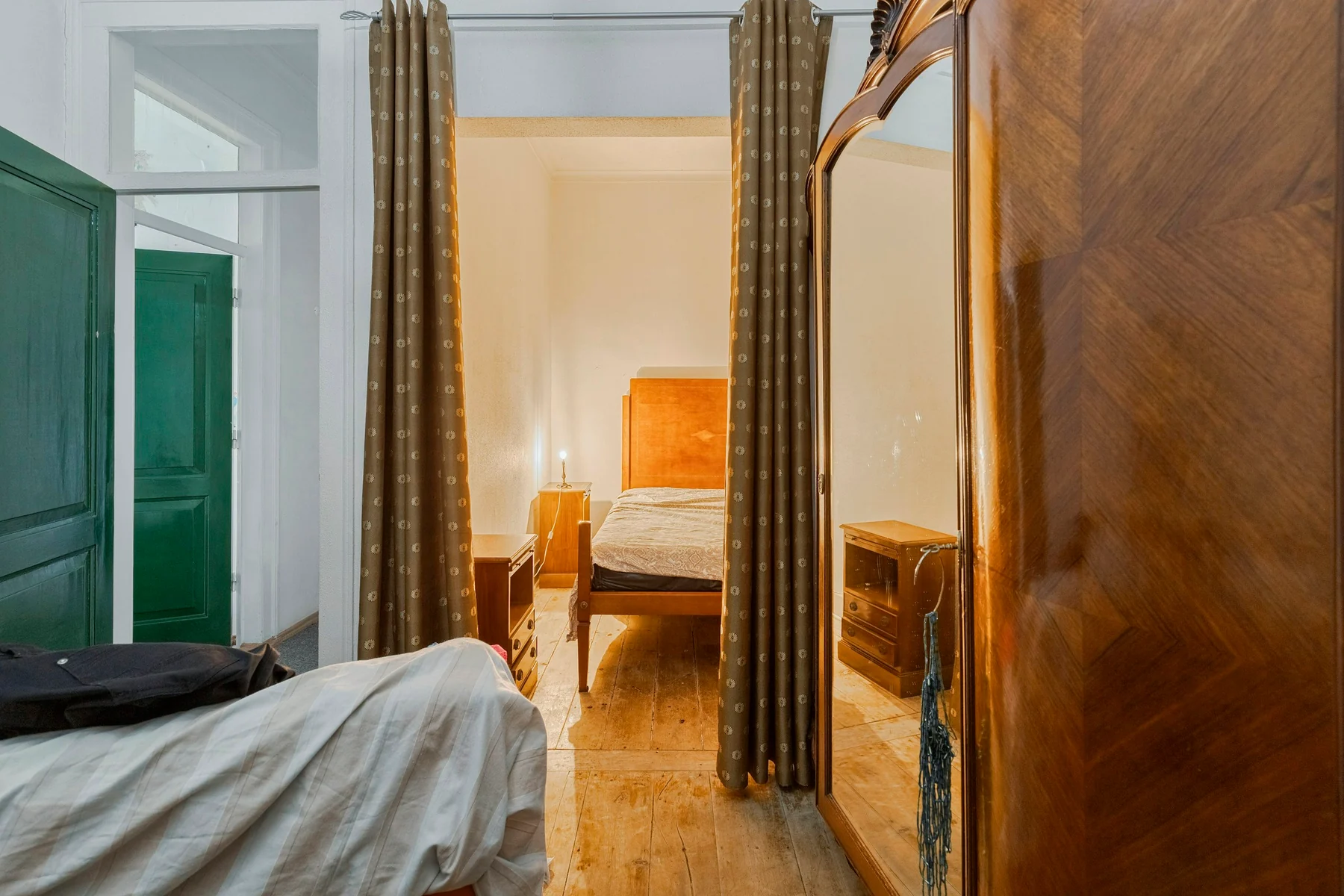
Review the occupied state
- Furniture relationshipKeep enough space for the frame, decoration, cleaning access and the full open state of furniture below.
- Door and curtain movementMap swing, handles, fabric and nearby circulation against the mirror's projection and vulnerable edges.
- Useful reflectionTest the primary user and distance, then check other ordinary users without promising one universal eye line.
- Light and privacyReview glare, direct sun, reflected windows, screens, private rooms and what becomes visible from the doorway.
- Wall evidenceRecord only known construction and services; leave concealed structure and suitable attachment to the installer on site.
A listing-room photograph cannot solve this drawing. It may use a different camera height, crop, lens, wall, light and distance. The buyer's room test establishes whether the mirror is useful; it still does not certify a mounting position.
Give transport to a specialist carrier
Send the carrier the full outer dimensions, projection, actual or documented weight, glass and frame condition, vulnerable decoration, fixed attachment points, collection-floor route and destination route before accepting a quote. Ask whether the mirror travels framed and intact, which orientation and support the exact assembly requires, how it is protected from impact and vibration, and who stops if the condition differs at collection.
| Evidence supplied | Carrier confirms | Buyer records |
|---|---|---|
| Complete front, edges, back, condition and dimensions | Collection handling points, people/equipment, orientation and protected package | Agreed scope and any condition that changes it |
| Stairs, turns, lift, doors and temporary resting space | The protected object can pass the route without improvisation | Route measurements and access responsibilities |
| Cracks, loose areas, old repairs and vulnerable decoration | Whether a conservator, glazier or frame specialist must act before movement | Named professional handoff and unresolved risk |
| Destination wall and installation appointment | Safe temporary support and who transfers custody to the installer | No unattended leaning or ad hoc storage gap |
Use the delivery-route Guide for protected dimensions and turning envelopes. The carrier, not the seller's front photograph, decides the exact packaging and movement method.
Give the wall decision to the installer
National Park Service exhibit guidance requires a framed object's fastener to support its weight and transfer that load into a wall designed to accommodate it. For a home purchase, the honest translation is a professional brief: exact object, actual or documented weight, fixed frame points, intended position, wall construction and known services reviewed together on site.[4]
The installer owns
- Wall and concealed servicesConfirm structure, finish, voids, pipes, cables and any condition that changes location or attachment.
- Frame attachment pointsAssess whether existing plates, rings, cleats, wire or later hardware are suitable, require conservation or must not carry the mirror.
- Load transfer and restraintSpecify the complete attachment for the exact mass, geometry, wall, use and local conditions.
- Final positionReconcile the buyer's useful view and room clearances with safe working access and the approved attachment.
Installation boundary
No fastener shopping list belongs in a universal Guide
Do not reuse seller screws, select a hook from a claimed weight alone, copy the museum installation or drill a trial hole to make the purchase work. A competent installer owns the exact wall survey, attachment and load path.
Recognise when the coating needs a conservator
A conservation reference indexed by the Smithsonian explains that historic tin–mercury mirror coatings were used for centuries and can require special precautions during transport, repair and disposal. Do not identify such a coating from spotting, waviness or seller folklore. When an early amalgam is documented or reasonably suspected, keep the back closed and ask an appropriate conservator to define the next step before movement or work.[5]
Stop and seek specialist advice when
- The coating is documentedA conservation record, provenance or specialist examination identifies an early amalgam or another treatment needing controlled handling.
- The back is disturbedLoose material, droplets, powder, damaged sealing or an opened historic backing is reported or safely visible.
- Repair requires openingGlass removal, re-silvering, backing work, disposal or frame intervention would expose concealed layers.
- Condition changes the moveCracked glass, loose retention, a failing frame or uncertain material makes ordinary collection inappropriate.
The professional may conclude that the age effects can remain exactly as they are. The value of the handoff is not automatic treatment; it is a scoped decision that protects the object, handlers, home and evidence before an irreversible intervention.
Send one complete vintage-mirror request
Message to copy
Ask for the object, view, wall and handoff facts
Hello—could you show the complete mirror straight-on in diffuse light, gentle oblique views across the glass, every edge and the complete back only where this can be done safely? Please include whole, close and corresponding reverse views for every crack, chip, dark or cloudy area, loose part, frame loss, repair or altered fitting. Could you measure the maximum outer width, height and depth; visible glass at several points; every fixed projection; and give the actual or documented weight if known? Please show all labels and fixed hanging points in context and say what is original, replaced, repaired, loose, opened or untested only as known. Please do not press, shake, scrape, wet, dismantle or lift an uncertain mirror for the inspection. I will confirm the protected route with a carrier and the exact wall and attachment with an installer. Thank you.
Buy when the useful reflection works at the real distance, the complete object and wall envelopes agree, visible age and likely work suit the purchase, and responsible carrier and installer plans exist. Pause when a front view substitutes for the back, glass retention or weight; the viewing job has not been tested; or consequential material, condition, route or wall facts lack an owner. Decline when fragile condition, required intervention, privacy or glare, access, installation uncertainty or total specialist cost makes the mirror wrong for the room.