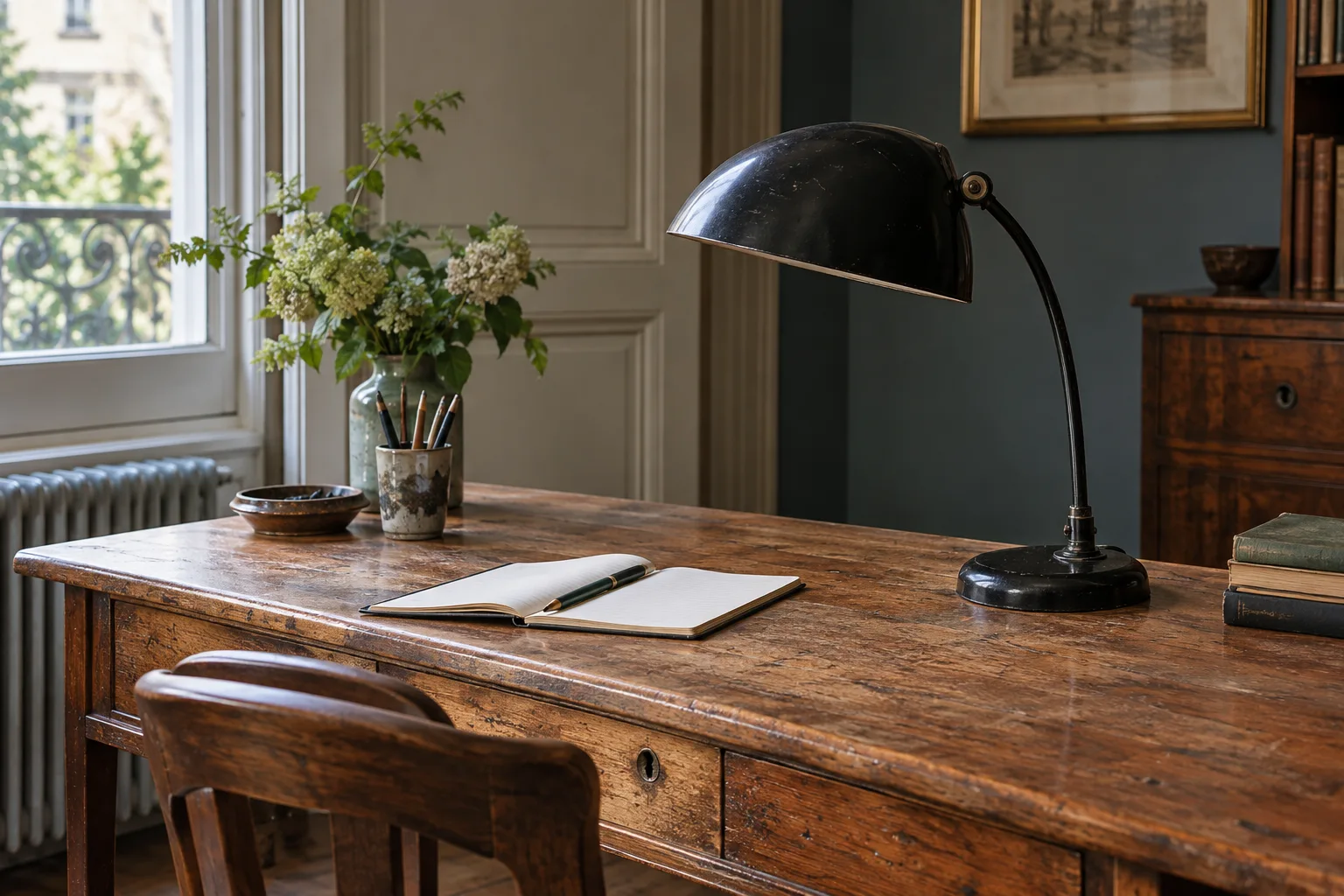
There is more than one Kaiser idell desk lamp
A dark curved shade on a slim stem looks convincing almost anywhere with books and a wooden desk. That familiarity can make different lamps blur together in online listings. Start with the model number, because the broad-shaded 6631 Luxus and the smaller 6556-T occupy a desk differently.
Fritz Hansen’s Kaiser idell brochure connects Christian Dell’s work with 1931 and records a 1936 catalogue featuring the 6631 Luxus. The brochure’s model drawings offer a useful comparison. It is an undated manufacturer publication; its measurements describe the referenced products, not every vintage example.[1]
| Desk model | Height | Shade diameter |
|---|---|---|
| 6556-T | 43 cm | 21 cm |
| 6631 Luxus | 42.5 cm | 28.5 cm |
| 6722-T | 25.5 cm | 14.6 cm |
Notice how little the height changes between the first two entries while the shade diameter changes substantially. For your desk, draw the candidate shade’s outline on paper and compare it with the usable surface. Then request the actual base dimensions and reach. A height measurement alone cannot tell you how much working space remains.
If a seller names one model but the shape and dimensions point elsewhere, ask them to resolve the discrepancy. Do not assume that any one difference proves a copy: the wrong description, an altered lamp or an inappropriate reference can all produce a mismatch.
Read the lamp from shade to base
Ask for a complete side view and close views located within it: the shade attachment, the lower stem connection, base, switch and cable exit. Include the underside where it can be shown without dismantling anything. This lets you follow the assembly instead of admiring an isolated maker’s mark.
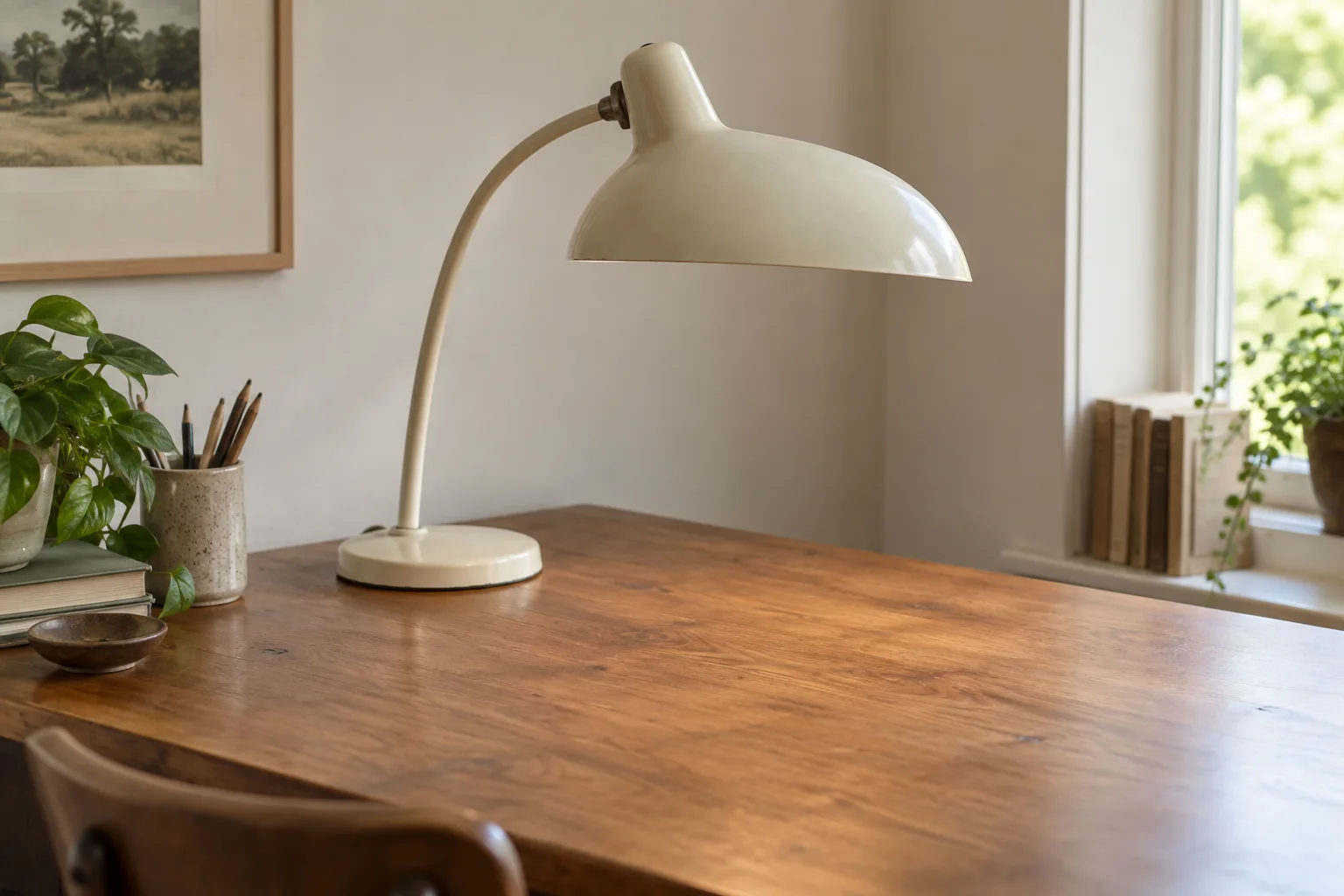
The manufacturer’s brochure identifies the characteristic swivel joint and embossed Kaiser idell wording. Treat these as parts of a wider comparison. A visible word does not establish the date, completeness or condition of the whole lamp, and an unmarked photograph is not enough to settle its origin.[1]
Ask the seller to describe which adjustments still work and whether the shade holds its intended position. Where the lamp is sound and the owner agrees, observe normal adjustment without forcing it. A stiff joint is a reason for assessment, not an invitation to tighten, lubricate or dismantle it during the viewing.
Look at the shade rim and profile in several views. A bent rim can hide in a three-quarter photograph. Ask whether any metalwork has been reshaped or repaired, and whether the lamp stands correctly on its base. Cosmetic wear and an uncertain supporting joint are different matters.
Fresh paint should come with a work record
Decide which finish you want to live with. An old surface with modest wear can look at home on a used desk; a carefully refinished lamp may suit a cleaner composition. Neither choice removes the need to know what happened underneath.
Ask for pre-restoration photographs and a list of replaced parts. Separate surface work from repairs to the shade, stand or joint, and separate both from electrical service. “Fully restored” can cover quite different jobs. A glossy photograph does not tell you whether a worn joint was repaired or merely painted around.
Avoid using black, cream or another colour as a production date. A finish can change during an object’s life. If an earlier colour or unusually untouched surface is the reason for a premium, ask what evidence supports that particular claim.
Make the restoration description specific
Please list paint or plating work, repaired metal or joints, replacement switches, sockets and wiring, and the evidence for the model and production period. Are there photographs from before the work and a record from the person who completed the electrical service?
Have doubtful electrical condition assessed by an appropriately qualified professional before use. A plug attached to a cable is not evidence of a completed service, and a lamp lighting up once does not answer the condition question.
Make it work as a desk lamp again
Think about the job: illuminating a notebook, sharing space with a monitor or giving a softer pool of light beside a chair. Measure the candidate base and the area swept by ordinary adjustment. Include the cable route so it does not have to cross the place where you write.
Try a serviced example in a comparable position if possible. Check whether the shade blocks your view, whether the light reaches your working area and whether the adjustment you need is within the lamp’s normal movement. Avoid choosing a larger shade simply because its silhouette is more recognisable.
Use the rewiring quote guide to ask for an exact service scope, including the intended country of use and any replacement parts.
Add that work to the delivered price before comparing offers. A lamp with supported history, modest finish wear and completed service may be ready to become useful furniture again. A freshly painted example with unexplained parts and a loose shade needs a different price and a clear repair plan.