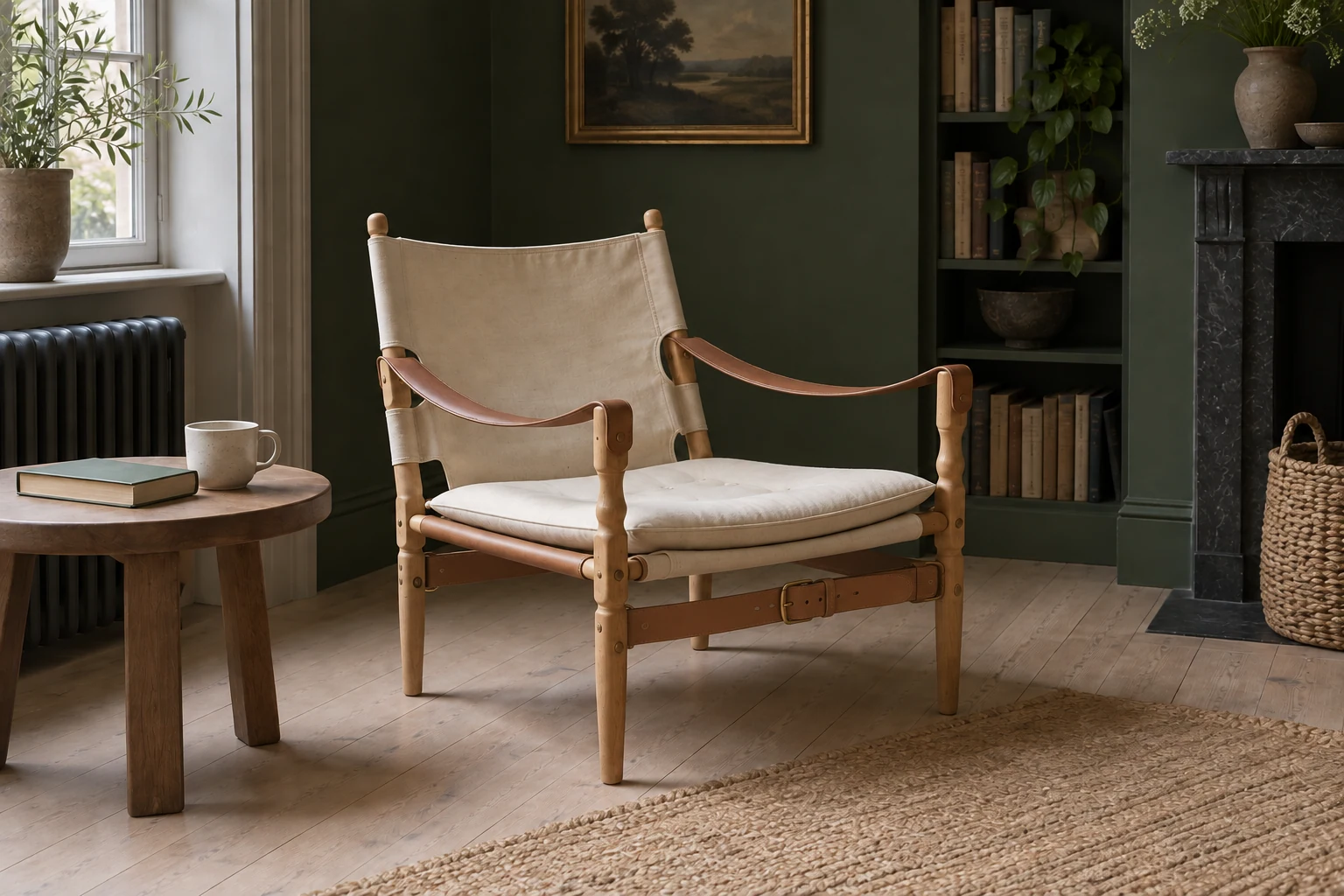
A Safari name does not identify the chair
Many open timber-and-sling chairs are described as safari chairs. For this Guide, the reference is Kaare Klint’s design, shown in 1933 and now offered by Carl Hansen & Søn as KK47000. The manufacturer lists current ash-frame versions with canvas or leather. A similar silhouette does not establish that a second-hand example comes from this production history.[1]
An older reference makes the distinction useful. The National Gallery of Victoria’s object D100-1974 names Klint as designer and Rud Rasmussens Snedkerier as manufacturer, and records beech, leather and canvas. That museum object is evidence of a documented older example; it does not identify another chair or make current ash specifications universal.[2]
The Safari Chair Library story covers the design’s history. Here the practical question is what remains on the chair you might buy, and what completing it will involve.
Ask for marks in place, any original paperwork, whole views from front and side, and a clear record of replaced parts. A freshly made cover may be a sensible repair. It should simply be described as a replacement rather than used to imply an untouched older chair.
Count the soft parts separately
Lift a loose cushion only if the seller can do so normally and without disturbing fragile material. You need to see the supporting seat beneath it. A thick new pad may make a listing inviting while leaving the condition of the sling or its attachments out of view.
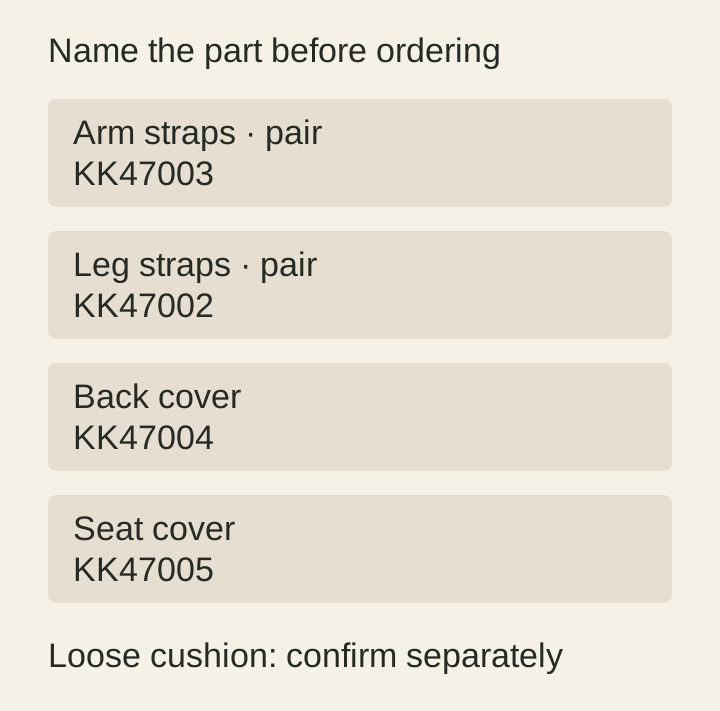
Carl Hansen lists KK47003 arm straps as a pair of natural saddle-leather straps. Its KK47002 leg straps also come as a pair. Those are distinct products: “needs new straps” is not a complete shopping list. Ask which straps are affected and whether both pairs are present.[3]
The leg-strap listing covers the Safari Chair and Safari Stool. That shared current description still does not establish the fit of a loose strap on an unidentified older frame. Send the chair record and requested measurements to the supplier before ordering.[4]
The back and seat have their own references, KK47004 and KK47005. The manufacturer lists each in fabric or leather. A quote for one cover therefore does not mean both supporting surfaces, the cushion and the leather arms have been renewed.[5]
Confirm the seat cover explicitly when discussing a complete refresh. Ask the supplier to name the material and version, identify what is included, and explain whether any associated fitting work is necessary.[6]
Read wear at the attachment points
Inspect the canvas or leather where it meets the frame, as well as across the broad visible surface. Request close views of split edges, stretched holes, opened stitching and previous patches, with wider views showing their positions. Creasing and colour change can be part of normal use; a failing attachment changes whether the chair can be used.
Give the wood its own assessment. Look for splits around connections, substituted rails, added screws or glue, and any reported movement. Do not dismiss every loose connection as a feature of a collapsible design, or assume every connection should be glued rigidly. A maker or restorer familiar with this chair must distinguish intended assembly from damage or alteration.
Avoid pulling on a brittle strap, dismantling an uncertain frame or sitting heavily to see whether it tightens. A seller’s assurance that it has always felt this way does not identify a missing component. Pause the trial where completeness or support remains unresolved.
Choose the chair you want to live with
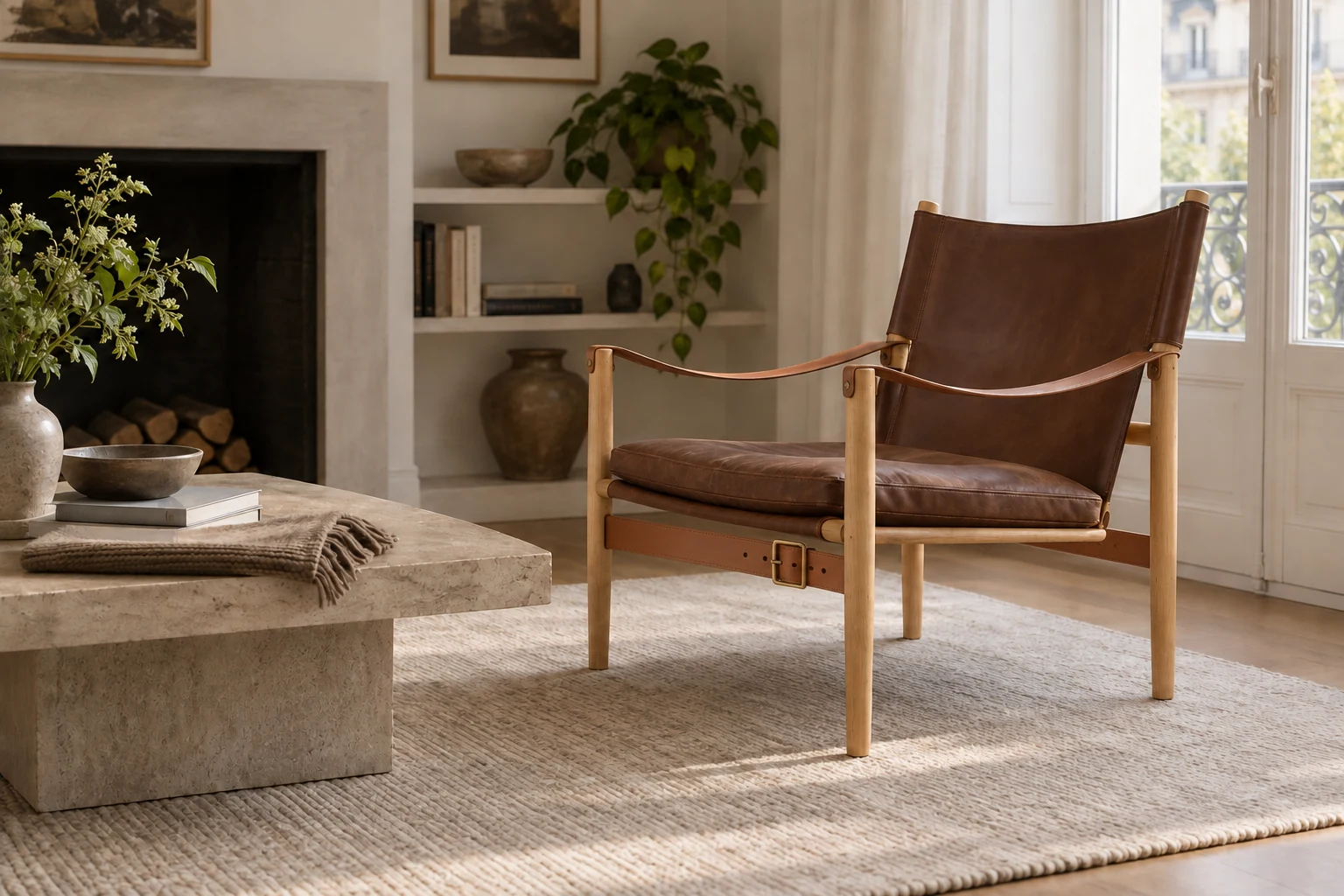
The seat and cushion determine how you settle into the chair. Once its condition is suitable for a normal trial, check whether you can lower yourself comfortably, rest your arms where you want them and get up without hauling on the straps. A low reading chair and an upright occasional chair can occupy a similar floor area while feeling quite different.
Decide how much of the existing appearance you want to retain. One pale replacement strap beside three dark older ones may be perfectly acceptable, or it may bother you. Ask about the expected colour relationship and whether replacing sound matching parts would sacrifice material you wanted to keep. Do not start dyeing or conditioning old leather to force a match.
| Offer | What must be settled |
|---|---|
| Complete chair with worn but serviceable surfaces | Condition assessment, normal seating trial and a care plan suited to the materials. |
| Frame with missing or failed soft parts | Correct arm straps, leg straps, seat, back and cushion, plus confirmed fit and fitting work. |
| Recently renewed chair | Which parts changed, who supplied and fitted them, and the condition of the retained frame. |
| Uncertain maker or altered frame | Research and specialist assessment before ordering model-specific accessories. |
Compare the purchase with the full confirmed parts-and-labour total. Current accessory availability makes an enquiry worthwhile; it does not turn an incomplete chair into a fixed-price project. Include transport and any frame work, and confirm lead times before planning the chair for a particular occasion.
Agree how the complete chair will arrive
A knock-down design does not make every older example ready to dismantle. Ask who will pack it, whether its present condition permits separation, and which instructions apply. If it travels in parts, keep a photographed inventory and agree who will assemble and check it on arrival. Do not accept an unexplained bundle of rails as a complete chair.
A message for the seller
Please show the whole chair, marks in place, the seat beneath the loose cushion, both arm straps and both leg straps. Which covers, straps or wooden parts have been replaced, and is any material split, patched or loose at an attachment? I would also like the actual dimensions, a record of any frame work, and confirmation of what is included and how it will be packed.