
Start with the collection, not the drawer count
Sewing notions, seed packets, camera accessories and stationery all suggest different interiors. A drawer that is excellent for small packets may be frustrating for a bulky lens. List your largest object, your most frequently used object and anything that must stay upright.
Take one example or make a paper template of its footprint, then record its height separately. Include any box or liner you intend to use. Avoid putting valuable, delicate or food-contact objects directly on an unidentified old drawer surface during a viewing.
For reference cards, measure your cards rather than assuming every cabinet used one standard format. For ordinary document storage, the filing-cabinet Guide is the better starting point: lots of small drawers will not solve an A4 filing task.
The inside may contain a rod or follower
Look into the drawer from above and from its open end. Some card systems have a retaining rod, a movable divider or follower, and stops that limit travel. Identify which fittings are present and how much clear space remains with them in their intended positions.
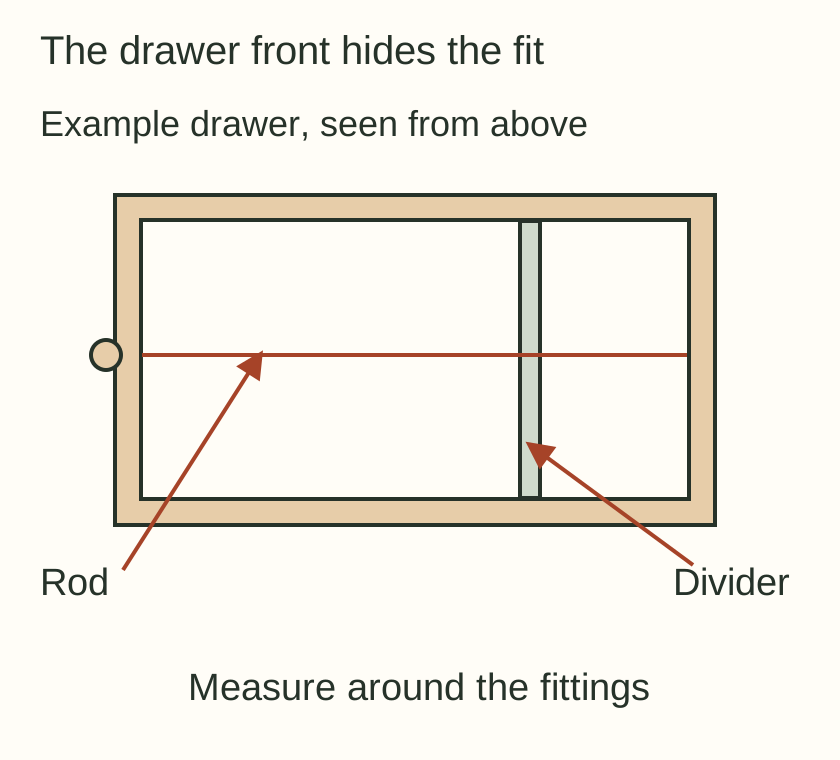
Suppose your boxed item is 15 cm wide and a drawer is described as 16 cm wide outside. The side thickness and internal fittings could make that a failed purchase. Ask for the clear width at the narrowest point, usable depth and clear height when closed. The seller’s overall cabinet measurement cannot answer any of those three questions.
If a fitting obstructs your intended use, ask whether it was designed to be removable and whether the seller can demonstrate that method. Do not base the purchase on cutting out a rod or tearing out a divider; the alteration could damage the drawer and remove a part you later need.
A good top drawer does not represent them all
One Portland Revibe listing for a four-drawer index cabinet discloses that only three drawers retain their metal divider hardware and that the bottom two do not close fully. It is a useful seller-reported example of why “four drawers” is not a complete condition description.[1]
At a viewing, check drawers across the top, middle and bottom and examine every drawer that you intend to rely on. With a large cabinet, agree a systematic inspection with the seller. Keep other drawers closed and support an extended drawer normally; do not pull several out together to test the cabinet.
Look for a missing bottom, a split around a handle screw, rough running surfaces and a front that has been forced into a different opening. Ask the seller to remove a drawer only by the appropriate method. A reluctant drawer may have a stop; forcing it is a poor way to find out.
Check the base, top and any stacked sections
Small card drawers can sit in a tabletop box, a large cabinet or stacked modules. Ask for a full photograph including the top, sides, back and base. A close-up of beautiful brass pulls does not show which kind is being sold.
For a stack, identify how the sections are intended to join and be secured. Compare their footprints and connections, and ask about later bases, tops or mixed sections. Matching colour alone does not establish that the assembly belongs together.
A stable-looking empty display is not evidence for a fully loaded installation. Establish the intended securing arrangement and condition before filling it. If the cabinet has no reliable instructions and the proposed arrangement is uncertain, get competent advice or choose a simpler complete unit.
Missing hardware can become the expensive part
A few mismatched label cards are easy to accept if they suit your use. A missing drawer, damaged pull or unusual metal follower can be harder to replace neatly. Ask for dimensions and clear front-and-back photographs of a complete counterpart before searching for parts.
Decide which differences matter to you. A disclosed replacement handle may be a sensible compromise on practical storage; an unexplained drawer that does not fit is a functional problem. If the asking price depends on a particular maker or institutional history, request documents and research that claim separately.
For collection, agree whether drawers travel in place or separately and how they will be labelled. Keep a simple map of their original positions. Do not assume a full cabinet is manageable because each individual drawer feels light.
Make the seller request specific
Message to the seller
I want to store [objects], the largest measuring [width × depth × height]. Could you show an open drawer with its rods/dividers/stops, measure the clear interior, and flag any missing or poorly fitting drawers? Please also show the full back, base and section connections, and confirm what separates for collection.
Buy the cabinet whose interiors work with your collection and whose missing parts you can account for. If you need to remove much of its original system simply to make your objects fit, a different cabinet may do the job with less work.