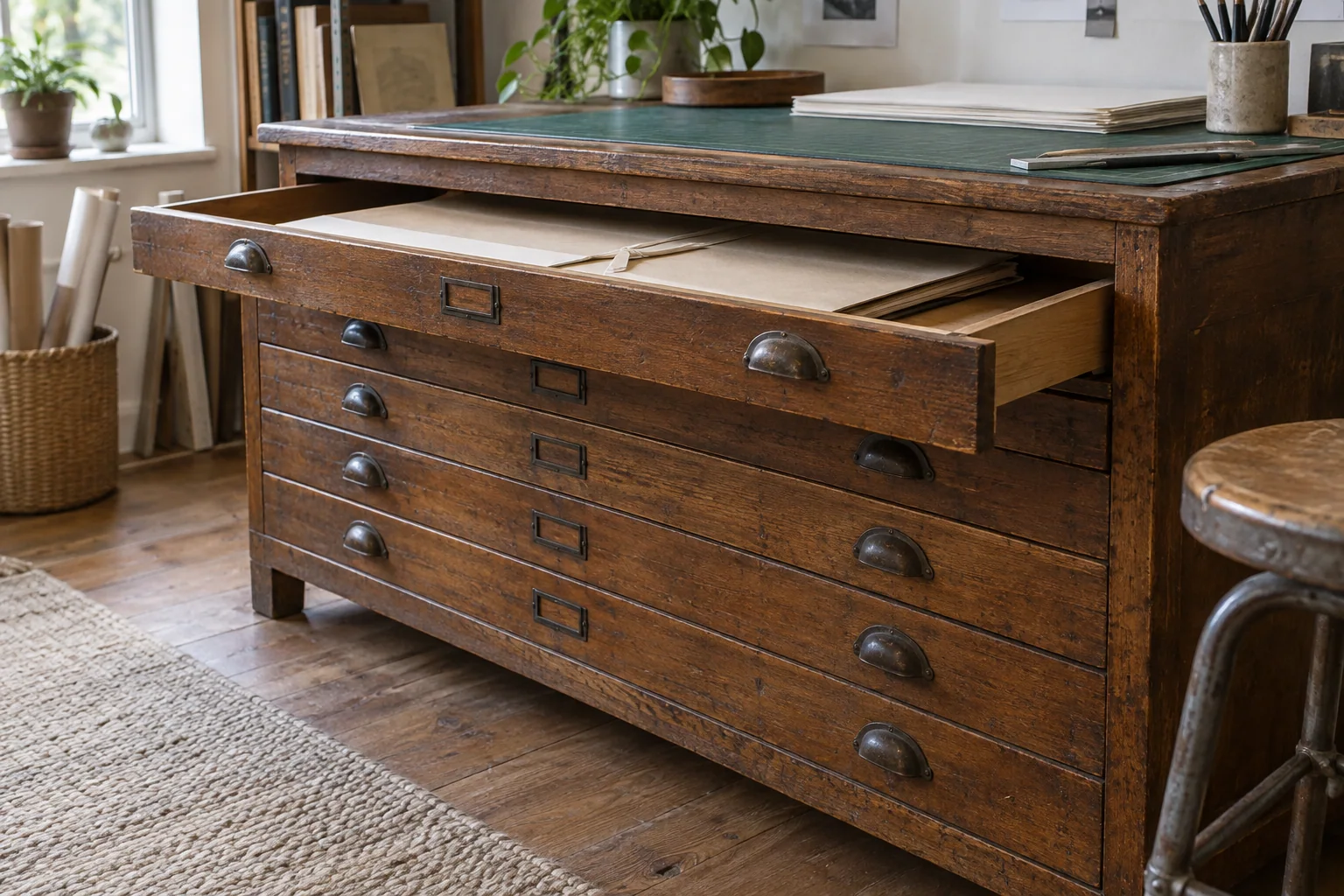
The useful size lives inside the drawer
A drawing may fit a nominal paper size while its mount, folder or protective box does not. Put the actual object flat and measure its maximum width, depth and thickness. Include any part that projects. Ask for clearance around it so it can be lifted without bending a corner against a drawer side.
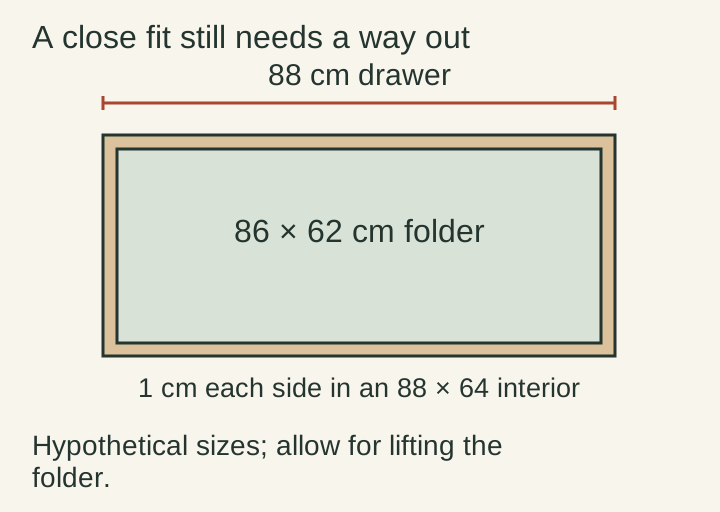
Request three different measurements: the clear interior, the narrowest opening the object passes through and the height below the drawer above. A deep drawer front can conceal a shallow tray. A broad interior may still be awkward if the drawer cannot expose enough of it.
For example, a hypothetical 86 × 62 cm folder would have only 1 cm of clearance on each side in an 88 × 64 cm interior. That arithmetic describes a close fit, not a recommendation. Try a cardboard stand-in and consider the route for your fingers and the stiffness of the folder.
The drawer needs floor space of its own
Ask the seller to open each drawer normally, one at a time. Note rubbing, skewing, stops and any place where it drops or catches. Have the owner show a removable drawer only when they know how to handle its size and weight safely. Multiple open drawers are not a stability demonstration.
Draw the closed cabinet footprint and extend it by the actual drawer travel. Add the space where you stand and the route for taking a portfolio away. If the chest doubles as a work surface, check whether a stool or chair will obstruct the drawer whenever you need it.
Inspect the drawer bases for distortion, separated joints, staining and repairs. Ask what was stored in the cabinet and whether any drawer has a persistent smell. A tidy exterior does not describe the surfaces that will be close to your paper. Decide whether the proposed contents are light sheets, heavier folders or equipment; the seller should not infer capacity from the chest’s original job.
Old wood and valuable paper need a deliberate separation
The Canadian Conservation Institute’s paper-storage guidance recommends appropriate protective folders and enclosures and explains the risks from unsuitable contact materials. Take the practical consequence seriously: do not place an important print directly against an unknown old drawer or an improvised lining.[1]
Ask a paper conservator or conservation-materials supplier about an enclosure suited to the work, especially for friable media, valuable photographs or fragile paper. A general “acid-free” product description does not answer every question about an object’s media, size or condition. Preserve enough drawer height for the chosen enclosure.
For cutting mats, blank working paper and everyday studio supplies, your requirements may be less exacting. Describe that use honestly. An attractive plan chest can be excellent household storage without being a conservation cabinet.
Find out whether it really separates for the stairs
Some chests separate into sections; some only appear to. Ask the owner to identify the actual joints, base and removable parts. Removing drawers may reduce carrying weight but leaves a broad carcass whose dimensions still have to pass the route. Get a carrier’s agreement to the handling plan before booking.
A useful seller request
Please measure one complete clear drawer interior, its opening height and its full normal travel. Could you show all drawers operating individually, the drawer bases and the back, and confirm which parts are designed to separate for transport? My largest enclosed item measures ___ × ___ × ___.
Choose the chest that works when a drawer is open and your hands are full. The closed front is only half the furniture.