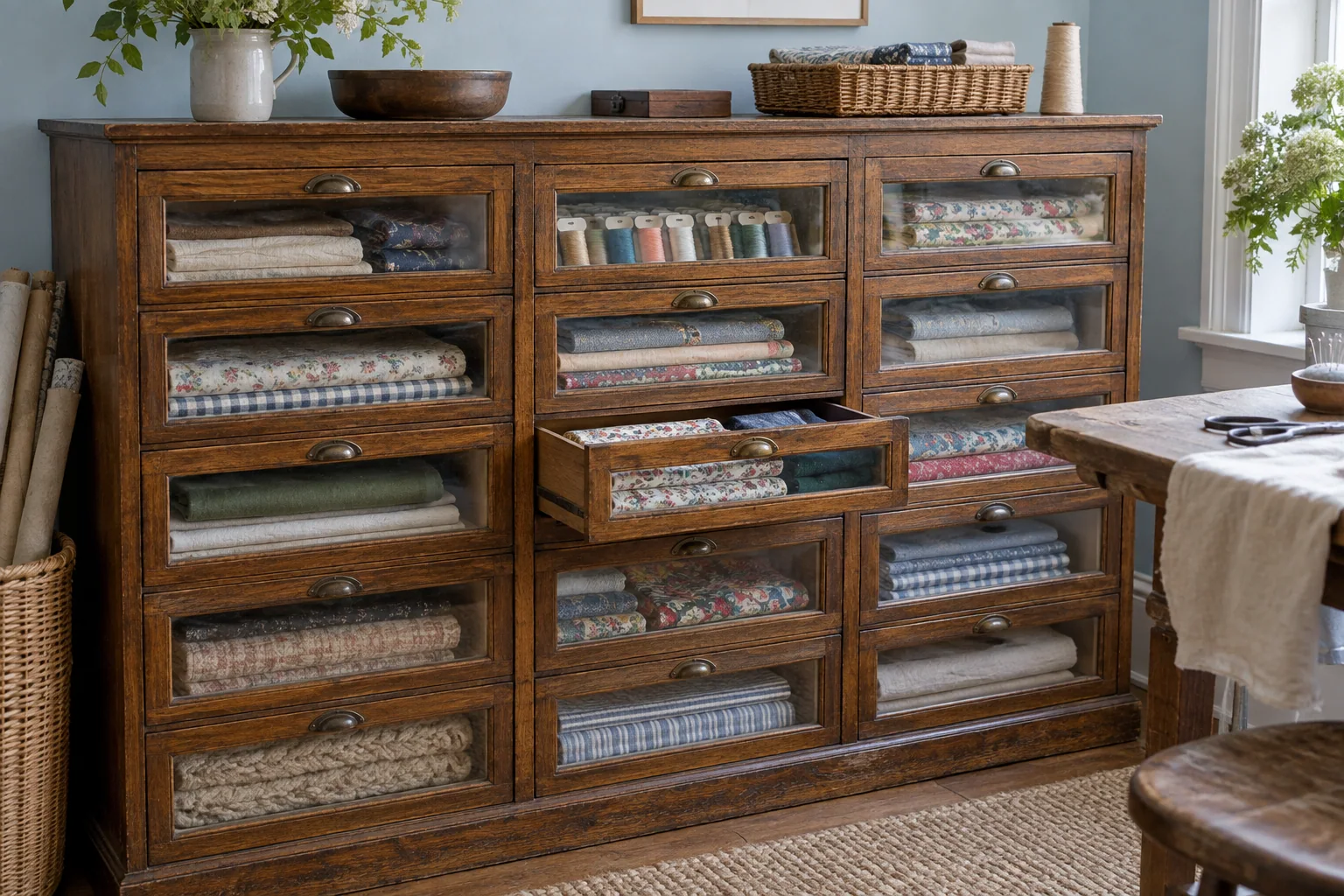
Give each drawer a job before buying twenty of them
The pleasure of these cabinets is being able to see what you have. In a sewing room, one drawer might hold folded cottons and another thread cards; in a studio, broad paper and small materials can stay separate. That usefulness disappears when the contents need to be stacked deeply or wedged behind a narrow opening.
Compare the form with a card catalogue. Small card drawers divide objects into many narrow compartments; a haberdashery drawer can offer a broad working layer. Neither is automatically better. Lay out the things you actually own, including the bulky exceptions, before deciding which arrangement solves your storage problem.
External dimensions are a poor guide to capacity
One Stone & Crow cabinet provides a useful concrete example: the dealer lists the case at 198 × 91 × 49 cm and its smaller drawers internally at 40 × 40 × 13.5 cm. These are that seller’s measurements of that cabinet, not standard haberdashery dimensions. The lower drawers are described separately because their height differs.[1]
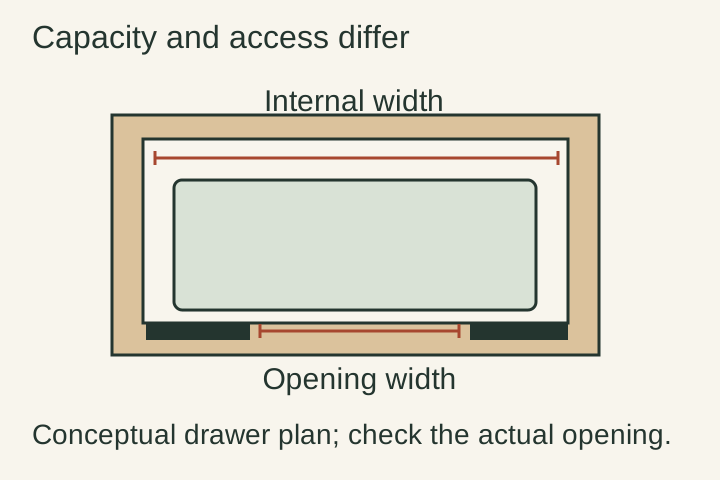
| Constraint | A practical trial |
|---|---|
| Internal width and depth | Lay a typical folded bundle flat without compressing it into the corners. |
| Internal height | Check a realistic stack, including any liner or box. |
| Access opening and drawer travel | Make sure the contents can be lifted out without catching above or behind them. |
As an illustrative example, a folded piece 42 cm wide will not lie flat in a 40 cm-wide drawer. Refolding could solve that, but only if the resulting bundle is not too thick. This is a storage decision you can make at home before arranging a long collection journey.
Inspect the drawer as a small piece of furniture
Ask to see each drawer moving normally and examine its base, runners, joints and handle. A good front can conceal a sagging bottom or repairs along the sides. Check whether a drawer is intended to come out completely before attempting removal; do not pull on the glass to free a stuck one.
For a glass-fronted drawer, look for visible cracks, damaged retaining strips and movement where the glass meets the wood. Ask a suitable repairer to specify replacement or securing work. Glass type and fitting need to suit the particular construction and use; a similar-looking pane is not the complete repair.
A drawer that carries cloth easily does not thereby have an established capacity for a dense collection of metal objects. Describe the intended contents to the repairer if loads will be very different from the previous use. Avoid inventing a weight limit from one successful demonstration.
Check the cabinet in the room with drawers open
Mark its depth on the floor and add the space needed to draw out a drawer and stand in front of it. For a tall cabinet, check which drawers you can see into and reach comfortably. The upper rows may be better for light, occasional items than things you need throughout a working day.
Before filling it, settle the condition of the case, its support and any necessary securing with the installer. The Conservation Institute’s advice to assess weakness and empty furniture before moving is particularly relevant to a large cabinet with many removable parts.[2]
Old shop storage is not automatically archival storage. If you are keeping valuable textiles, photographs or works on paper, get material-specific conservation advice about the interior and any liners. Do not treat a pleasant old-wood smell or a freshly cleaned drawer as proof that it is suitable.
Choose the useful cabinet
Compare the price with all drawers and glass ready for use, delivered and positioned. A smaller complete cabinet that fits your supplies can be more satisfying than a spectacular wall of drawers you cannot comfortably open or fill.