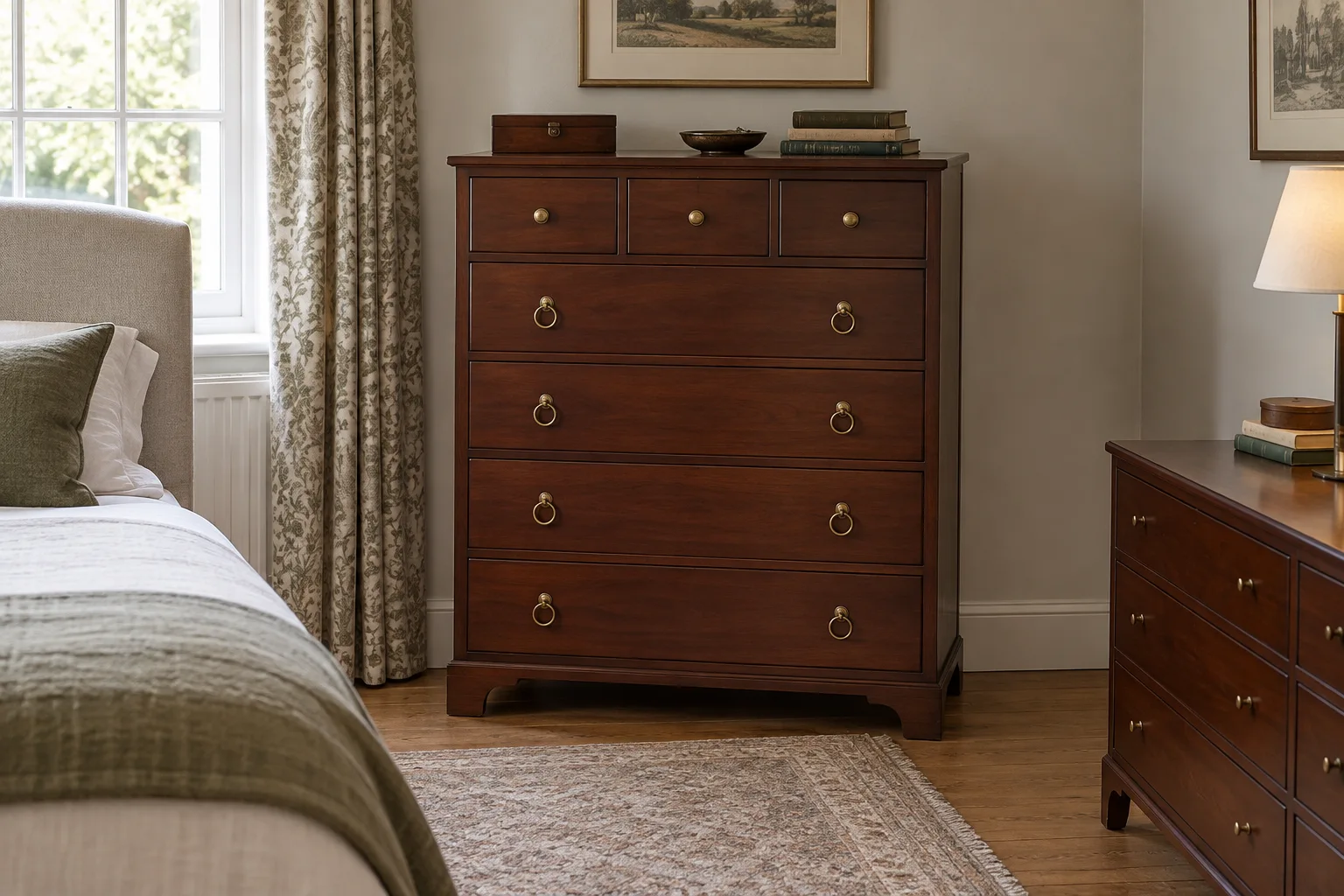
Let the first piece earn its floor space
A low chest gives you a useful top for everyday things and room above for a mirror. A taller chest uses more wall height. A dressing table provides a seat position, which only helps if you will actually sit there. Pick the missing function before picking the prettiest listing.
Minstrel’s appeal is that small repeated details can hold these different pieces together: a dark timber appearance, restrained drawer fronts, small knobs or ring handles and a shaped lower edge. It can make a collected bedroom feel coherent without filling every wall with matching furniture.
Steven Braggs’s history attributes the range to John and Sylvia Reid, dates its introduction to 1964 and describes both solid and veneered makore in its construction. Treat this as historical research, not proof that a seller’s chest is solid mahogany throughout.[1]
Low and tall need not mean different floor space
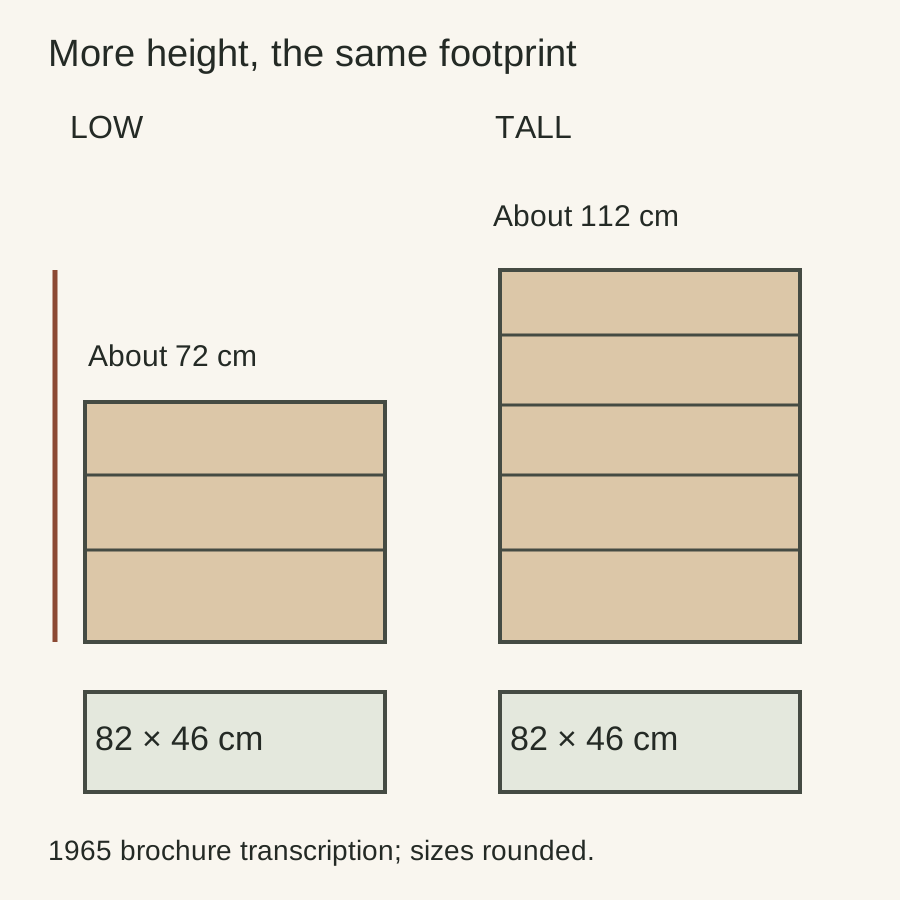
Retrowow’s transcription of the 1965 Stag brochure lists the low S160 and tall S161 chests at the same width and depth: 2 ft 8¼ in by 1 ft 6¼ in. Their heights are 2 ft 4¼ in and 3 ft 8¼ in respectively. Rounded to centimetres, that is about 82 × 46 cm of floor space, with heights of about 72 and 112 cm.[2]
That comparison is useful when floor space is tight: more storage can rise vertically. It is an early brochure transcription, not a measurement guarantee for every later Minstrel chest. Measure the exact candidate, including its projecting top and handles, and assess suitable stability and securing for the room.
The same transcription repeats some model numbers against different pieces. Use it as a range reference and starting point for research, rather than ordering an unseen chest from a number alone. Your seller’s dimensions, drawer layout and photographs must identify what is actually included.
Bring a folded jumper to the comparison
A drawer count does not tell you how much useful storage you gain. Ask for the internal width, depth and height of the drawers you intend to fill. Three little top drawers may be excellent for socks and accessories while adding little capacity for bulky knitwear.
Measure a representative folded stack and compare it with the clear interior, including how far the drawer can open in your room. A deep chest opposite the bed may have enough storage on paper but insufficient room for you to stand in front of an open drawer.
| Missing function | Useful first candidate |
|---|---|
| Folded clothes with limited wall width | A tall chest with suitable internal drawer sizes. |
| Storage plus a daily landing surface | A low chest, with space above it kept useful. |
| A place to dress while seated | A dressing table with usable knee space and an appropriate stool. |
| A lamp, book and a few bedside items | One bedside piece first; check the actual mattress relationship. |
Compare the finish in the same light
A chest photographed beneath warm bulbs can look close to another photographed in daylight while their real finishes differ considerably. Ask for unfiltered views in ordinary daylight, including a whole front and the top. If possible, see the pieces together or compare a candidate with your existing furniture in the room.
The top, drawer faces and exposed side can age differently. Previously stripped or refinished pieces may introduce another colour and sheen. Ask what has changed before treating “restored Minstrel” as an exact colour category.
Place a slightly different chest on another wall instead of forcing two nearly matching pieces side by side. Repeat a lamp material or textile colour to connect them. You can keep the useful family resemblance without refinishing an otherwise pleasing surface.
Count the handles as carefully as the drawers
Compare the knobs, rings, backplates and fixing holes across the whole chest. One missing ring can be a small job if the matching fitting is available; several replacements may change the front’s character. Confirm dimensions and attachment before buying spares, and keep removed original fittings with the piece.
Look at the shaped lower corners and the underside as well as the polished front. Record repairs, missing trim and any altered feet which could explain a height difference. Check that drawers work normally without assuming a fresh finish includes repairs to their runners.
A useful saved search note
I need a Minstrel [piece] no wider than [measurement], with [drawer or knee-space requirement]. I can accept [finish variation or disclosed wear], but need [working drawers, complete fittings and other essentials]. Please send the actual dimensions and explain any replacement top, hardware or feet.
A bedroom can be complete before the suite is
One Minstrel chest beside a plain bed and different bedside tables can be enough. Leave room for the person using the bedroom rather than every item once offered in the catalogue. Buying a piece at a time gives you the chance to discover what you still need before another chest arrives.
For the design background, read the Stag Minstrel Library story.