Why this designer matters
Charlotte Perriand helps explain why furniture history is not only a history of named chairs and cabinets. Her work connected individual objects to rooms, buildings, technology and the routines of the people who used them.
Centre Pompidou identifies Perriand as a French furniture and object designer, born in Paris in 1903 and active across furniture, architecture, urbanism, photography and art. Its account describes a recurring aim: to make industrial and technical progress useful to more people. 1
That aim becomes concrete in the Maison du Mexique bookcase. Designed in 1952 for student accommodation, it provided storage, helped divide a room and was manufactured as a repeated unit rather than treated as an isolated display piece.2 3
One object cannot represent an entire career. It can, however, reveal a method: begin with how a person inhabits space, connect furniture to that space, and work with production partners who can turn the idea into usable equipment.
The story
Perriand studied at the École de l'Union centrale des arts décoratifs from 1920 to 1925. Centre Pompidou's biography notes her early interest in newer materials, including metal, and places her 1927 work with Le Corbusier and Pierre Jeanneret within a wider break from conventional decorative practice. 1
The important point is not a list of famous collaborators. It is the expanding scale of the problem she addressed. A piece of furniture affects posture and storage; a room affects movement and privacy; a housing programme affects how many people can use the solution and how it must be produced.
Centre Pompidou connects Perriand's later work to collective equipment and to collaboration with the workshops of Jean Prouvé after the Second World War. 1 The Maison du Mexique commission is one documented result. It turns the broad phrase “collective living” into a specific task: equip 77 student rooms in Paris with furniture that is compact, repeatable and useful from more than one side.
This page therefore uses the bookcase as evidence rather than as a claim that one design summarises everything Perriand made. It shows how her attention to the room, the user and production can meet within a single commission.
Work and historical context
The Maison du Mexique formed part of the Cité internationale universitaire de Paris, a campus created to provide student accommodation and bring together residents from different countries. Centre Pompidou places Perriand on the 1952 interior team and describes the bookcases as equipment for the student rooms.3
The commission was not simply about finding an attractive place for books. Each room had limited space and repeated needs. A useful piece had to organise belongings, participate in the room plan and be suitable for manufacture as a series.
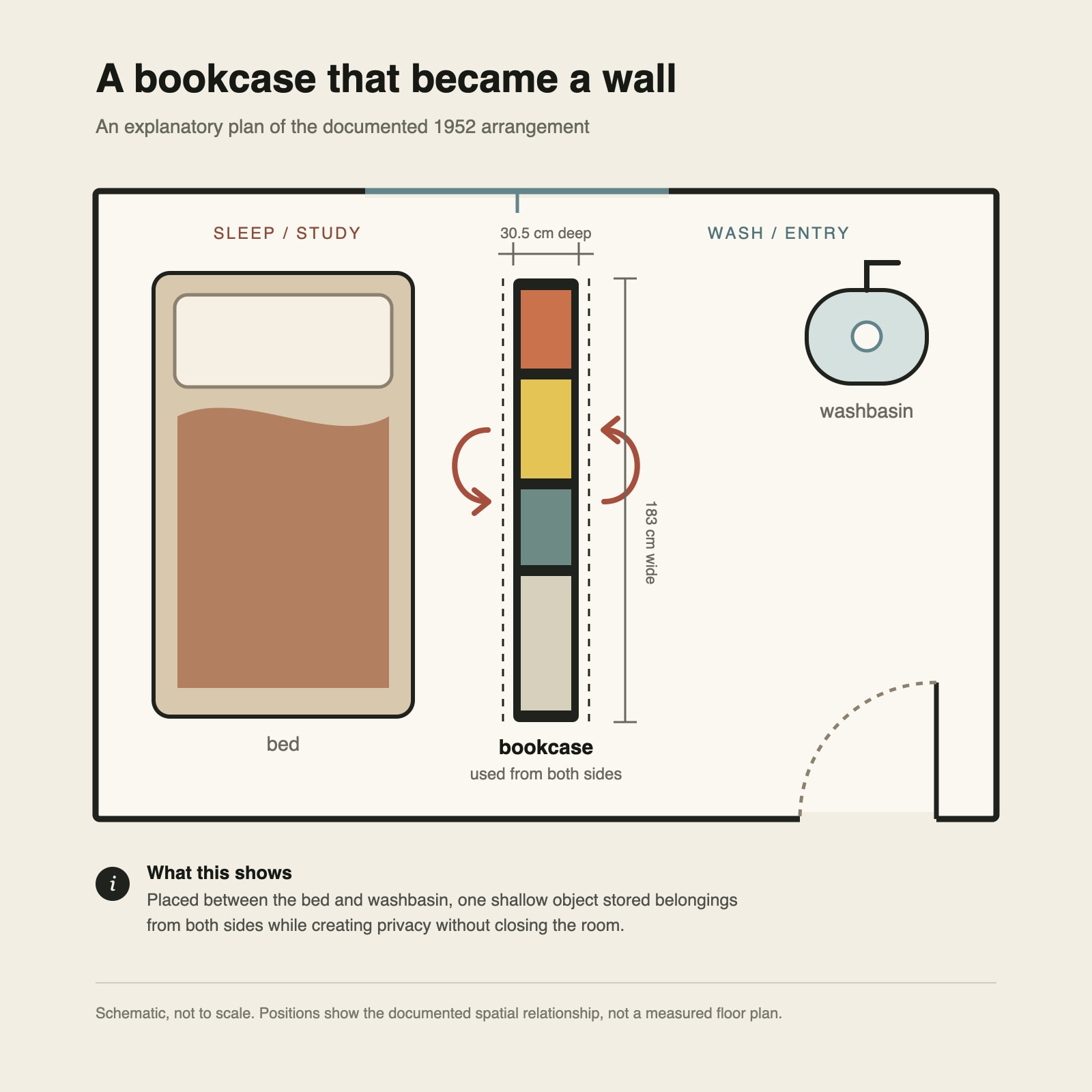
The bookcase answers those constraints with a broad, shallow form. It can be used from both faces, so it need not depend on a wall behind it. Open areas and closed compartments provide different kinds of storage, while the whole unit also works as a partial divider.3
This is a good example of historical context affecting form. The campus, the student room and the number of rooms were not background decoration. They were part of the design problem. Understanding that setting tells the reader more than treating the bookcase only as a pattern of coloured panels.
Collaboration and production
The Centre Pompidou object record assigns distinct roles. Charlotte Perriand is the designer; Ateliers Jean Prouvé in Maxéville is the manufacturer. 2 Its focus article says the workshops produced 77 examples for the 77 rooms. 3
Those statements should remain visible together. Naming only Perriand would hide the workshop that converted the design into a repeated physical system. Naming only Prouvé would hide the interior and spatial thinking that defined what the unit needed to do.
The material list also belongs to this collaboration. The object record names wood, lacquered steel and embossed aluminium, while the focus describes sheet-steel compartments and small sliding aluminium panels. 2 3 Different materials could serve different structural, storage and closure roles within one repeatable unit.
The reviewed records do not divide every drawing, workshop decision or detail between individual contributors. PatinaHall should therefore present the documented designer and manufacturer roles without inventing a finer account of authorship than the sources provide.
Look closely
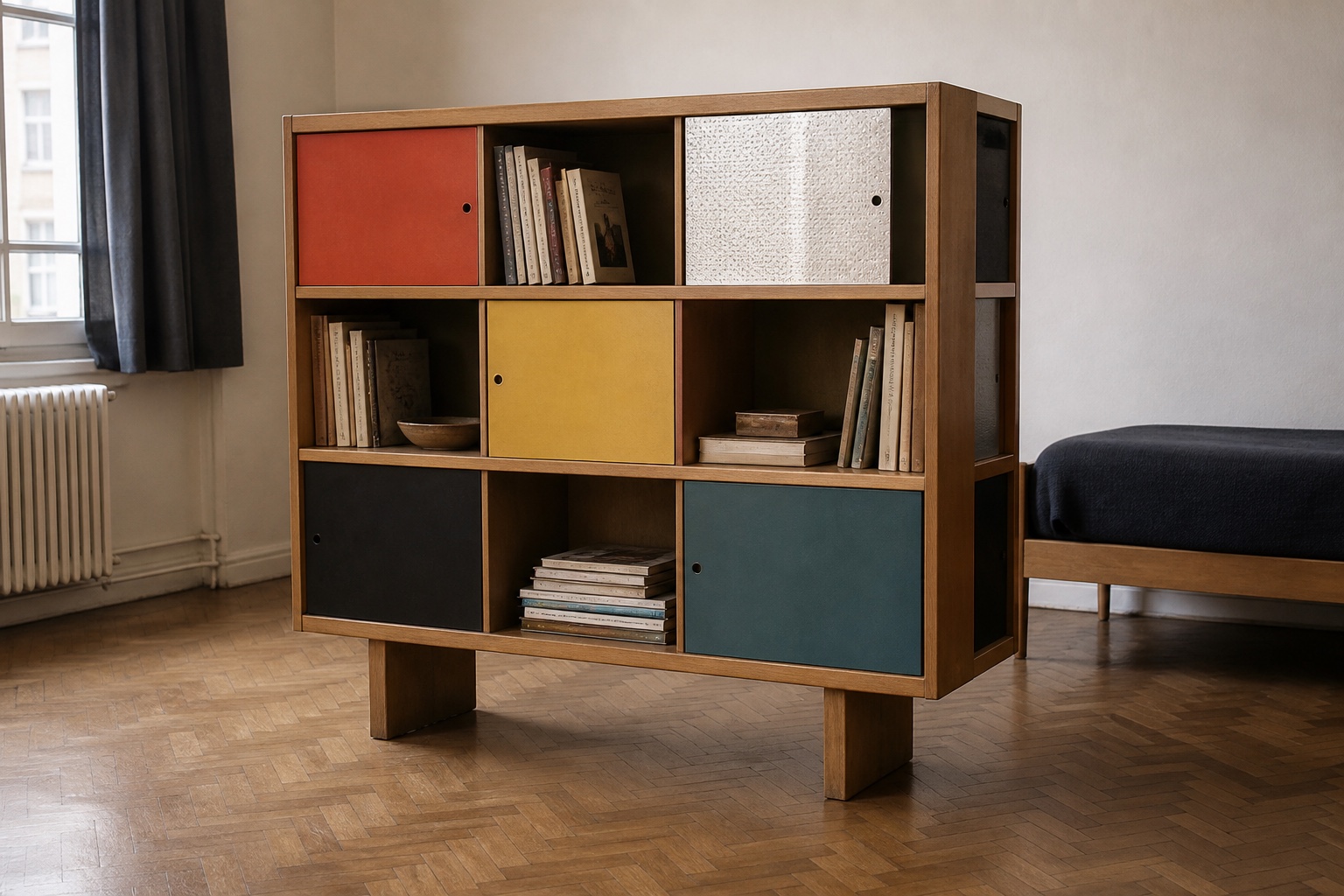
The image above is a PatinaHall editorial reconstruction, not a documentary photograph or a portrait. It uses the Maison du Mexique commission to explain Perriand's approach to inhabited space, but it cannot verify the original object, colours or room.
Start with the documented idea of two usable faces. It explains why the unit can stand within a room and work as both storage and a divider. A single front view would hide half of that idea.2
Next trace the grid of open and closed spaces. The repeated compartments make the series legible, while sliding panels let some contents be concealed. Then step back and compare the bookcase's width, height and shallow depth with a simple room plan. The object record gives dimensions of 161 by 183 by 30.5 centimetres for the museum example.2
Finally, keep the roles in the caption: designed by Charlotte Perriand, manufactured by Ateliers Jean Prouvé, commissioned for the Maison du Mexique. That line teaches more than attaching one famous name to the image.
The Centre Pompidou photographs remain linked research references rather than PatinaHall assets. The reconstruction keeps that boundary visible. It may be replaced by a documentary image only after reuse permission, credit and exact object identity have been reviewed.
What the evidence establishes
The three reviewed Centre Pompidou records support a focused account.
- Charlotte Perriand was a French designer whose work extended beyond individual furniture into interiors and collective living.
- The Maison du Mexique bookcase was designed in 1952 for 77 student rooms at the Cité internationale universitaire de Paris.
- The unit combined storage with a two-sided partition role.
- Ateliers Jean Prouvé in Maxéville manufactured the original run.
- The catalogued museum example records wood, lacquered steel and embossed aluminium.
These claims answer this page's primary question: how one documented commission connects a designer's spatial thinking with collaborative production. They do not require a complete career chronology or a catalogue of every object associated with Perriand.
What remains uncertain
This compact source set does not establish every stage of Perriand's career, every collaborator's contribution or every version of the Maison du Mexique bookcase. It does not provide workshop drawings that allocate each technical decision, and it does not trace all 77 units after their original use.
The sources also do not authenticate a marketplace object. A seller's use of Perriand's name, a grid of similar proportions or familiar coloured panels is not enough to create a documented designer relation. Another object needs its own marks, dimensions, materials, construction and provenance evidence.
Finally, an accessible museum record is not an image licence. The documentary photographs carry separate credits and require a later rights decision. This article cites the evidence while keeping those image bytes outside the site.
Related subjects
Three exact entities organise the next reading paths. France is the reviewed place association for this profile. Ateliers Jean Prouvé represents the production collaboration. The Maison du Mexique bookcase is the documented design through which this article explains collective interiors.
The bookcase now has its own reviewed public page and is linked here. The organization and place remain graph entities rather than empty routes until their own articles are released. This preserves one canonical page per subject and avoids duplicating the same biography under country, style and collaboration headings.