
Who was Jean Prouvé?
Jean Prouvé began with metal before he began with furniture. The official timeline records his training in wrought iron and modern welding, followed by his own Nancy workshop in 1924. The Ateliers Jean Prouvé opened in Nancy in 1931; in 1947 the workshops moved to a factory at Maxéville. 63
Those dates matter because the workshop was not background scenery. Furniture, lamps, façade panels and buildings were developed in a culture of prototypes, forming, testing and repeatable assembly. MoMA's collection moves from a school desk and bracket lamp to chairs and architectural components, while Centre Pompidou's record extends the view through technical drawings, house studies and building details.14
Prouvé is often described as a designer, architect or constructor. The useful part is not choosing the perfect label. It is noticing that the same practical questions followed him from a chair leg to a wall panel: where does the force go, what can this material do, and how will people put the thing together?
Why the rear legs are different
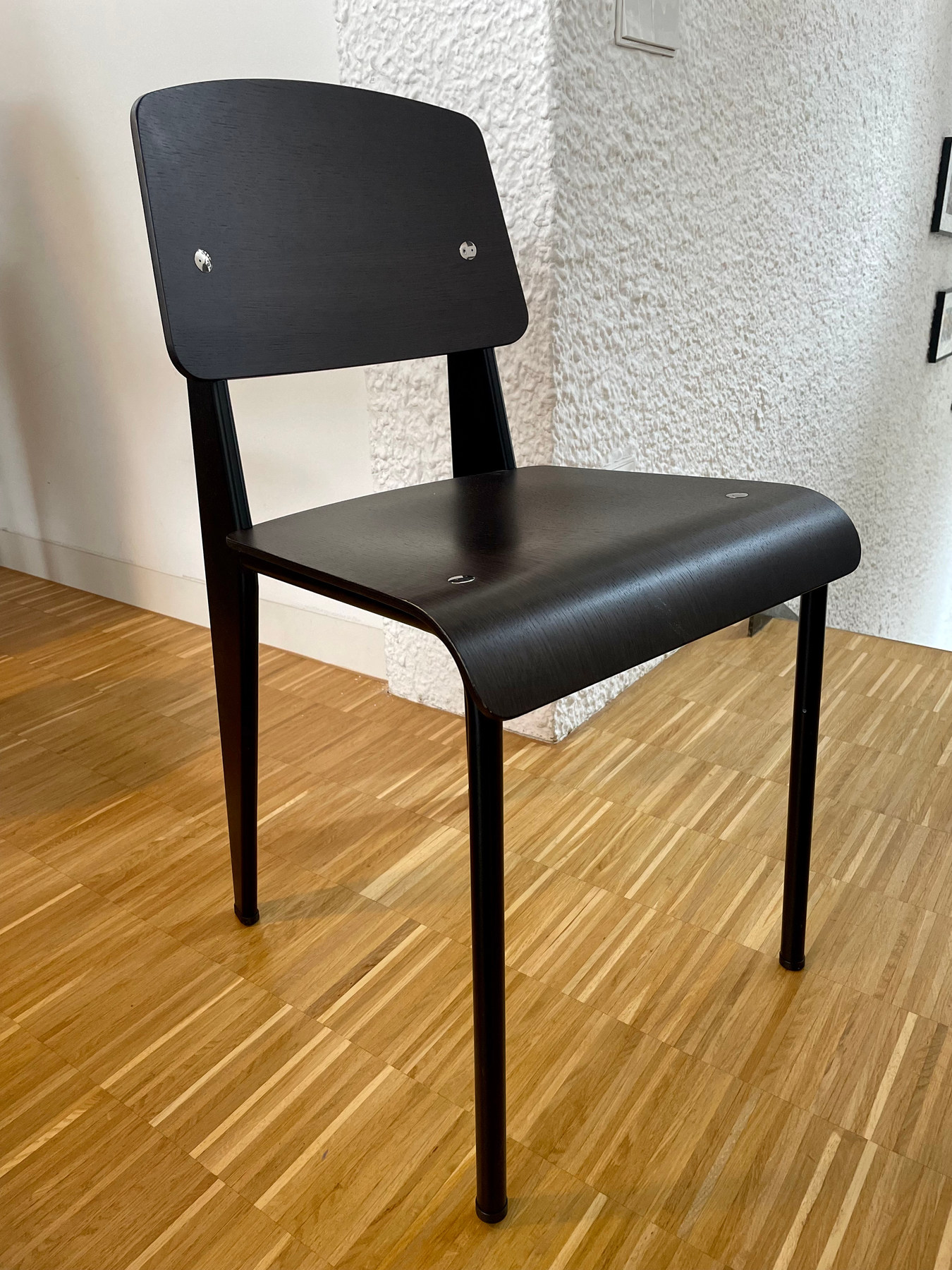
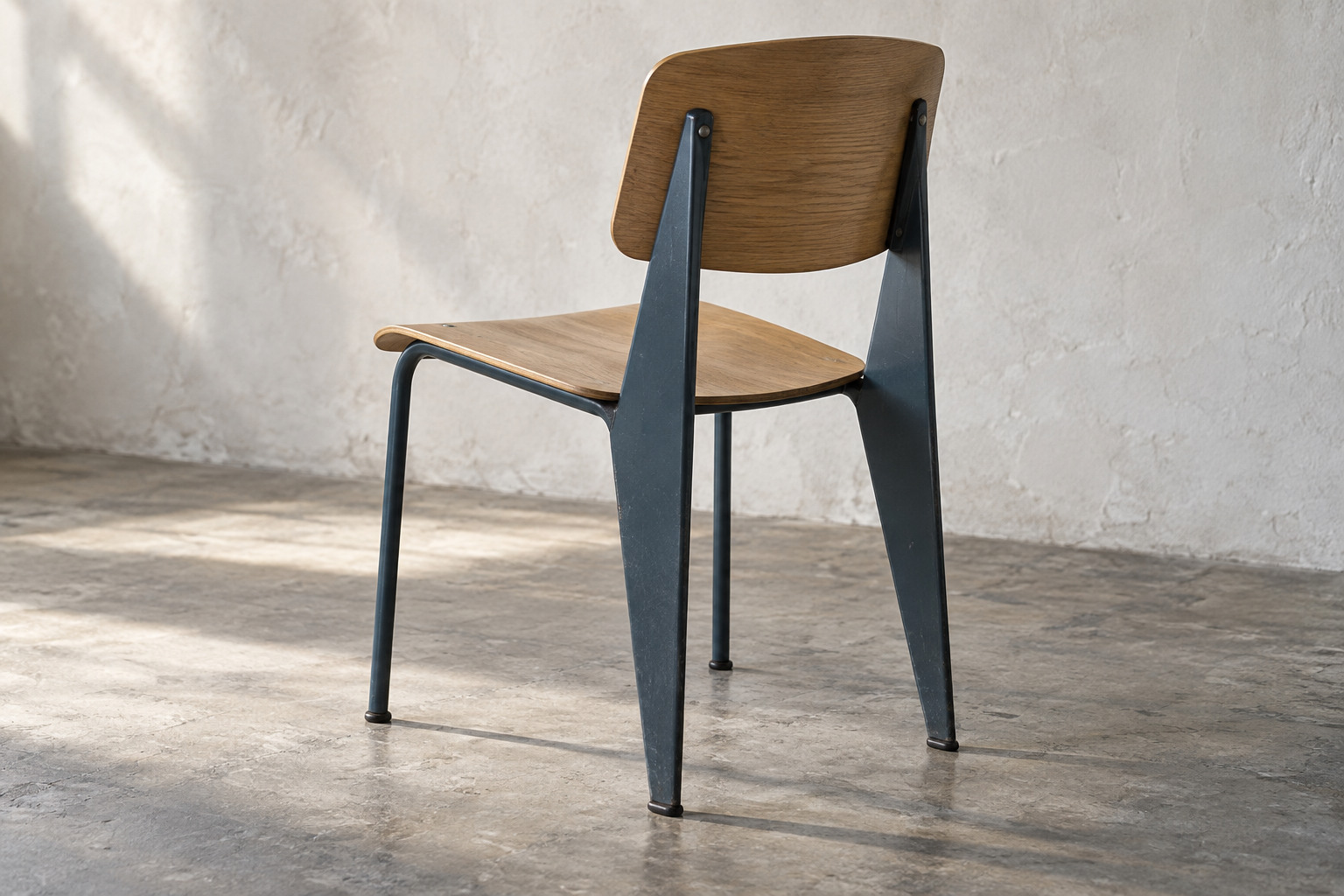
A chair has one slightly unfair habit: the rear supports usually have to carry the sitter and resist the leverage of the back. On Prouvé's Standard Chair, the rear legs are not being dramatic; they simply have the harder job.
MoMA describes rear supports cut and bent from sheet steel into tapered, fin-like sections. Their changing depth helps resistance build around the heavily loaded connection between seat and back. The slimmer front legs answer a different force problem, so making all four legs identical would have been tidier but less honest.3
MoMA catalogues its Standard Chair no. 305 as a 1952 object made by Ateliers Jean Prouvé from enamelled steel, plywood, aluminium and rubber. Its workshop history separately says the design began in 1935 and continued to develop for production through the 1950s.2 The distinction is simple but important: 1952 dates that museum chair, not the first thought behind every Standard Chair.
Three scales, one method
Body: the Standard Chair
The chair puts different materials and sections to different work. Plywood meets the body, steel carries the frame, rubber protects contact points, and the formed rear supports show where stress concentrates. The result is recognisable, but recognition is a side effect of the structural answer rather than a decorative costume.2
Room: the swing-jib lamp
The swing-jib lamp reduces room-sized lighting to a wall pivot, a long tube and a tension wire. Prouvé's official archive says he first made the idea for his own use, then varied the arm and mounting for different spaces; it entered the Ateliers catalogue in 1947.7 It is a lamp with almost no interest in looking lamp-like. Its reach and its joint explain nearly everything.
Building: the 6x6 demountable house
At the end of the Second World War, the same attention to parts and assembly expanded into emergency shelter. The 36-square-metre 6x6 house used a bent-steel portal frame with standard wood panels and was intended for quick assembly, immediate occupation and later movement if necessary. 8
The chair and house are not a matching set, thankfully. They are related by a method: concentrate structure where it is needed, divide work among suitable materials, and make the sequence of assembly understandable.
The workshop was part of the design
Prouvé did not treat production as the dull part that began after the clever sketch. Forming equipment, sheet sizes, joints and the order in which people could assemble components all influenced the result. A fold could stiffen thin metal. A bolt could make a joint inspectable and demountable. A repeated part could turn one good prototype into furniture for a whole institution.
MoMA's workshop history records commissions for schools, cafeterias, hospitals and offices. These were real orders with quantities, budgets and bodies waiting to use them, not an abstract celebration of industry. The Ateliers were also a collective of specialised work rather than one heroic hand somehow operating every press at once.3
Working with Charlotte Perriand
Workshop culture also makes collaboration easier to see. Centre Pompidou lists Charlotte Perriand among Prouvé's artistic collaborators, and MoMA documents their close work on furniture for student residences. 43
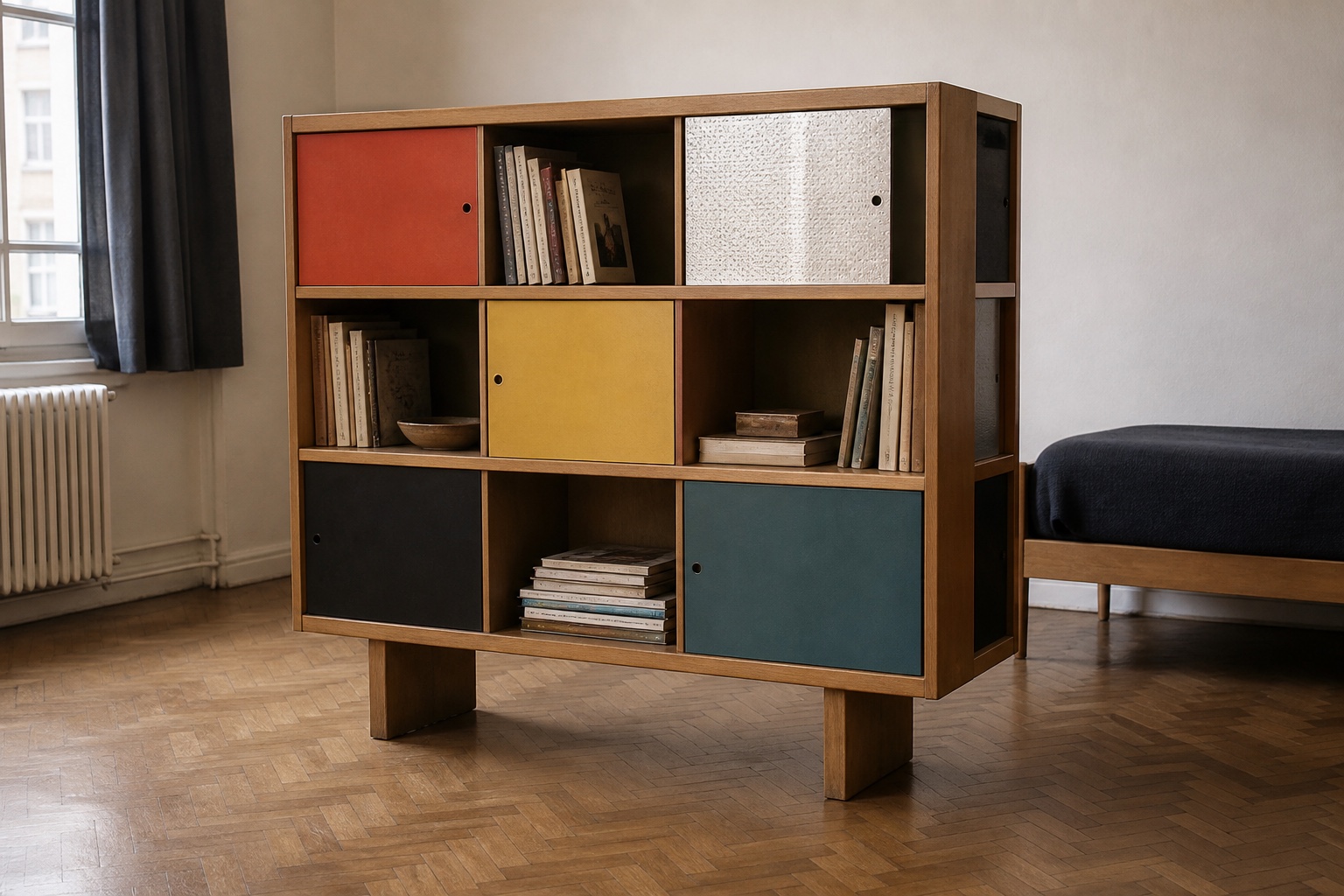
The Maison du Mexique bookcase keeps the roles unusually clear. Centre Pompidou names Perriand as designer and Ateliers Jean Prouvé, Maxéville, as manufacturer. The commission equipped 77 student rooms with a double-sided piece that combined storage and spatial division in wood, lacquered steel and embossed aluminium.5
That record does not tell us who settled every dimension or workshop detail. It does show why a furniture history becomes poorer when it turns every shared project into the work of one famous name.
From Maxéville to Beaubourg
Prouvé's structural thinking eventually carried authority far beyond his own workshop. In July 1971 he chaired the international jury for the future Centre Pompidou. The jury selected the proposal by Renzo Piano, Richard Rogers and Gianfranco Franchini, developed with engineers from Ove Arup and Partners. 9
That does not make the Centre Pompidou a Prouvé design. It shows something more interesting about his position by then: a metalworker who had spent decades testing how objects and buildings go together was trusted to judge a building whose structure, services and assembly would be unusually public.
How to look at Prouvé furniture
You do not need to recognise a model from across the room to learn from it. Start with four questions.
- Where does the load travel? Follow weight from the seat or top, through supports and joints, to the floor.
- How has thin material gained stiffness? Look for folds, channels, tapers and pressed profiles before assuming that strength requires bulk.
- Why is each material there? Wood, steel, aluminium and rubber may be handling touch, structure, protection or assembly differently.
- What does the joint reveal? A bolt, bracket or folded connection can explain how parts meet and whether they can come apart again.
These questions explain design; they do not authenticate a chair. A visible fold or tapered leg can be copied, licensed, restored or used in unrelated furniture. The lesson worth keeping is broader: when structure is resolved clearly, it can become visual character without needing extra decoration.
Research note
This profile connects reviewed design and workshop history. A museum record for one 1952 chair cannot establish every Standard Chair variant, and visual similarity cannot identify the maker or date of an individual object. The portrait and contemporary chair photograph have separate public-domain records. The reconstructed rear view explains a structural idea; it does not document a historical chair or the Maxéville workshop.
.jpg)
