A famous chair that keeps its voice down
Remove the famous name and the J39 could pass, at first glance, for the chair that was already in the room. It has four round legs, a square woven seat, stretchers and a broad back rail. Nothing announces a technical revolution. There is no theatrical profile to identify from the other end of an airport.
That first impression is the useful puzzle. Designmuseum Danmark includes the J39, or “People's Chair”, among ten Danish chairs to know and dates it to 1947. The chair became recognisable without being designed as a recognisable logo. Its identity lives in adjustments to familiar parts: the back is wide without being heavy, the legs continue above the seat without becoming posts of a throne, and the woven plane keeps the middle open.1
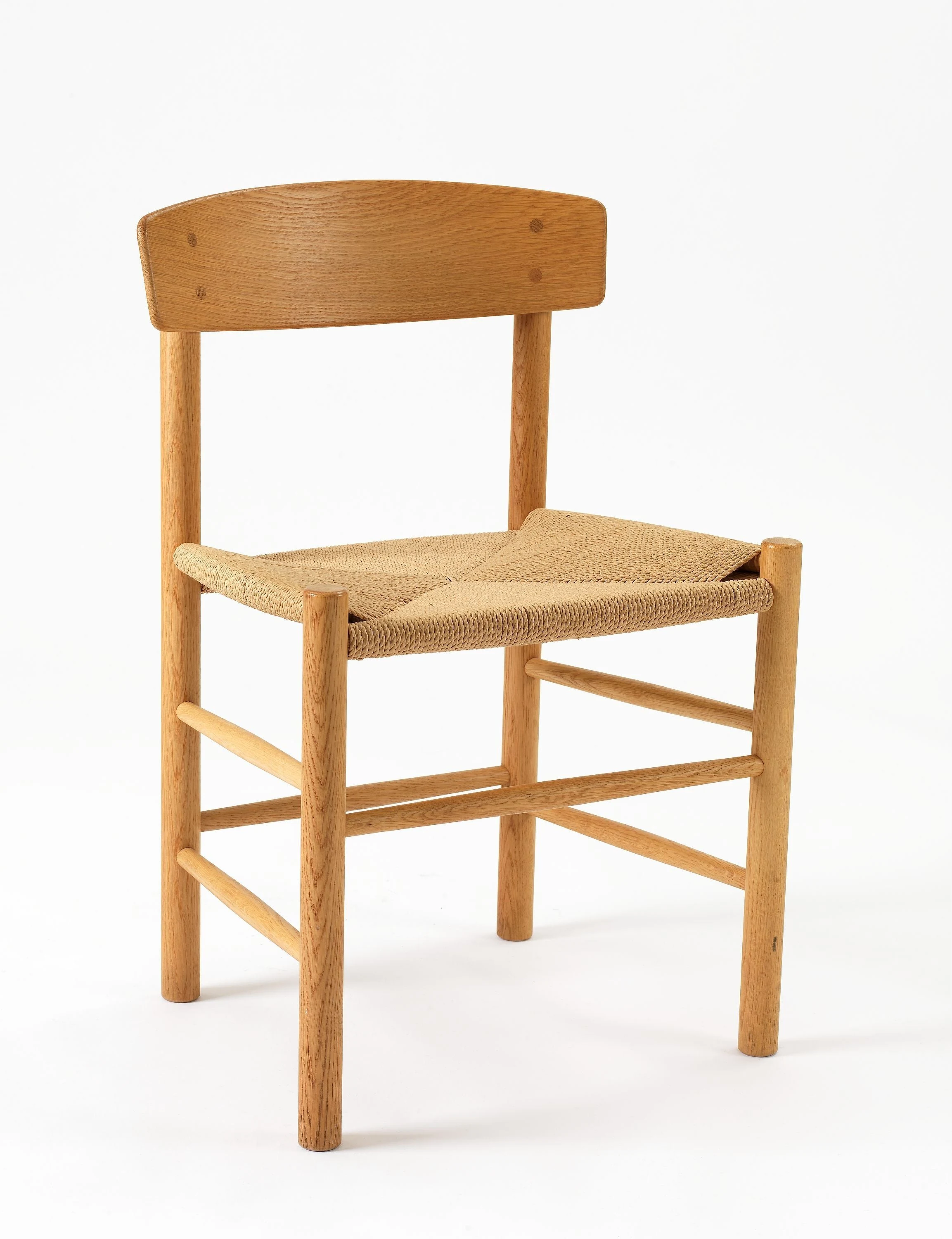
The photograph credited to arnve shows one later J39 against a white ground. It is especially useful because the full frame can be read without a table, room or styling around it. It does not tell us who made this particular chair, when it was made or whether every visible part is original. 6
Four legs, one deliberate exception
Most of the frame speaks in round sections. Legs and stretchers meet as clear lines; the front posts stop just above the seat, while the rear pair rise to receive the back. Follow those rear posts and the chair finally permits itself one broad gesture: a gently bowed timber rail whose top edge lifts slightly at the centre.
Fredericia's current specification distinguishes that back from the rest of the frame. It describes a solid-wood chair with a moulded-veneer back whose core and face veneer use the same wood, alongside a woven paper-cord seat. That record helps explain why the back can be broad and curved without looking like a thick plank.2
The scope is important. A current catalogue does not turn every chair sold as a J39 over many decades into one material recipe. It does, however, clarify a design decision that remains visible: one shaped surface meets a frame of separate members. The curve answers a shoulder blade; the sticks below answer gravity. J39 is the rare classic that can sit at a café table without asking for a small brass plaque.
The seat is part of the structure
The paper cord is not upholstery in the usual sense. It does not conceal a seat board or soften a boxed frame. Cord crosses the opening and becomes the place where the body is carried. In the photograph, diagonal changes in the weave form four fields that converge towards the middle. The surface looks calm from a distance and highly directional up close.
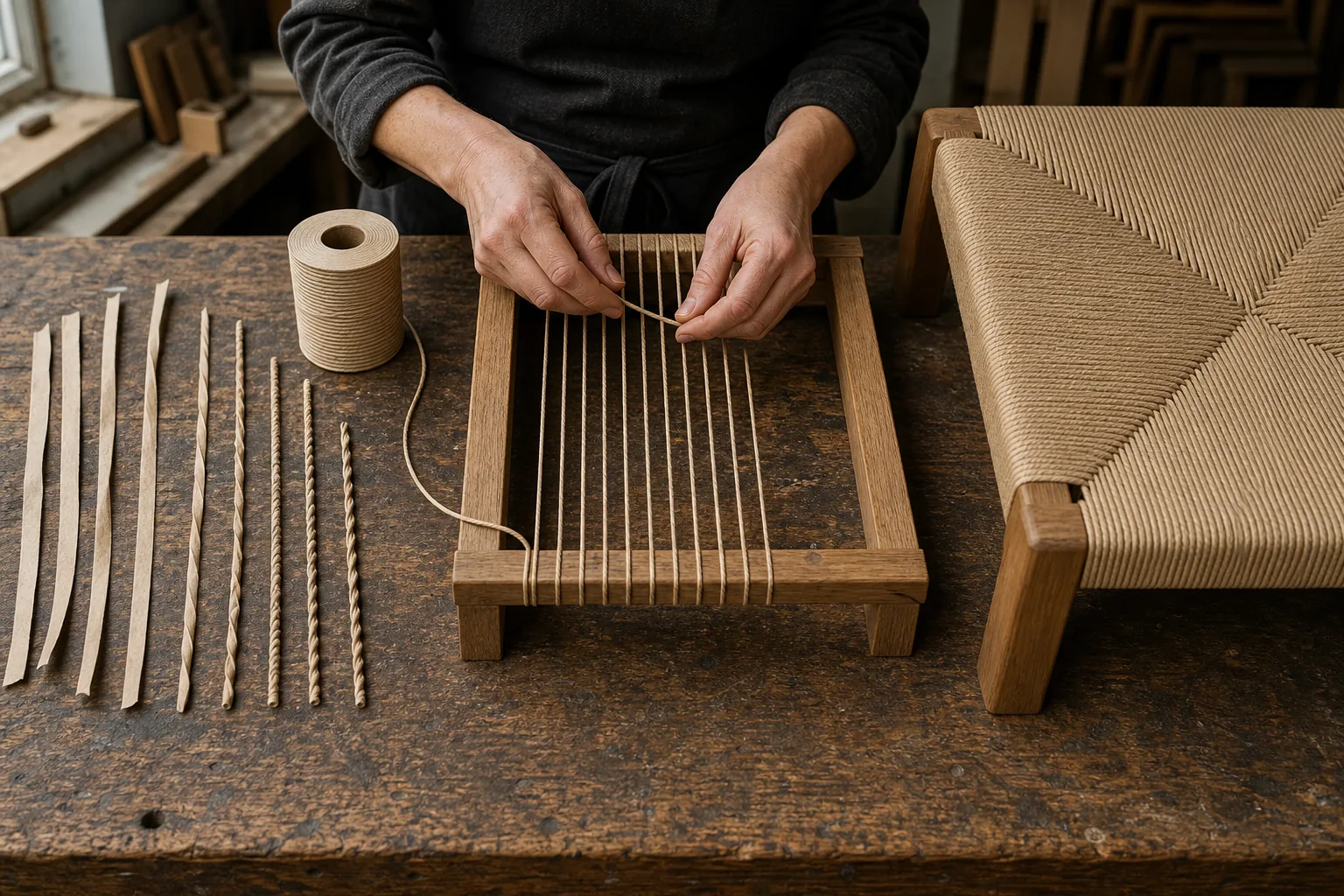
This is where apparently simple furniture becomes labour. The frame must give the weaver a stable perimeter; the cord must be laid with enough consistency to distribute pressure; and the completed plane must work with, rather than merely decorate, the timber. Our separate study of paper cord follows that material and its weaving in more detail. Here its editorial role is narrower: it prevents J39's plain outline from becoming inert.
Fredericia offers natural and black paper cord in current production and describes the material as one that develops patina. Those are present-day options and claims, not a field guide for identifying an old seat. A vintage chair may have been rewoven, altered or assembled in another production period. Colour alone is not a birth certificate.
“People's Chair” is a programme, not a popularity contest
The nickname can sound as though a public vote was held and J39 won. Its more interesting meaning lies in the system around the chair. Fredericia's history records that Mogensen launched J39 in 1947 through the Danish Cooperative Wholesale Society. Möbeldesignmuseum places him at the head of FDB's furniture section from 1942 to 1950, after cabinetmaker training and study under Kaare Klint.4 5
Fredericia's anniversary account describes Mogensen's ambition as democratic: good, solid furniture for broad everyday use, capable of rational production. That is a manufacturer's historical interpretation, and it should remain attributable as such. It does not prove what every household paid or how evenly the chair reached Danish homes.3
It does explain why restraint matters. A chair intended to join dining rooms, restaurants and institutions cannot require the room to become its stage. Repeated chairs must make a rhythm around a table, move without ceremony and accept that life will supply the visual excitement — meals are generally quite capable of this on their own.
Klint appears as a method, not a costume
Fredericia calls J39 a further development of Kaare Klint's 1936 Church Chair for Copenhagen's Bethlehem Church. The relationship is the manufacturer's account, not a licence to collapse the two designs into one. It is most useful as evidence of how Mogensen worked with precedent: familiar chair types could be measured, clarified and prepared for another setting rather than discarded for the sake of novelty.3
That approach fits Mogensen's education under Kaare Klint, but biography should not do all the explaining. The object carries the method itself. Its parts retain ordinary names and visible connections. Innovation happens in their proportion, production logic and cooperation, not in making a chair cease to look like a chair.
The contrast with Mogensen's later Spanish Chair is revealing rather than genealogical. The Spanish Chair claims space with broad oak sides and large leather planes. J39 uses the same willingness to show structure, then turns the volume almost all the way down.
Fame arrives without a signature pose
Fredericia says J39 has remained in continuous production since 1947. That is a notable manufacturer history, not a guarantee that every chair resembling the design came from one uninterrupted line or one factory. Long-lived designs accumulate licensed production, repairs, replacements, family stories and misattributions. The longer the life, the more carefully an individual object must be read.
Yet longevity sharpens the design's central achievement. J39 can acquire age without depending on a fashionable surface effect, because the underlying idea is relational: a back curves towards the body, cord spans a frame, stretchers steady light legs, and all of it makes room for a table and other people.
That is how an ordinary chair becomes famous. It does not eliminate character; it locates character in use, proportion and repeated small decisions. J39 leaves enough silence around itself for daily life to be heard — and, after nearly eight decades of looking, that quiet has become unmistakable.