Paper should not be able to do this
A paper-cord seat carries a small contradiction into the room. Paper tears, creases and dislikes spilled water. A chair must accept weight every day. Yet the pale woven surface found on many Danish chairs can remain useful for decades, growing darker and smoother where hands and clothes repeatedly meet it.
The explanation is not that the paper has been disguised as something else. It is still cellulose. Its ability comes from changing the form of the material and then making thousands of small crossings work together.
PP Møbler describes its paper cord as thin, unbleached paper made from cellulose from wood chips, twisted into cord. The workshop stresses that the material becomes strong in a tight woven pattern and that the weaver must continually control tension to keep the result symmetrical. 1
That short description contains the whole logic of the seat. A flat strip is turned into a continuous line. One line becomes a field. The field is pulled against a rigid frame. Paper, timber and the craftsperson's judgement become one structure.
From strip to line, then line to surface
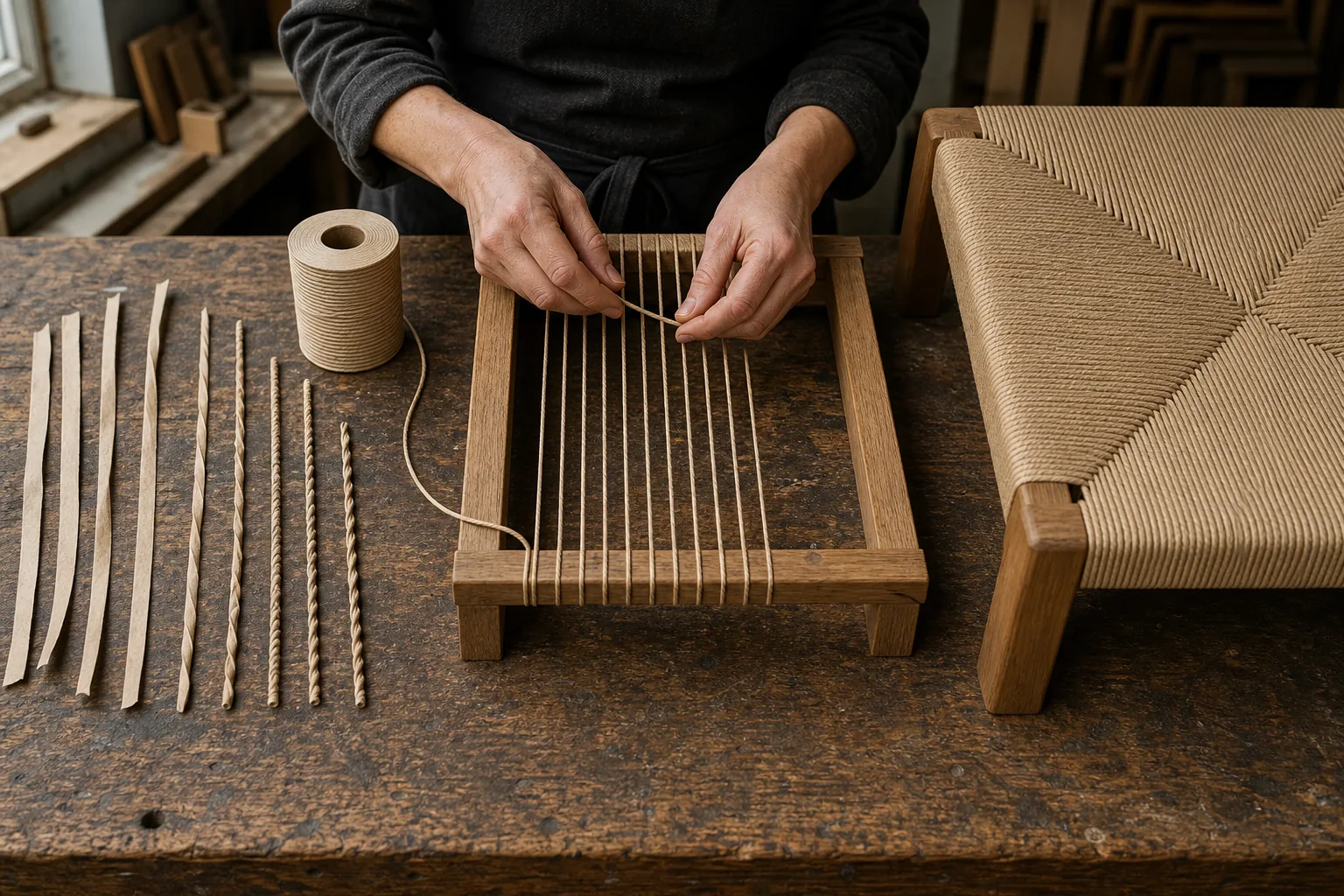
Paper cord is not cane, wicker or cotton rope. Cane comes from rattan; wicker describes a family of woven constructions rather than one material; textile cords may contain plant or synthetic fibres assembled in other ways. Danish paper cord begins with narrow paper that is tightly twisted into a relatively thin, consistent strand.
Carl Hansen & Søn's current material account describes natural cord as unbleached paper, with black cord dyed and white cord bleached. It also places the introduction of the technique in the early twentieth century as a less expensive alternative to leather and upholstered fabric. 2
Twisting matters because a sheet and a cord fail differently. The twist gathers the paper into a compact round strand that can bend around rails and cross neighbouring strands without presenting one broad tear line. The cord is still vulnerable to abrasion, staining and damaged fibres, but it can now be handled as a long structural material.
A 2024 material study of paper yarn made for textiles, rather than furniture, helps make that transformation visible. Its samples were produced by cutting paper into narrow strips and twisting them into yarn; the researchers identify strip weight, yarn diameter and amount of twist as important variables. Under magnification the yarn retained a layered cross-section and fine grooves from the rotated paper strip.8 The study does not provide a service rating for a Danish chair seat. It does show why paper is only the beginning of the material description: geometry changes what the cellulose can do.
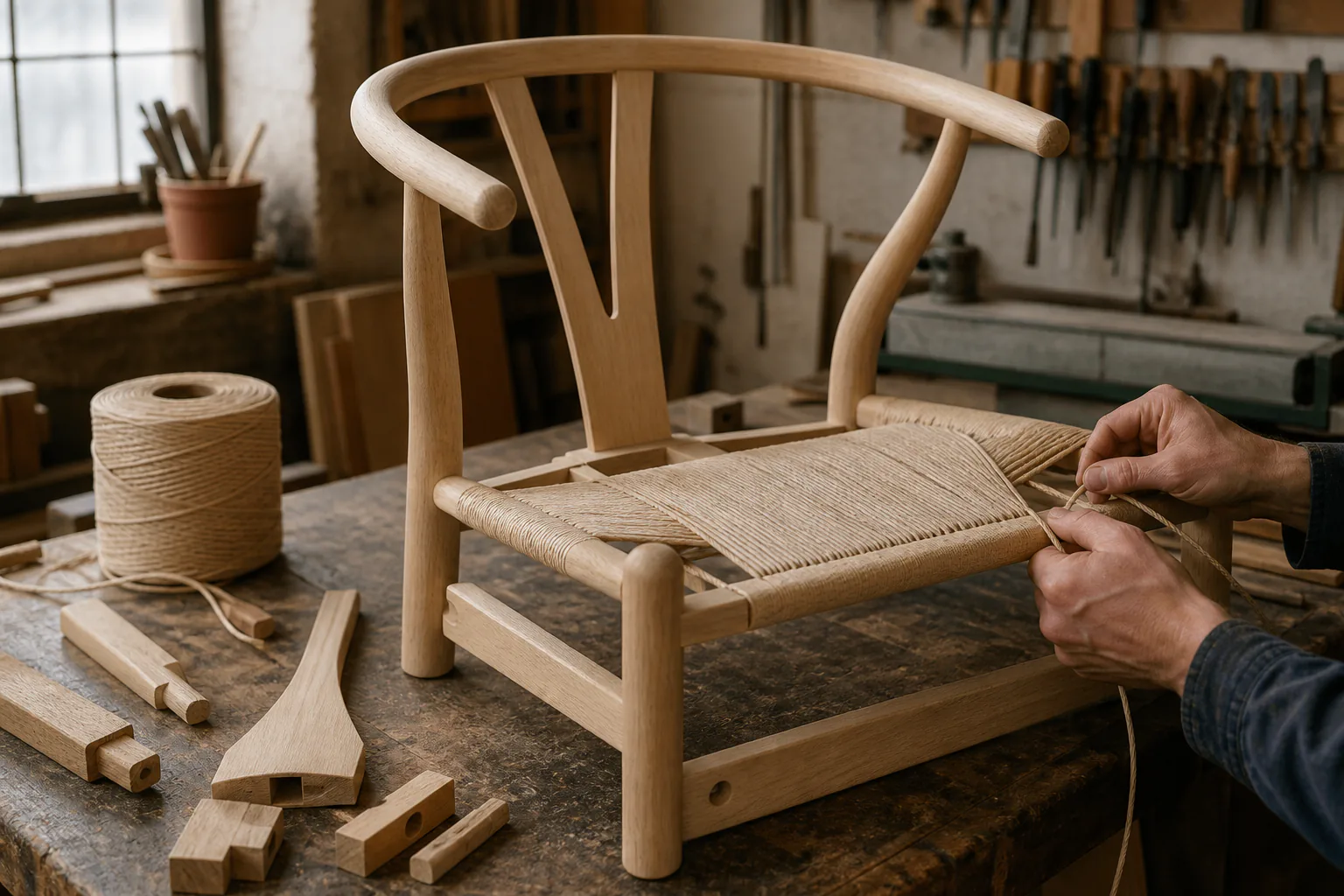
Weaving adds the second transformation. A seat is not a paper mat dropped inside a wooden frame. Cord wraps around the rails, crosses other runs and is kept under deliberate tension. When someone sits, the load is accepted by a large woven area and carried towards the frame rather than resting on one isolated strand.
This is why a photograph can hide the most important part of the work. Colour and pattern are immediately visible. Even tension is quieter. It appears in regular spacing, a stable surface and corners that resolve without sudden bunching or loose passages.
The pattern belongs to the chair
Paper cord did not create one universal Danish seat. The pattern has to answer the shape of the frame, the position of its rails and the visual character of the chair.
Carl Hansen & Søn's account of its weaving traditions says that Hans J. Wegner adapted an existing envelope-weaving technique to paper cord for the CH24 in 1949. It also connects the broader adoption of paper cord to material shortages during and after the Second World War, while presenting that history from the perspective of a current manufacturer. 3
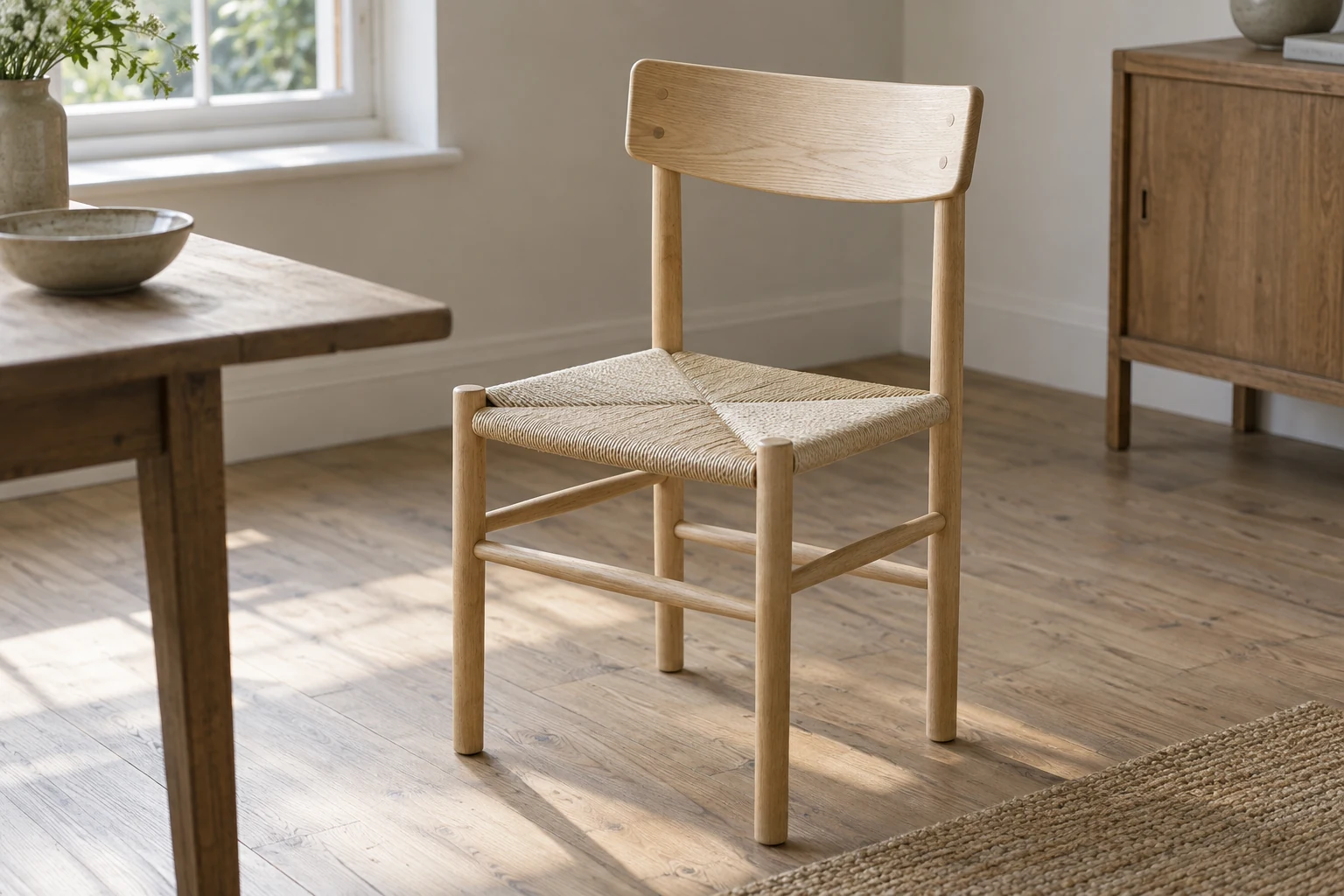
In an envelope weave, diagonal changes near the corners make the seat look as if four planes fold towards the centre. The geometry is decorative, but it is not decoration applied afterward. It is the visible record of the route the cord takes around the frame.
The maker's CH24 production account says an experienced weaver uses more than 120 metres of cord and about an hour to complete one seat. 4 Those figures make the surface easier to read. What looks like a calm patch of beige is a long sequence of repeated decisions: place the strand, pull it consistently, preserve the spacing and resolve the corner without losing the pattern.
The Metropolitan Museum of Art records beech and paper cord together in its Wishbone Chair, designed in 1949 and manufactured during the following decades.6 That pairing is important. The wooden frame is visually spare partly because the woven surface can complete the seat without a thick upholstered volume. The cord gives slightly where a solid board would not, while the rails give the cord the boundary it needs.
Wear is part of the material's biography
New natural paper cord begins pale and comparatively dry in appearance. With use it acquires tone and polish. The centre may change differently from the wrapped edges; a repaired passage may reveal a newer colour; one chair in a set may record more years at the table than the others.
Age alone is not proof of quality, and damage should not be romanticised. A broken crossing can transfer strain to its neighbours. Persistent looseness, cut fibres or a failing attachment point deserve attention. But an old woven seat does not need to look new in order to remain coherent.
Carl Hansen & Søn's care guidance says its cord is given a thin wax layer, normally needs little maintenance and should be cleaned sparingly with a tightly wrung cloth and neutral colourless soap. The same guidance advises dabbing spills rather than rubbing them into the cord, avoiding detergent, and using a skilled weaver when repair or replacement is needed. 5
The distinction between repair and replacement matters. A local failure may sometimes be addressed without discarding the entire history of the seat. In other cases, a complete new weave is the honest way to return the chair to use. A well-documented reweaving changes the material history of the object, but it can preserve the purpose for which the chair was made.
One contemporary Fredericia profile gives this idea a human scale. Kathrine Agger describes finding one J39 in a rubbish container and later taking a chair with a failed paper-cord seat to Blindes Arbejde, a Danish social- economy workshop, to be rewoven. The repair returned an ordinary working chair to her studio rather than turning it into an untouchable relic. 7
Look at the cord as construction
The next time a woven chair appears in a room or listing, let the eye stay on the seat for a moment. Follow one strand to the rail. Notice whether the spacing remains calm as the pattern approaches a corner. See how much visual weight the timber frame avoids because cord closes the space between its parts.
Then look at the changes made by use: softened colour, slight differences in tension, an old repair or a complete later reweaving. These are not merely condition notes. They show how a replaceable material can allow a durable wooden frame to continue living with people.
Read the CH24 Wishbone Chair for the larger object in which curved wood, joined components and an envelope-woven seat are made to depend on one another. The portrait Hans J. Wegner: a lifetime spent asking about the chair places that material experiment inside a career built through cabinetmaking, collaboration and repeated return to the same deceptively simple problem.