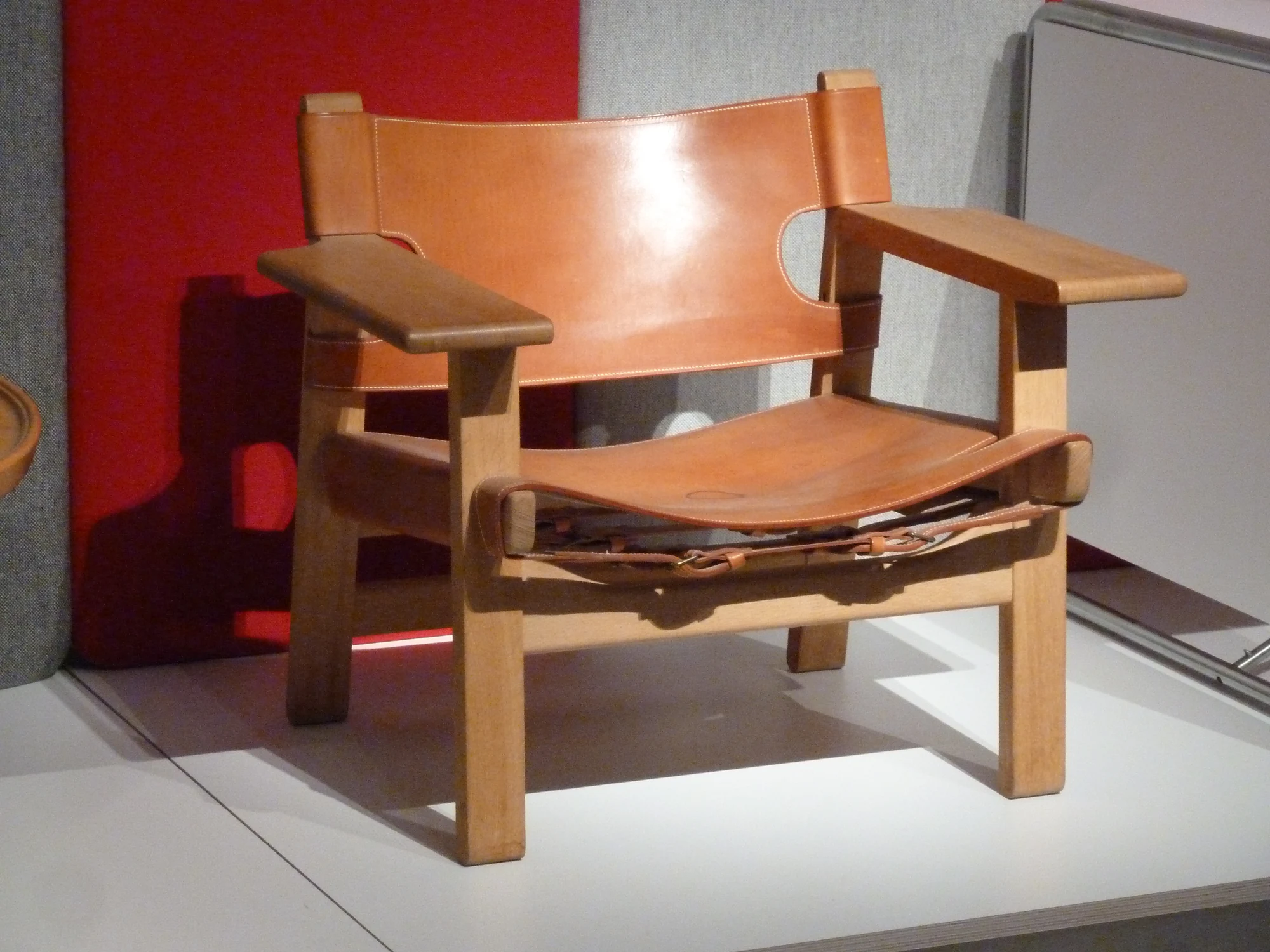
The arms draw a room around the sitter
Start with the empty rectangles beneath the armrests. Each is bounded by a front post, a rear post and a broad timber arm, so the chair's width belongs to its two side frames before anyone sits down. The low leather seat then hangs between those sides instead of filling them with an upholstered box.
That arrangement makes the Spanish Chair feel both substantial and open. Its arms claim almost as much visual territory as a small table — enough to make a side table feel faintly under-employed — yet light still passes through the frame. Mass is concentrated along two edges while the middle remains seat, back and air.
Ramblersen's 2011 photograph documents a Spanish Chair displayed at Designmuseum Danmark. It shows the low stance, rolled leather edges and front straps particularly clearly, but it is an exhibition view rather than a record of when this individual chair was made.4
Leather is a working surface
In conventional upholstery, fabric or hide often covers padding, webbing and the joins that hold everything together. Here the leather is itself the broad surface. The seat settles into a shallow curve between timber supports; the back bows between two uprights. The sitter can read where the material carries the body because there is nowhere for that action to hide.
The buckles make the point even more directly. Fredericia's current Model 2226 specification describes vegetable-tanned saddle-leather seat and back panels, metal buckles and straps that can be tightened as the leather expands. It also describes those panels as interchangeable and backed with canvas. 1
Those are useful construction facts, but their scope matters: they describe Fredericia's current production, not every Spanish Chair made since 1958. What the photographed example lets us observe safely is the larger principle. Its seat is tensioned rather than stuffed, and the means of adjustment remains visible beneath the front edge. Ageing is treated as something the chair can answer, not something design must pretend will never happen.
The name points to Spain, not to one proven prototype
Fredericia dates the Spanish Chair to 1958 and identifies it as model 2226. In the manufacturer's account, Mogensen encountered an ornate chair with broad arms while travelling through Andalucía, recognised a construction rooted in traditional Spanish and medieval seating, and simplified the idea in oak and saddle leather.1
That is an illuminating origin story when kept in quotation marks, so to speak. It explains why width, exposed frame and hide belong together in the manufacturer's understanding of the design. It does not identify one surviving antique chair as the exact prototype, and the name “Spanish Chair” does not mean that production took place in Spain.
The distinction protects the story from becoming tidier than its evidence. Mogensen could respond to a long furniture tradition without leaving us a single museum accession number from which every line descends. Influence can be real even when its family tree remains incomplete.
The Hunting Chair shows the earlier question
The Museum of Fine Arts, Houston, gives that wider development a useful earlier point. Its Hunting Chair was designed for the 1950 Copenhagen Cabinetmakers' Guild exhibition and manufactured by Erhard Rasmussen between 1951 and 1955. The museum records its exact object in oak and leather. 2
MFAH also describes the 1958 Spanish Chair as a wider version of a 1951 dining chair and treats the Hunting Chair's experiment with form and material as important to Mogensen's later career. That is the museum's interpretation, not proof that the Houston chair is a first Spanish Chair in disguise. What it does show is that exposed timber and tensioned leather were already active questions in Mogensen's work before 1958.
The setting mattered too. The Cabinetmakers' Guild exhibitions made experimental furniture available for close public and professional scrutiny. A chair whose structure could be read across the room was well suited to that culture of looking.
A carpenter edits the monument
Möbeldesignmuseum's profile records that Mogensen trained as an apprentice cabinetmaker in 1933–34, studied at the School of Arts and Crafts from 1936 to 1938, and was a student of Kaare Klint. It also places him at the head of FDB's furniture section from 1942 to 1950.3
That background helps explain the Spanish Chair without turning biography into destiny. His study under Kaare Klint matters here because Mogensen did not discard precedent; he subjected it to measurement, use and revision. Cabinetmaker training made joints and material behaviour difficult to dismiss as somebody else's problem.
The resulting chair is monumental without depending on ornament. Its posts are thick, its arms unusually broad and its stance close to the floor, but every large timber member belongs to a visible frame. Mogensen did not make the old idea modern by putting it on thin legs. He made it clear by deciding which parts still had work to do.
What the chair keeps visible
The Spanish Chair makes a useful comparison with Klint's Safari Chair. Both allow a flexible surface and an exposed timber structure to retain separate identities. But the comparison is about how we can read them, not evidence that one exact chair was the other's direct model: the Safari Chair organises portability and disassembly, while the Spanish Chair turns width and tension into a settled, low territory.
This is why the broad arms cannot be reduced to a photogenic signature. They anchor the side frames that receive the leather spans. The leather cannot be reduced to a luxurious finish because it forms the seat and back. The buckles are not jewellery because they acknowledge that a working hide changes.
The reviewed sources establish a 1958 Børge Mogensen design, Fredericia's model number and current specification, the manufacturer's Andalucía account, and a related earlier museum object. They do not authenticate another chair or turn every production period into one specification. The safest conclusion is also the most interesting one: the Spanish Chair feels generous because it shows exactly where its generosity is carried.
