First, remove the floor
Most chairs explain themselves from the ground up. Feet meet floor, legs lift seat, and back rises behind the sitter. Hanging Egg begins at the other end. A chain descends to the top of a woven shell; below it, the body of the chair floats with an unmistakable gap between basket and floor.
That reversal changes more than the silhouette. A conventional chair stays where its legs are placed and offers a stable view in one direction. A suspended chair can turn, sway and answer small shifts of the body. Nanna Ditzel Design describes the Ditzels' idea as an egg-shaped curved shell hung from a chain so the form becomes coherent and floating. The archive associates that suspension with rocking, retreat and a view of the world in motion. 1
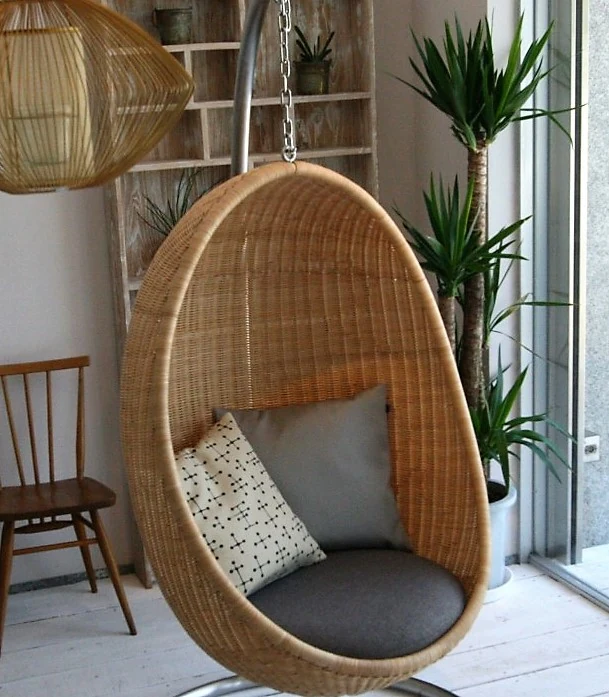
Laylahipo's 2017 photograph shows a later Hanging Egg hanging from a curved stand in a domestic interior. It is not the prototype and does not establish the age or maker of another chair. What it documents beautifully is the design's central absence: where four legs ought to make furniture predictable, there is daylight.6
One shell must perform several jobs
Once the legs go, the familiar inventory of chair parts becomes harder to separate. There is still a seat, a back and protection at the sides, but the eye encounters them as regions within one egg-shaped enclosure. A thick, rounded rim begins near the suspension point and travels around the opening, giving the softer field of weave a continuous boundary.
Sika Design says the Ditzels had worked with wicker in Robert W.'s workshop from 1950 and experimented with designs in which seat and frame became a cohesive body. Its history presents Hanging Egg as part of that sequence and dates the distinctive form to 1959.2
The shell is coherent without being visually seamless. Vertical and curved members can be followed beneath the finer weave, the rim is emphatically thicker, and the cushion remains a separate soft element. The achievement is not hiding construction until the chair resembles a plastic bubble. It is making boundary, support and woven surface cooperate strongly enough that the whole reads before the parts.
Rattan makes a room that can breathe
An egg could easily become a sealed pod. The Hanging Egg instead produces enclosure through a woven material. In the photograph, the rattan is dense enough to draw an unmistakable volume around the sitter, yet light passes between its lines. Plants, windows and furniture remain visible through the shell as softened fragments of the larger room.
The terminology in the reviewed records is useful. Nanna Ditzel Design calls the historical design a wicker chair, describing a woven-furniture tradition; Sika specifies rattan for the current indoor model. Sika's product page shows a rattan-frame version and offers either a chain or a metal stand as present hanging options.3
Those current details must stay in the present tense. They do not establish the exact cane, inner frame, cushion or support used in every historical edition. Nor should a photograph's warm colour become a material test. The safer visual conclusion is also richer: many slender lines can produce a strong sense of interior without using a solid wall.
Motion becomes part of sitting
A rocking chair describes an arc on runners. Hanging Egg has no such visible track. Because its body is suspended from above, the chair can change angle in plan as well as move gently through space. The sitter does not merely look out of a fixed opening; the opening and its framed view can travel together.
Trapholt made that bodily fact part of a 2024 museum experience. Visitors to its Nanna Ditzel exhibition could try a Hanging Egg and, in the museum's vivid description, feel the ground disappear while turning. This is evidence of how the design was interpreted and experienced in that exhibition, not a performance measurement for every chair.4
Movement also introduces social ambiguity. The shell suggests retreat, but a small rotation can return the sitter to conversation. It is private without a door and theatrical without a stage. Even sitting still looks provisional, as though the chair has paused between two views.
The room becomes part of the mechanism
A floor-standing chair asks for enough level ground. A suspended chair asks a larger question of its surroundings: what carries the connection above, and what space must remain clear around a moving shell? In the Ditzels' design, support has not disappeared; it has migrated beyond the traditional chair frame.
That distinction is easy to lose in photographs, which often crop the chain before its load reaches a ceiling or show a freestanding support as background scenery. Sika's current chain and stand options make the dependency explicit, but they are product choices rather than universal installation instructions. A real ceiling, anchor, stand, chain and clearance require assessment for the specific object and place; resemblance to a published image cannot certify them.
This expanded boundary is part of the design's drama. Hanging Egg borrows a piece of architecture to complete the chair, then repays the room by making previously empty air visible. The occupied volume is no longer a footprint on the floor but a moving envelope around a person.
1957 or 1959? Keep the loose thread visible
The official Nanna Ditzel Design archive labels Hanging Egg 1959, as does Sika's designer history and current product account. A research catalogue from the MoMoWo project gives a more divided chronology: designed in 1957 and produced by Sika Design in 1959.5
The reviewed sources do not tell us whether 1957 refers to an early drawing, a prototype or another milestone. This page therefore uses 1959 as the graph's documented design date because the official design archive and current manufacturer converge there, while preserving the 1957/1959 account in the story. Historical furniture rarely becomes more accurate when a loose thread is snipped simply to make the label neat.
The date also places a playful neighbour nearby. Nanna Ditzel Design notes that Arne Jacobsen's Egg appeared in 1958 and presents the Ditzels' wicker egg the following year as a refined, humorous statement. The archive's comparison is not proof that one design structurally descends from the other. Jacobsen's Egg Chair stands on a central pedestal; Hanging Egg makes suspension its premise. They share a nickname and an enclosing outline, then disagree rather splendidly about gravity.
That disagreement returns us to the opening question. When a chair leaves the floor, sitting becomes a relationship among shell, body, movement and room. Hanging Egg is memorable not because it floats free of structure, but because it lets us feel where structure has gone.