A waiting room can become a naming machine
Airport Chair sounds like a brief: design something for departures, bolt it down and make it survive coffee, luggage and delayed flights. Wegner's history is less conveniently linear. The name became durable through association with Copenhagen Airport at Kastrup, while design records, model numbers and makers belong to overlapping parts of a wider seating family.
Carl Hansen & Søn's official airport case says Wegner's Airport Chair was chosen for Copenhagen Airport in the 1960s and that versions continued to be supplied there over many years.2 The public setting did more than provide a backdrop. Repetition across gates made the chairs part of the airport's visual identity; thousands of anonymous sitters helped turn a place into a common name.
That is the human interest of the design. A chair can leave the quiet clarity of a catalogue photograph and acquire meaning through use: waiting, meeting, missing a connection, finally boarding. Some furniture earns a nickname from its shape. Airport earns one from where people repeatedly encountered the family—giving it, frankly, a better travel history than most carry-on bags.
First keep 1958 separate from the 1960s
Designmuseum Danmark's Furniture Index records CH401 as an easy chair designed by Hans J. Wegner in 1958.1 That is a design date. Carl Hansen's airport case places the airport's choice of Wegner seating in the 1960s.2 That is an installation and use history. The two statements belong beside one another, not on top of one another.
Carl Hansen's CH401 sheet compresses the story more tightly, describing the 1958 design in direct relation to Kastrup and using both Kastrup Chair and Airport Chair as names.3 Manufacturer summaries often turn a long adoption story into one clean origin sentence. The safer Library account preserves the more precise pieces: a 1958 design record, documented airport selection in the following decade and a name that became attached to the seating family.
This separation matters when dating an object. “Designed in 1958” does not mean “made in 1958”. “Used at Kastrup” does not mean every example stood in that airport. A design, a production run and one chair's provenance are three different timelines, even when a listing manages to fit them into one line.
CH401 is a record, not a resemblance button
The Furniture Index's CH401 entry lists Wegner as designer and names several makers or production contexts: A.P. Stolen, Carl Hansen & Søn, Johannes Hansen and Fredericia Furniture.1 Read that as an institutional attempt to index the model's broader history, not as evidence that four factories simultaneously made one anonymous chair.
Carl Hansen's product sheet describes its CH401 as the single lounge chair in a series that also includes two-, three- and four-person sofas. It specifies a solid beech inner frame, upholstery and stainless-steel elements for that documented later product.3 The airport case specifically mentions CH402, CH403 and CH404 sofas as signature seating in one concourse.2 “Airport Chair” therefore operates at two scales: a named chair and a recognisable family used in public.
A.P. Stolen belongs in that history, but an AP model number should not be reverse-engineered from a photograph. Market descriptions circulate several numbers for low Wegner airport seats and related variants. This article does not assign one to the current PatinaHall chair because the reviewed listing and photograph do not supply independent object-level proof. The right question is “Which exact model does the evidence establish?”, not “Which number makes the title sound most complete?”
Upholstery in public is meant to have a future
The airport case contains an unusually useful piece of furniture history. Carl Hansen reports that intensive use did not end the life of older chairs; airport staff could retain original seating and renew the upholstery when colour schemes changed.2 That is a maintenance story, not a failure of originality.
Collectors often treat first upholstery as a moral category: untouched is good, renewed is suspect. Public seating offers a different measure. Fabric and foam absorb wear; a durable underlying chair can continue after those surfaces are replaced. In an airport, a responsibly renewed seat may be more historically continuous than a fragile “original” one removed from use.
This does not make every reupholstery equivalent. Profile, seam placement, padding thickness and attachment can alter the design's proportions. Nor does an airport's reported practice tell us who renewed a chair elsewhere. It does make one principle clear: upholstery date and design date need not match, and that mismatch can be evidence of a useful life rather than a reason to erase the object from history.
Two soft planes meet a bright support
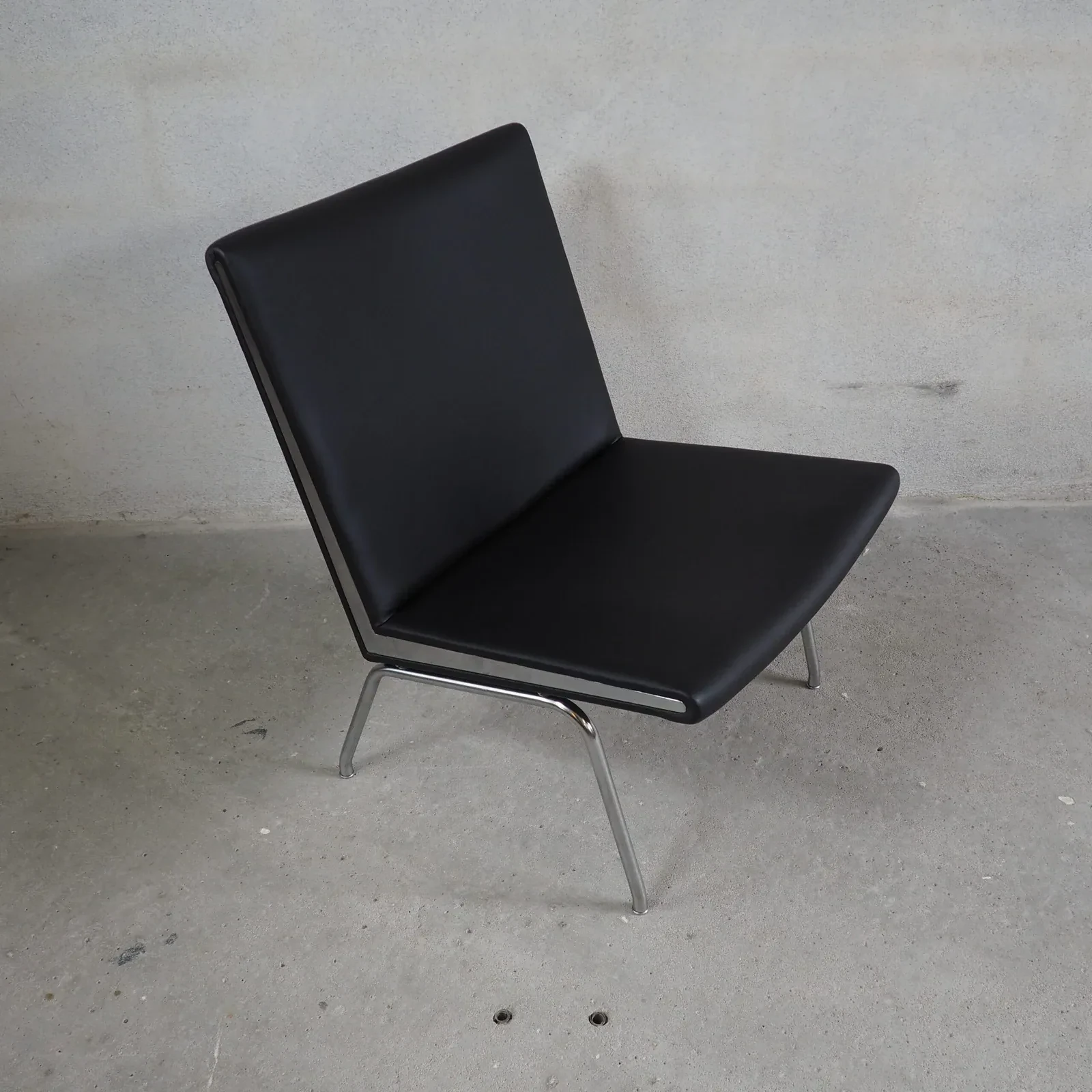
The current PatinaHall image shows a seller-described Airport lounge chair in three-quarter view.4 A black padded back leans towards a separate black seat. Their meeting forms a crisp angle, while exposed polished metal carries the composition to the floor. There are no broad wooden arms to mediate the transition.
The visual economy suits the public-name story. Seat and back communicate their bodily jobs immediately. Bright metal remains narrow enough to keep the chair open at the sides, yet it draws a firm boundary beneath the upholstery. The black surfaces look like two planes suspended on a silver line rather than a conventional armchair reduced by removing its arms.
Look closely at the metal instead of treating all silver as one material or method. A flat strip following the seat and back is not the same thing as a tubular leg. Carl Hansen's current CH401 sheet documents flat stainless-steel side pieces and a beech inner frame for its model.3 Those details are comparison evidence for CH401, not specifications silently transferred to the photographed chair.
The present chair is a prompt, not an airport passport
The PatinaHall seller describes the pictured chair as a 1958 Wegner Airport Chair for A.P. Stolen, newly upholstered in black leather and with two bushings remade.4 Those statements are relevant to the current listing. They have not been independently verified for this Library story, and the photograph cannot prove them.
What the image can do is organise a better inspection. Start with the two upholstered planes and their angle. Follow the metal side element and identify where its section changes. Examine the underside, labels, fasteners and feet; record dimensions; compare them with an exact documented model. Ask whether new padding has changed the profile. Then seek provenance if an airport-use claim is being made.
No single silhouette settles model, maker, date or former location. The Furniture Index establishes a 1958 CH401 design record; the manufacturer documents later CH401 construction and a wider Airport series; the airport case records long public use.132 Those layers make the history interesting precisely because they are not one certificate for every low steel-framed chair.
Continue to Wegner’s CH29 Sawbuck Chair for another 1950s Wegner design with an entirely different public presence. CH29 lets timber joints and splayed legs carry the identity; Airport lets a place, repeated use and renewable upholstery become part of the name.