Softness arrives as two precise panels
Model 80 contains plenty of upholstery, but none of it is allowed to dissolve the chair's structure. The seat is a shallow padded plane laid between four legs. The back is a separate padded rectangle held inside two rising timber uprights. Around both, visible wood keeps drawing boundaries.
That sounds like a minor distinction until the chair is compared with a fully upholstered shell. In a shell, fabric or leather can become the whole visible body and the support retreats underneath. Model 80 reverses the hierarchy. Its cushions are prominent, yet the eye can still travel along the timber from the rounded front posts to the rear uprights and around the back panel. Comfort has been invited in, but it has not been handed the keys to the entire silhouette.
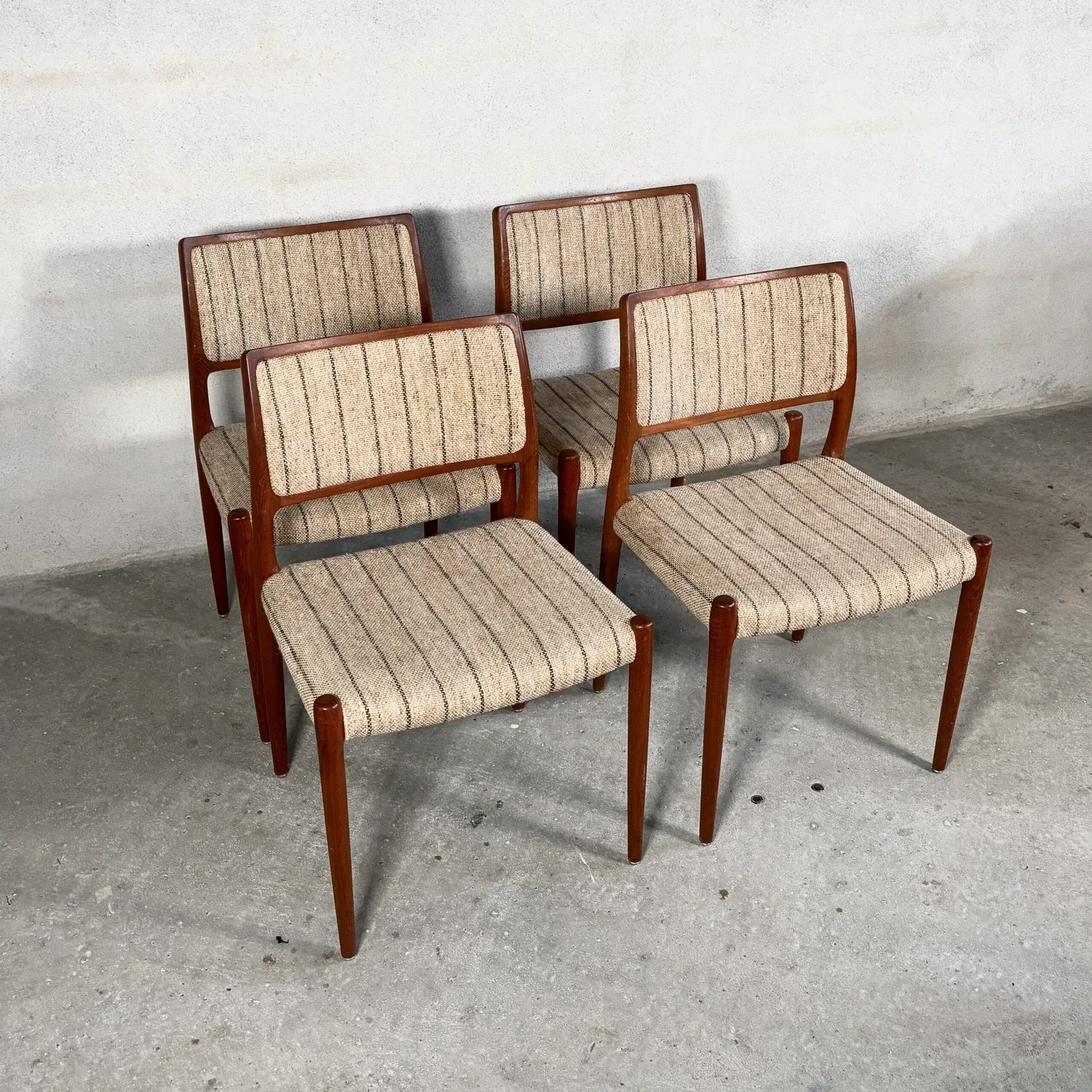
The current PatinaHall image makes this particularly legible because four chairs repeat the idea.4 Beige striped fabric turns each padded panel into a little diagram, while dark timber marks the outer limits. Together they resemble a committee of chairs that has actually agreed on where every margin should be.
Two records meet at 1968
Designmuseum Danmark's Furniture Index records Model 80 as a side chair from 1968 by Niels O. Møller, made by J.L. Møllers Møbelfabrik. It indexes examples in rosewood, teak and oak and with leather or fabric upholstery.1 As with any catalogue index, that set of materials describes documented possibilities, not a claim that every chair used every option.
J.L. Møller's own Model 80 record independently gives the same designer and year.2 The agreement is valuable because it joins an institutional furniture record to the continuing maker's model history. We do not have to build the identity from a seller title or from visual resemblance.
The maker's present page describes a solid-wood frame, a fully upholstered backrest and current fabric or leather choices. It also calls Model 80 one of the more intricate pieces in its collection to produce.2 That is a useful current manufacturing account. It does not tell us the wood, upholstery date or workshop history of a chair encountered elsewhere, and its present dimensions should not become a ruler with which every older object is pronounced genuine or false.
The open band keeps the back from becoming heavy
Look between the lower edge of the upholstered back and the rear of the seat. A narrow horizontal opening remains. It is not leftover space awaiting a missing cushion. It separates two bodily tasks—supporting the back and supporting the sitter—and gives each its own visual plane.
The gap does several quiet things at once. It allows the rear uprights to be seen rather than buried behind padding. It lets the wall or room colour pass through, reducing the apparent mass of the back. In a group, it creates a repeated dark band that helps the eye distinguish one chair from the next.
Now follow the timber immediately around the back panel. The top corners are softly rounded, but the perimeter remains narrow and controlled. Upholstery approaches that edge without spilling over it. The contrast makes the padded surface look generous even though the chair stays visually compact: a small wooden margin can make the soft centre appear larger.
This is also a practical looking clue, not an authentication formula. On an individual chair, examine whether the panel sits evenly, whether the reveal is consistent and whether later fabric obscures the frame. Those observations can identify questions for closer inspection. They cannot date the textile or prove what lies beneath it.
A workshop learns to repeat without looking mechanical
J.L. Møller traces the company to 1944, when Niels Otto Møller and Kirsten Møller opened a 50-square-metre workshop in a former bicycle shed in Aarhus. The company says it moved from commissions towards serial chair production in the early 1950s, with Niels Otto designing and producing his own collection.3
That history gives Model 80 a useful context. A dining chair is rarely seen only once. It must survive repetition around a table, and its visual quality depends on correspondences: equal back heights, consistent openings, matched transitions and upholstery that sits within the same timber margins. Serial production does not remove craft from that problem; it makes precision recur.
The maker describes Møller as someone who systematised the production of handmade furniture while retaining an artisan identity.2 Model 80 makes that proposition visible. Its outline is too restrained to hide large inconsistencies. Where a bulky cushion might forgive a wandering edge, the narrow frame politely records every meeting.
This does not mean each surviving vintage chair should be identical today. Wood changes colour, upholstery is renewed, frames are repaired and sets can be assembled over time. Repetition establishes the design; individual history creates variation within it.
Four chairs make one idea easier to see
The PatinaHall photograph presents a seller-described set of four rather than one isolated profile.4 That is useful editorially. The nearest seats show how upholstery sits between rounded front posts. The rear pair brings the framed back panels together, turning their open lower bands and timber borders into a repeated rhythm.
Stripes add another layer of information. They make the direction and tension of the visible textile easy to compare across seats and backs. Yet they also belong to the current objects, not to the design's permanent identity. The seller calls the wool upholstery original; this article has not independently verified that claim. Model 80 remains Model 80 across documented fabric and leather options, and reupholstery can be part of an individual chair's useful life.
The best way to read a set is therefore comparative rather than accusatory. Do the timber margins align? Do the back panels sit at the same height? Are wear, colour and fastenings consistent? A difference is a prompt to inspect the objects and their records. It is not, by itself, a verdict delivered from a photograph.
What the line can and cannot prove
The licensed current image teaches Model 80's visual proposition beautifully: two upholstered surfaces are inserted into a slender, continuous-looking timber order. It does not prove that the pictured set was made in 1968, that its wood is teak, that all four chairs began life together or that their striped covers are original.4
For a useful first reading, ignore colour and style labels. Trace one front post, the seat edge, the rear upright and the top of the back. Then look only at the padded rectangles and the opening between them. If both drawings remain clear, the central Model 80 idea is present: softness has been carefully located rather than allowed to engulf the chair.
Object-specific attribution requires more—marks, underside construction, documented dimensions, provenance and comparison with reliable examples. The museum and maker records establish the repeatable design. They do not issue a passport to every chair with a framed cushion and good posture.
Continue to Model 370 Boomerang for a chair in which the timber outline becomes more animated. Model 80 holds upholstery inside a composed rectangle; Boomerang turns one side member into the design's most memorable gesture.