The nickname waits at the side
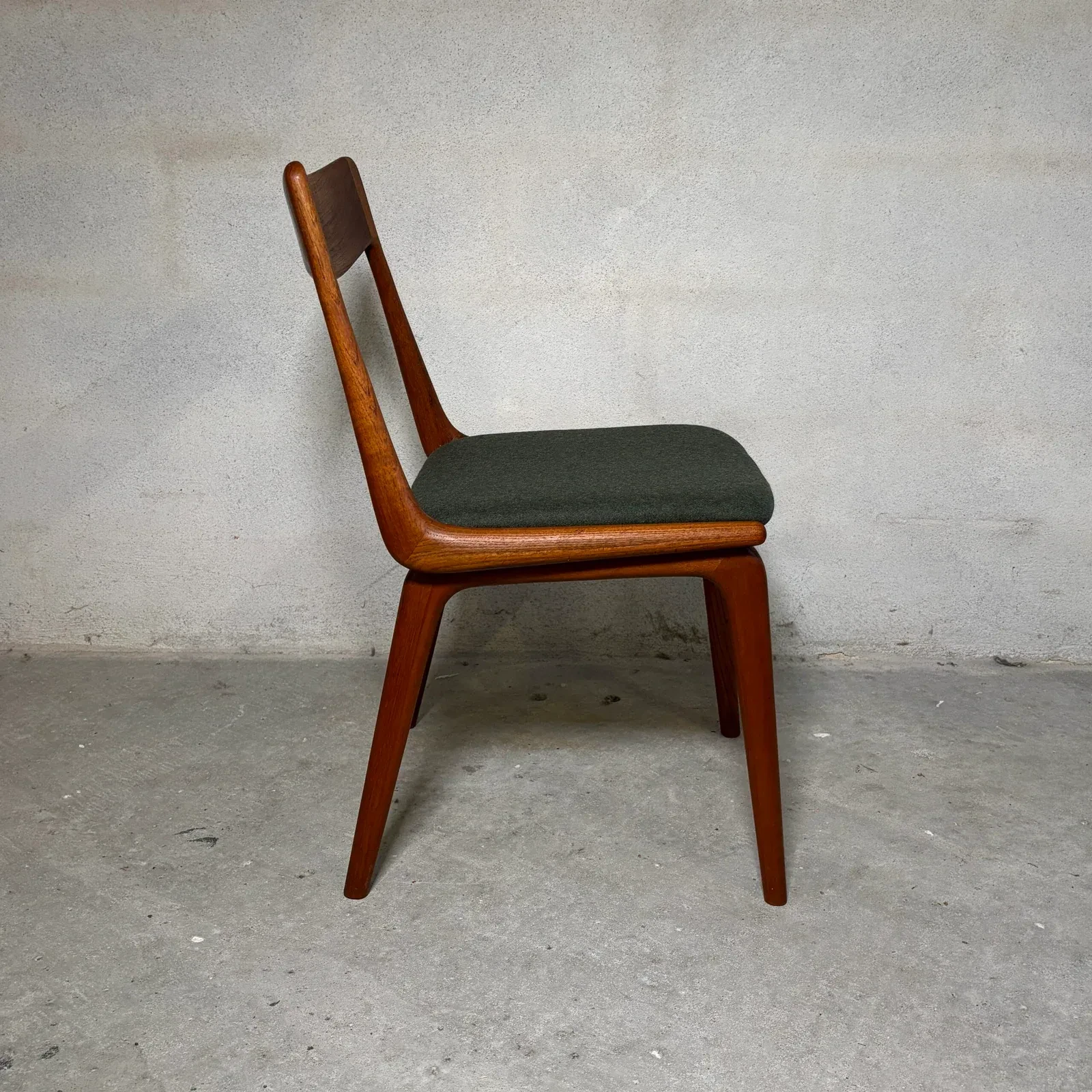
From the front, Model 370 can seem almost decorous. A curved timber back rail spans two uprights, an upholstered seat sits below and four tapered legs keep the whole arrangement light. The Boomerang name does not fully announce itself until the chair is seen in exact profile.
There, a long side member runs backwards at seat level, turns through a strong angle and climbs towards the top rail. The change of direction produces a recognisable open V without drawing a literal sporting implement. It is a boomerang translated into furniture grammar: one arm supports the seat edge, the other establishes the back.
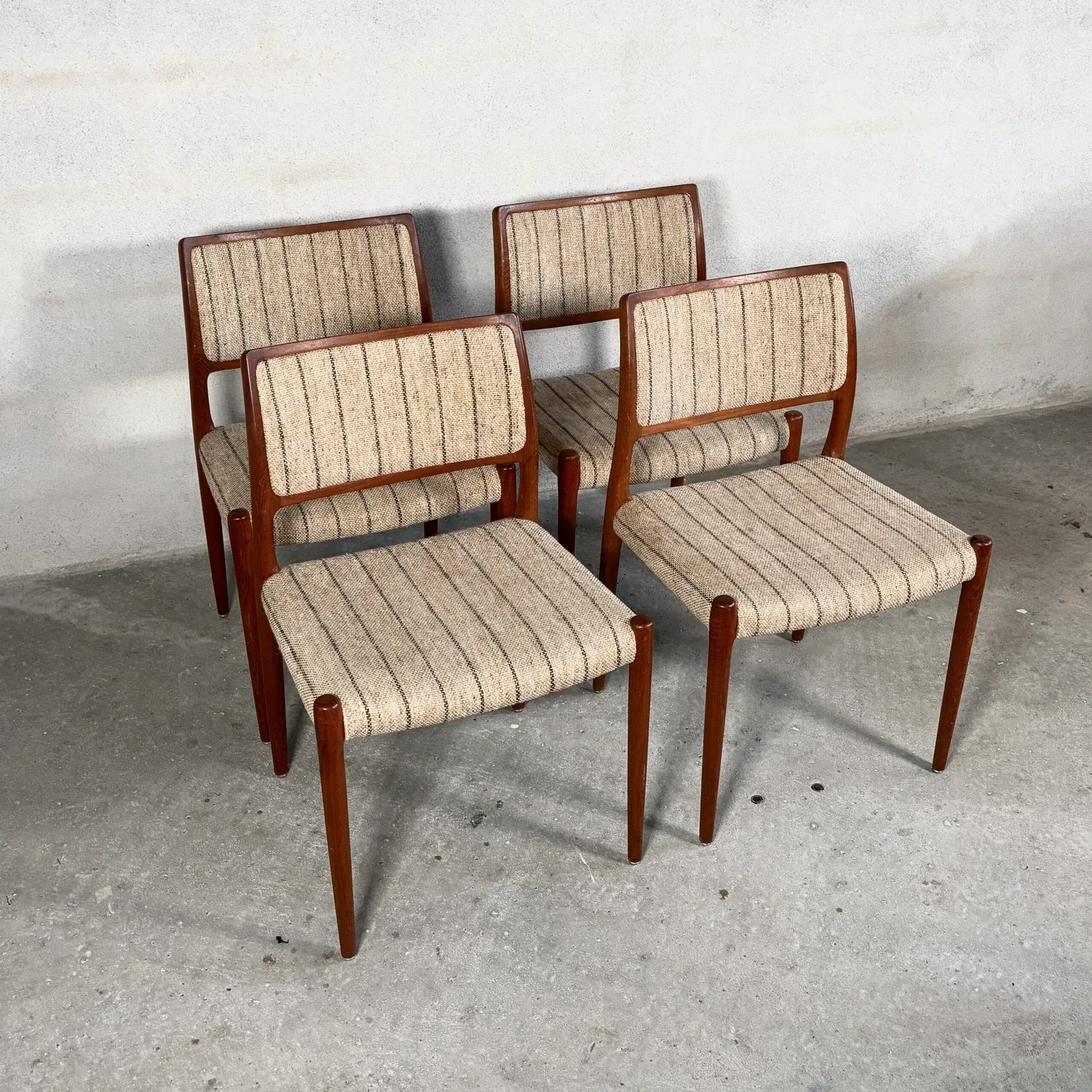
That is why the chosen PatinaHall photograph is not the listing's primary group portrait. Six chairs in formation make an impressive set, but they hide one another's profiles. The selected seventh view isolates a single chair side-on, where the angular member, upholstered pad and separate legs can be read without visual traffic.4 An editorial image should explain the story, not merely prove that six chairs can fit inside a square.
Model 370 is secure; an exact year is not
Designmuseum Danmark's Furniture Index records the chair as Model 370, names Alfred Christensen as designer and Slagelse Møbelværk as maker, and indexes teak and fabric. Its note points to an archival “Bommerang” reference.1 The spelling in that note wobbles; the identity does not.
What the exact record does not provide is a year. That absence deserves more respect than the many market pages that confidently print 1960, 1961 or a decade as though all three meant the same thing. A Lauritz archive for a marked Model 370 cites Mobilia 1962 nos. 82–83.3 This places the model in a specific period publication. It does not tell us the day a drawing was finished or the date every chair left the workshop.
Dagmar, which works with the Christensen estate on a different Slagelse reissue, describes Boomerang as a late-life design made when Alfred was about 70 and records his death in January 1962.2 Together, the sources support an early-1960s context. This article stops there. A slightly untidy date range is better furniture history than a perfectly polished invention.
One line turns, another structure stands
The profile becomes clearer when divided into layers. The upper angular member defines the seat edge and back support. Below it sits a four-legged underframe. The two meet near the front and rear of the seat, but they do not read as one continuous bent loop.
This distinction protects the chair from its own nickname. “Boomerang frame” can tempt us to see every piece as part of one grand curve. The photograph shows something more disciplined. Straight and tapered leg lengths descend to the floor, while the memorable turn happens above them. The chair obtains a gesture without asking the underframe to perform theatre.
At the turn itself, timber thickens visually and the direction changes. A photograph can show that transition, the grain and visible meeting lines. It cannot tell us the exact joint concealed inside, the adhesive used, or the condition of the connection. Those require object-level examination. Calling a photographed line a finger joint because another Model 370 has one would be the constructional equivalent of guessing a person's bones from their coat.
Upholstery is a pause in the timber drawing
Model 370 uses a padded seat but no upholstered back. That allocation matters. The body receives softness where its weight rests, while the chair's upper half remains an open timber composition: back rail above, air below, angled side members at the edges.
In profile, the seat pad appears to lie just inside the long wooden rail. Its rounded front slightly softens the geometry but does not conceal the turn towards the back. From the front, the fabric becomes a broad field and the timber back rail supplies a second, narrower horizontal. Each view gives a different part priority.
The current seller describes dark green wool fitted during restoration.4 That colour is handsome and makes the warm frame easy to see, but it belongs to these current objects' stated restoration history. Designmuseum's generic fabric index supports upholstery as part of the model, not this exact cloth, colour or date.1
For comparison, look at how an individual seat meets its wooden perimeter and whether it obscures the side line. Do not convert neat upholstery into proof of originality. A chair can be correctly reupholstered, badly reupholstered or photogenically reupholstered; those are three different assessments.
Slagelse was both workshop and design context
Dagmar's history says Alfred Christensen and his brother Erik founded Slagelse Møbelværk in 1931, with Alfred acting as chief designer while the company also worked with outside architects.2 That dual role—an owner thinking as a designer inside a furniture works—is useful context for Model 370.
The chair's memorable line does not float free from production. It has to meet an upholstered seat, a curved back rail and a separate underframe repeatedly. The Designmuseum index joins Christensen and Slagelse on the exact model record; Lauritz describes its archived examples as marked by the maker.13 Those are stronger connections than a vague national style label.
It is also a reason not to reduce Christensen to one nickname. Dagmar describes a broader catalogue and a shift from classically inflected furniture towards modern work.2 Boomerang is a particularly legible late proposal: a dining chair can remain useful and repeatable while one side elevation carries an unmistakable graphic signature.
Let the current chair teach looking, not certainty
PatinaHall's current listing describes a restored set of six Model 370 chairs by Alfred Christensen for Slagelse Møbelfabrik.4 The licensed profile teaches exactly what this article needs: the upper turn, the separate legs, the contained seat and the open back.
It does not establish that the pictured chair is an authenticated Model 370, that its timber is teak, that its joints retain their original state or that the set began life together. The seller's restoration and material statements remain seller evidence. Marks, underside construction, dimensions, provenance and comparison with documented chairs belong to an object-specific review.
For now, perform a simpler and genuinely useful test. Turn the image sideways in your mind. Follow the timber from the front edge of the seat towards the back, then up. Notice where that long gesture stops and where the ordinary work of four legs begins. The nickname becomes precise rather than promotional: Model 370 is not vaguely “boomerang-shaped”. It contains one highly legible boomerang line.
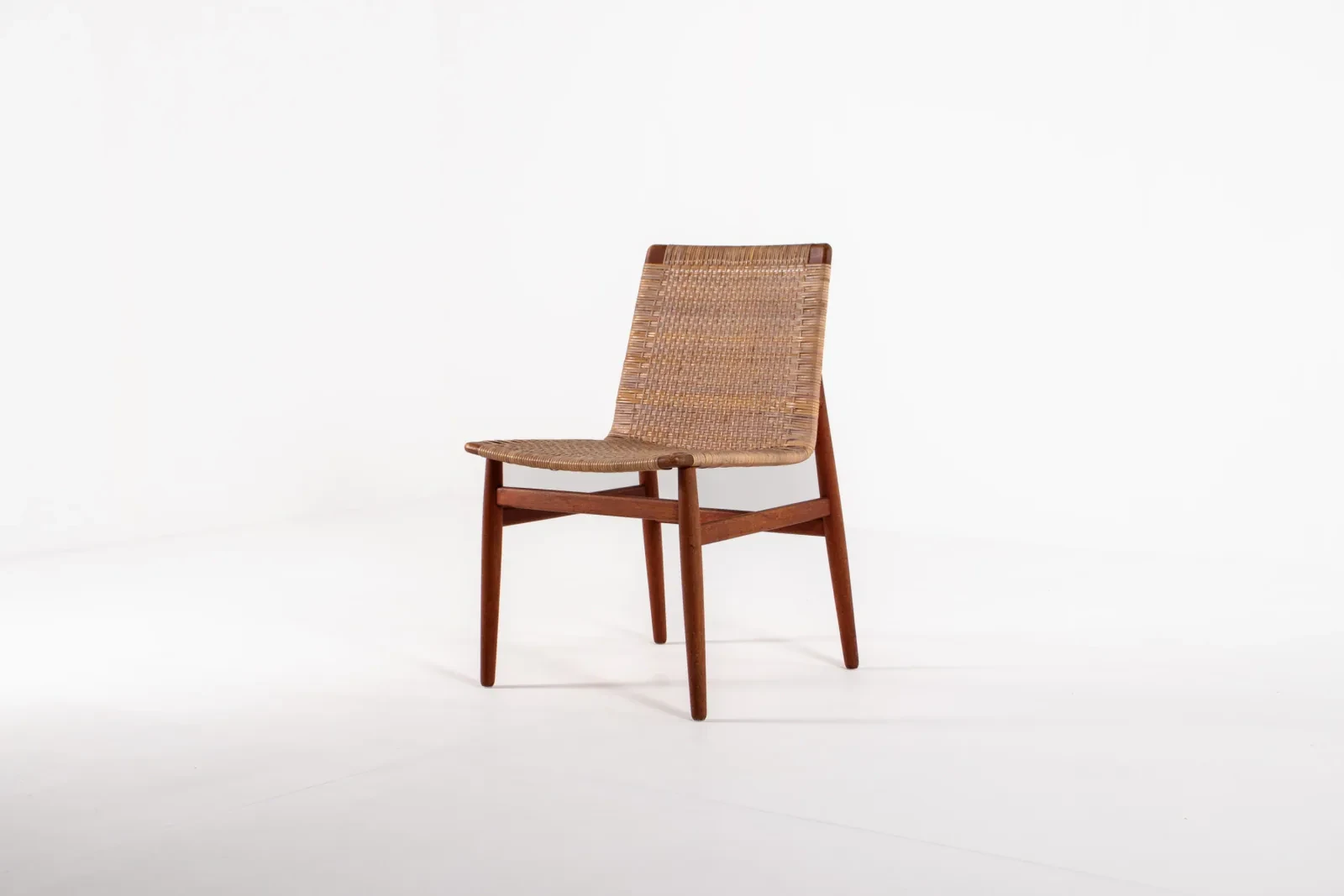
Continue to Jørgen Høj’s 1951 chair for a quieter side-chair argument. Christensen concentrates identity in one turning timber profile; Høj separates a restrained wooden skeleton from broad woven planes.