Two materials, two kinds of drawing
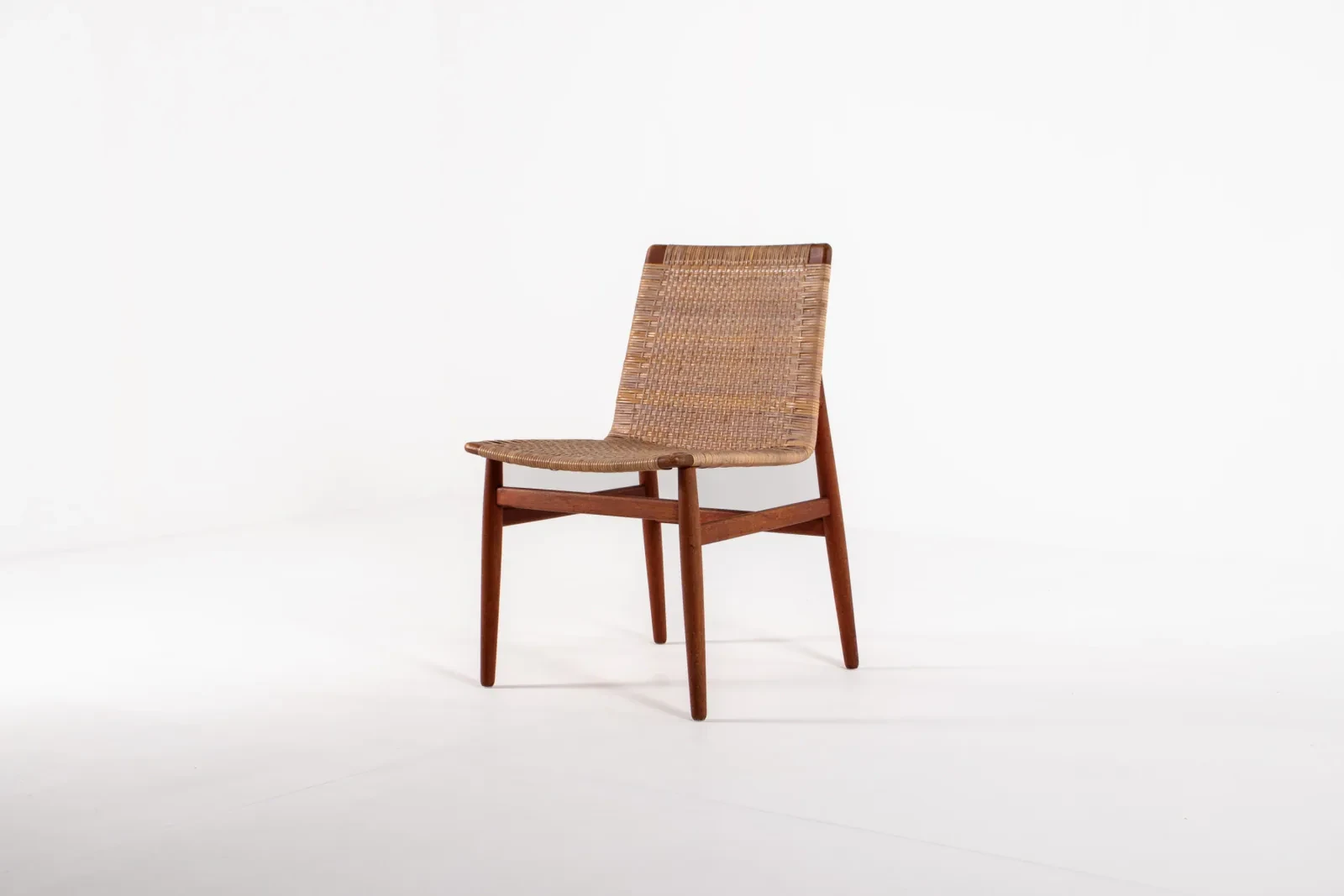
Begin with the silhouette and the chair seems almost conventional: four legs, a seat and a back. Then look at how those parts are described. The timber is mostly line. Round front legs and more angular rear members rise through a small network of rails, while the woven material spreads into two broad fields. One system outlines; the other fills.
That division keeps the chair visually calm. An upholstered pad would hide its attachment beneath a soft edge. A solid timber back would add another heavy board. Høj instead lets the woven panels announce both their extent and their dependence on the frame. At the front of the seat, strands turn over a narrow boundary; around the back, the grid meets a compact timber cap and side supports. Construction has not disappeared. It has simply agreed to use two different handwriting styles.
In the current PatinaHall photograph, the contrast is unusually clear because the chair is isolated against white.3 The timber skeleton reads from across the room. Move closer and the weave takes over, a small repeated grid where the frame had been drawing longer, more decisive strokes. It may be the only chair in which graph paper appears to have negotiated a friendly settlement with a cabinetmaker.
The record says 1951, but not everything at once
Designmuseum Danmark's Furniture Index gives the essential identity without trying to make it tidier than the archive permits. Its record is a side chair, dated 1951, designed by Jørgen Høj and made by Thorald Madsen Snedkeri. The materials index includes rosewood, teak and oak alongside cane and a woven seat.1 That list is useful evidence for documented versions; it is not a claim that one chair somehow contains all three woods.
The same record leaves the model field unknown. That absence matters. Market descriptions often become most confident exactly where an archive remains quiet, supplying a model number or a nickname because empty space looks untidy on a listing page. Here the honest identity is already specific enough: Høj, Thorald Madsen, side chair, 1951. A missing number does not make the design less real.
A separately archived Bukowskis set adds a second kind of evidence. Those eight chairs were described as teak with rattan seats, carried Thorald Madsen metal labels and had a recorded provenance belonging to that set alone. The catalogue also cites Grete Jalk's Dansk Møbelkunst gennem 40 aar and says the model was first shown at the Cabinetmakers' Guild exhibition at Copenhagen's Kunstindustrimuseet in 1951.2 The archive supports the model history; its labels and provenance do not jump across to an unexamined chair.
A woven panel is not empty space
The seat and back look airy because light passes through their grids. That can make the woven material seem like an absence between more important pieces of wood. The opposite reading is more useful. These are the largest surfaces on the chair, the parts that establish where a body sits and leans.
Look at the seat from three-quarter view. Its front edge projects slightly beyond the forward legs, so the woven plane has a visual life of its own. It does not merely occupy a rectangular hole between four rails. The back makes the point more strongly: a broad, gently leaning field rises above the seat, while relatively narrow timber members remain at its perimeter. The grid turns a thin material into a surface large enough to define the whole chair.
The weave also changes with distance. From far away it becomes a warm, almost continuous tone. At reading distance, individual crossings and edge wraps appear. Closer still, variation between strands prevents the panel from becoming optically flat. That changing resolution is part of the design's character; no heroic carving is required when several hundred modest crossings are willing to do the work together.
The underframe refuses to become a box
Below the woven seat, Høj keeps enough timber to make a convincing chair but not enough to close the space. Front and rear legs are linked by restrained rails; the side members meet the seat at different angles; daylight remains visible through the centre. The underframe therefore reads as a braced skeleton rather than a timber apron wrapped around a hidden platform.
This openness makes the division of labour legible. The woven seat establishes the horizontal plane. The timber underneath explains how that plane reaches the floor. From the front, the two systems overlap and the effect can seem simple. Walk around the side and the small changes in angle become clearer: the rear support climbs towards the back, the seat tips gently and the woven back continues that inclination.
It is worth resisting a structural fairy tale here. A photograph cannot tell us the condition of joints, the tension of the weave or the safe working load of an individual chair. What it can show is the designer's visual hierarchy: surface above, frame below, with neither pretending to be the other.
Why the 1951 exhibition context matters
The Cabinetmakers' Guild exhibition was not merely a date stamp attached to the chair after the fact. Bukowskis places this model in the 1951 display at the museum then called Kunstindustrimuseet and anchors the statement to Jalk's published survey.2 The institution is now Designmuseum Danmark, whose Furniture Index preserves the Høj–Thorald Madsen record.1
That pairing of designer and named workshop is the useful historical unit. Høj supplied the design; Thorald Madsen Snedkeri supplied the cabinetmaking context in which the model appeared. The woven panels do not cancel that workshop identity. They sharpen it by asking the timber frame to be exact at every boundary where a flexible surface must be held.
The exhibition evidence also explains why this modest armless chair deserves a Library story. Historical importance is not reserved for the loudest armchair in the room. A side chair can make a precise proposal about how much frame is enough, how a woven surface should meet it and how craft remains visible without becoming ceremonial.
Use the photograph as a question, not a certificate
PatinaHall currently shows one chair attributed by its seller to Jørgen Høj and Thorald Madsen.3 The licensed image is valuable because it gives a complete three-quarter view: front legs, side rail, rear support, woven edge and back plane can be compared without furniture or cushions obscuring them.
It does not confirm that this chair was shown in 1951, that its wood is teak, that its weave is original rattan or that Thorald Madsen's workshop made it. The listing's dimensions, material description and condition remain seller statements. Proper attribution would need evidence from the object—marks, construction, provenance and expert comparison—not a family resemblance on a bright screen.
The image still gives a useful first exercise. Cover the woven areas with your hand and read the timber drawing. Then cover the underframe and read the two planes. Put them together again and the chair's argument returns: frame the load, weave the contact, and let a little air remain between the two.
Continue to Møller Model 80 to see almost the reverse decision. Høj lets a woven field reveal its many strands; Møller encloses upholstered softness inside an exceptionally precise timber outline.