The lamp is the first thing the light illuminates
Most lamps divide neatly into source and shade. A bulb produces light; a surface stops us looking straight at it. Verona makes that relationship more active. Its source sits inside a descending family of circular shades, and the light has to negotiate their overlaps before it reaches the room.
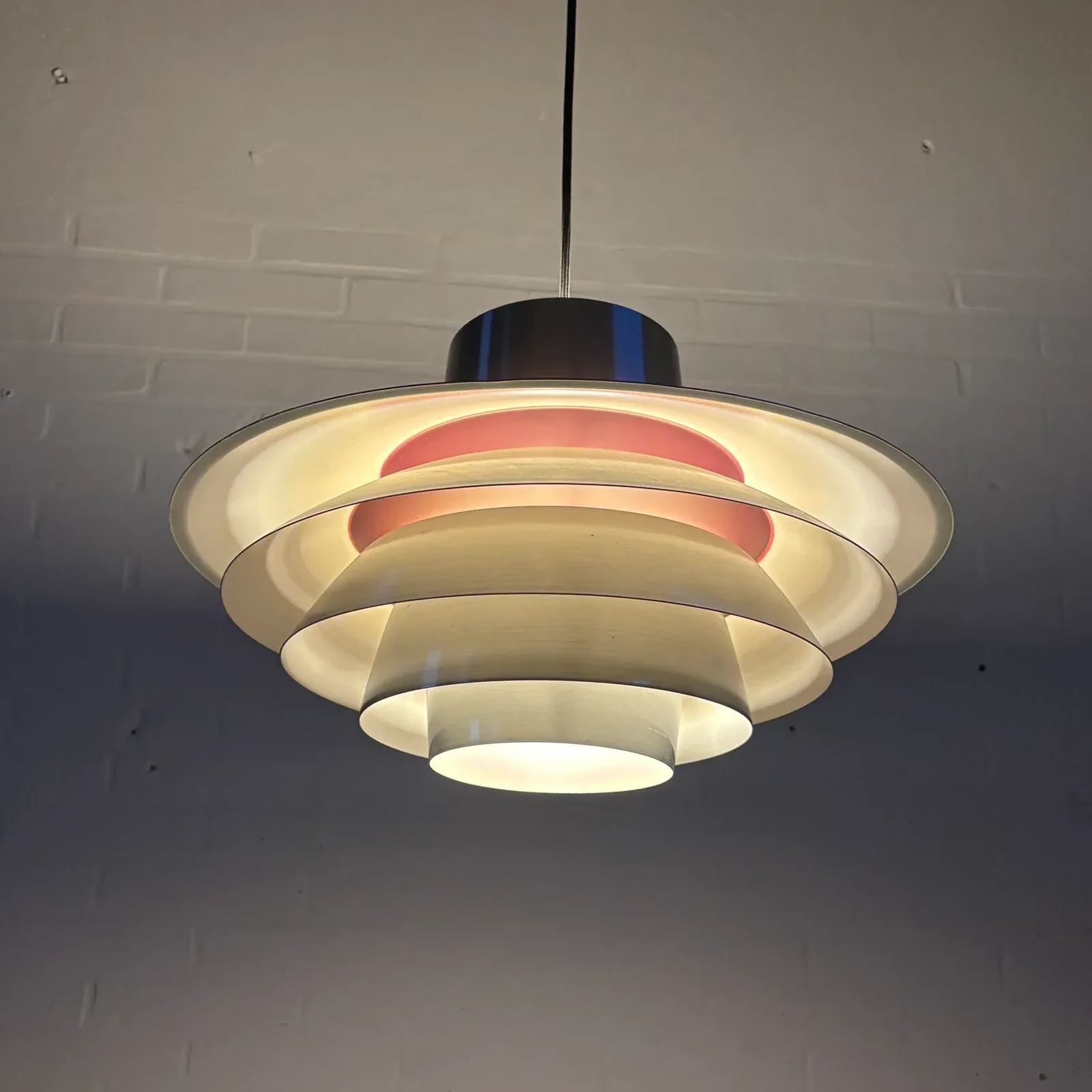
The consequence is visible in the current PatinaHall photograph. The pendant is switched on, yet no bare bulb dominates the image. Instead, the undersides of the rings become progressively illuminated and their thin edges remain dark.3 The fitting appears to glow from within, as if several small horizons had agreed to share one ceiling cable.
That self-illumination is Verona's central trick. It converts shielding from a negative operation—merely blocking glare—into the object we came to see. The shades hide the source, but in doing so they reveal one another. Light becomes both a service delivered to the room and a material that describes the lamp.
A stack of rings is not one big shade
Replace the rings with a single metal dome and the pendant would still conceal a bulb. It would not behave or look the same. Verona's nested construction creates several reflecting surfaces, several bright rims and several gaps through which light can leave sideways. The empty bands are as important as the aluminium.
LYFA describes its current Verona as a system that bends and shapes light around ring shades, keeps the source out of view and avoids visible suspensions between those shades.1 The last detail is easy to miss. A stack normally needs an obvious ladder of rods or brackets. When those connections recede, the rings seem to occupy the air independently, even though gravity has not granted them a special exemption.
Look from below and the layers overlap like contour lines. Look closer to the side and the depth of each shade becomes clearer. That changing reading is useful: the pendant is not a flat graphic repeated at different diameters, but a three-dimensional route that redirects light above, below and between its parts.
The manufacturer calls the result glare-free. Treat that as the design aim it documents, not as a promise about every bulb, mounting height or viewing position. A powerful exposed replacement source, an altered fitting or a very low installation can change how a particular lamp feels in use.
The date is 1968, and the name is Sven
LYFA dates Verona's introduction to 1968 and spells its designer's name Sven Middelboe.2 The distinction is worth making because market listings regularly produce Svend, Middleboe and other plausible-looking variants. Danish orthography can survive a seven-shade pendant; it should also survive a headline.
The same manufacturer biography gives a compact professional chronology. Middelboe had trained in business but made lighting his speciality, worked in a lighting company with Jørn Utzon in the late 1940s and joined Nordisk Solar as an in-house designer in 1955. LYFA presents Verona as the outcome of his continuing experiments with different shade constructions and combinations.2
That background is more useful than a generic claim that the lamp is “sculptural”. It tells us what was being explored: not sculpture with a cable added later, but variations in how multiple shades could control a source. Verona's memorable outline is the visible residue of that lighting problem.
There is a family, not one universal shade count
LYFA's present 480 product page specifies seven shades, aluminium, a diameter of 48 centimetres and current hand assembly using spinning techniques. It also says the wider Verona line comes in seven sizes and two materials.1 Those details are valuable because they explain a documented object available now. They are dangerous only when used as a time machine.
A vintage Verona should not be rejected or authenticated simply by forcing it to match the current 480 line by line. Size, number and spacing of visible rings, finish, internal supports, ceiling hardware and electrical components all need evidence belonging to the particular version and object. Even a photographic count deserves care: perspective lets one ring obscure another, and a dark cap can be mistaken for a shade.
The current PatinaHall listing describes its own pendant as brushed aluminium, 52 centimetres across and rewired with a black textile cable.3 Those are seller statements about one object. They neither rewrite LYFA's present specifications nor prove a historic production variant. The useful comparison is visual—how the layers distribute light—not a game of finding one magic number.
Why call a Danish pendant Verona?
LYFA says Middelboe took inspiration from the Arena di Verona, the ancient amphitheatre.1 Kept as an attributed manufacturer account, the comparison is illuminating. An amphitheatre arranges repeated ranks around an open centre; the pendant arranges concentric shades around a hidden source. Both turn a sequence of edges into a larger bowl-like volume.
The analogy works especially well from below. Each bright ring resembles a tier, while the central opening pulls the eye upwards. It also explains why the design remains legible at several scales. We do not have to count every component to recognise the rhythm of repeated circles stepping inwards.
But the name is not a technical drawing. It does not prove an exact radius, shade count or construction method, and it should not be inflated into a tale about a documented visit unless an archive supplies one. “Inspired by the Arena di Verona” is what the reviewed manufacturer says. That is charming and specific enough without inventing a travel diary for the lamp.
A lit photograph teaches effect, not electrical safety
The chosen PatinaHall image is unusually useful because the pendant is alight and photographed slightly from below.3 It shows warm illumination travelling across the underside of each ring, a darker top cap and a centre that remains visually protected. A switched-off catalogue silhouette could not teach that sequence nearly as well.
The same image cannot establish safe wiring, heat damage, earth continuity, socket condition or compatibility with a particular installation. The seller says this lamp has been rewired, but that remains a statement about this listing, not an electrical certificate and certainly not a characteristic of the Verona design. Vintage lighting needs object-specific inspection by a qualified person before use.
For visual reading, use three checks. First, find where direct sight of the source ends. Second, follow the brightest reflected surfaces outwards. Third, look at the dark gaps and rims that stop the glow becoming one featureless disc. Verona succeeds because concealment, reflection and empty space happen in sequence.
Continue to Le Klint Model 307 for a different way to make a shade perform in public. Middelboe stacks rigid rings around a hidden source; Esben Klint folds one broad surface into a field of luminous pleats.